Two events, separated by roughly 2,000 years of human history.
Both involve a sudden, supernatural transformation of human language. Both center on a crowd of people from across the known world. Both result in a moment that permanently reshapes the human story. And both — when placed side by side — reveal a pattern so precise, so structurally symmetrical, that the parallel demands examination regardless of where you stand theologically.
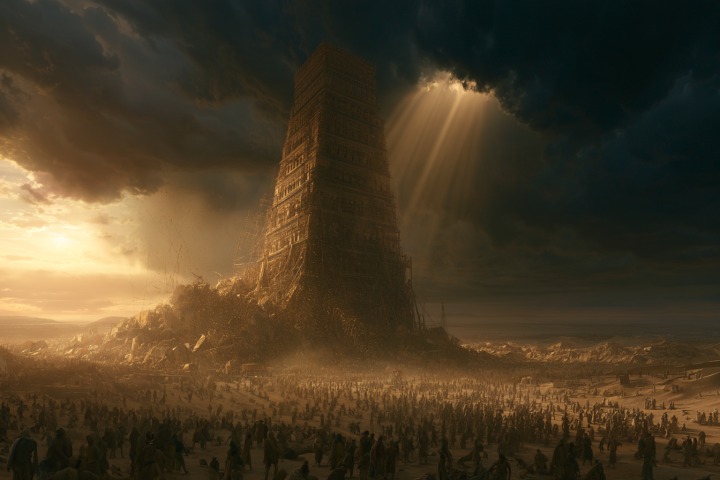
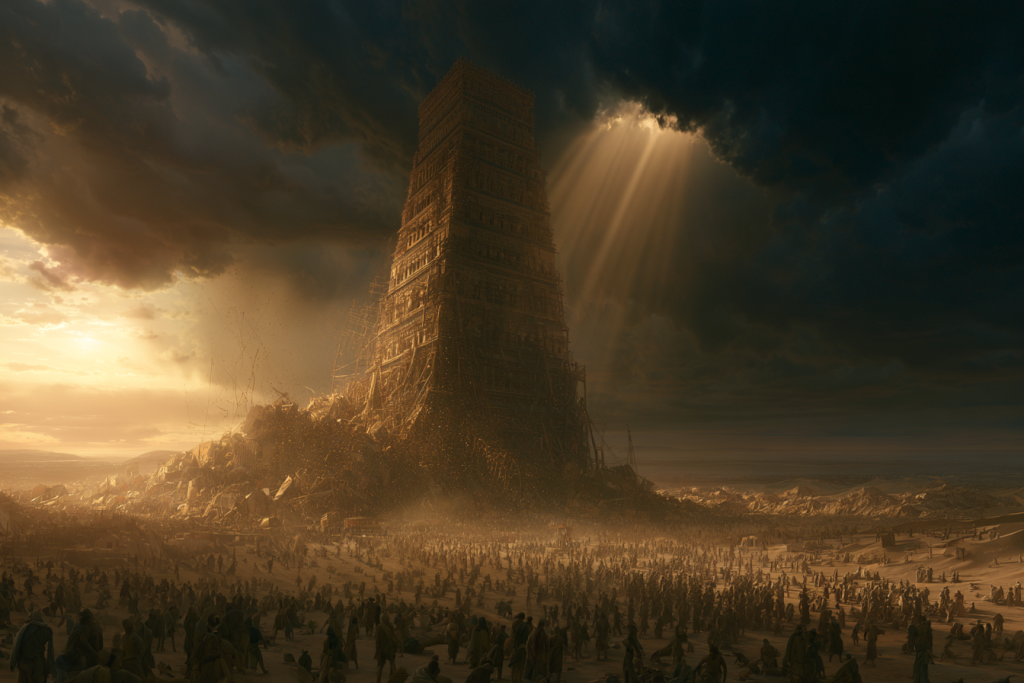
The first event happened on the Plain of Shinar in what is now southern Iraq. The entire human population, unified under one language, was midway through constructing the most ambitious structure the ancient world had ever attempted. A tower. An artificial mountain of fired brick and bitumen climbing toward the sky. And then — instantly, completely — the language that made the project possible was multiplied into incomprehensibility.
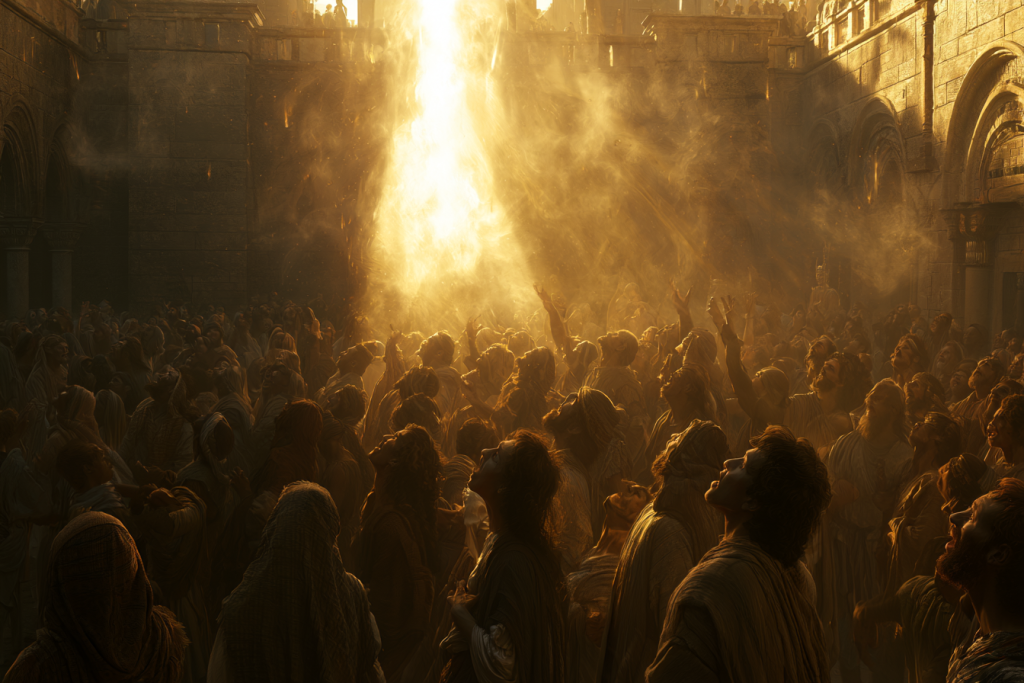
The second event happened in Jerusalem, in a small room, during the Jewish festival of Pentecost. A group of roughly 120 people from a minor province of the Roman Empire received something they had been told to wait for. And when it arrived, the streets outside filled with bewildered people from across the known world, each hearing their own native language spoken by people who had no natural means of knowing it.
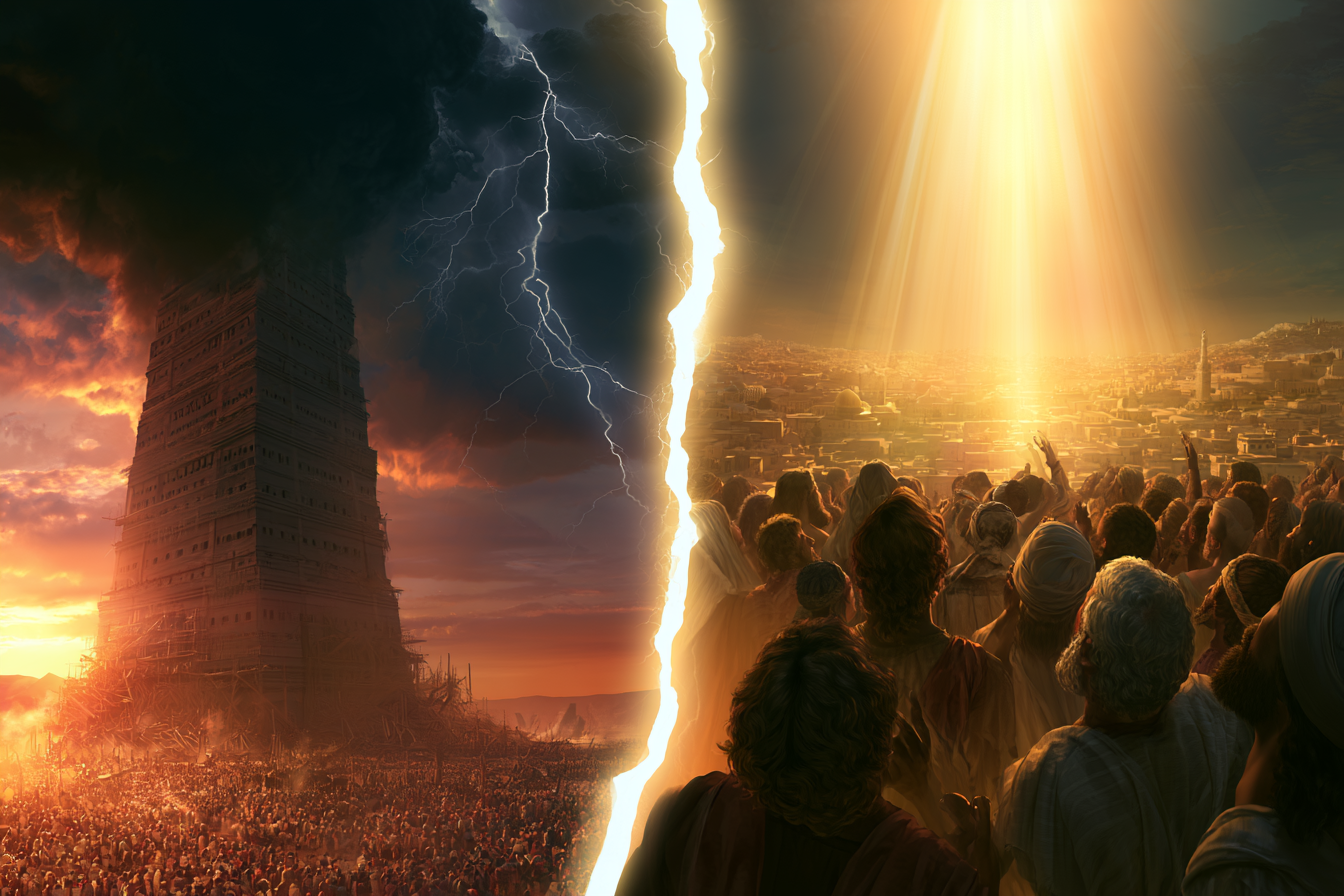
At Babel: one language became many, and humanity scattered. At Pentecost: many languages were crossed by one message, and a gathering began.
This is not a coincidence of religious narrative. It is one of history’s most precisely constructed reversals — and understanding what it reveals about the human condition is worth the effort of examining both events carefully.
The Architecture of Babel: What Was Really Being Built
To understand what Pentecost reversed, you need to understand what Babel actually was — not just architecturally, but existentially.
The builders of Babel were not, by the biblical account, evil people conspiring against divine order for malicious reasons. Genesis 11:4 records their stated motivation with disarming honesty: “Come, let us build ourselves a city and a tower with its top in the heavens, and let us make a name for ourselves, lest we be dispersed over the face of the whole earth.”
Two fears. Two motivations.
The first was the fear of dispersal — of being scattered across an unknown world, cut off from community, rendered vulnerable to the vastness of an empty earth. This was not an abstract anxiety. Humanity at this point in the biblical narrative carried the collective trauma of the flood. Their ancestors — the entire global population except eight people — had been wiped from existence by water. The God who had done that once could do it again. And a tower high enough to stand above any possible flood was not hubris. It was trauma expressing itself in brick and mortar.
The second motivation was the hunger for a lasting name. Not fame in a trivial sense, but memorial. The desire to be remembered, to leave something that would endure past a single human lifetime, to matter beyond the span of years a person can physically occupy the earth. This is not a unique ancient impulse. It is arguably the defining human impulse — the instinct that has produced every cathedral, every monument, every piece of art in human history.
What was being built at Babel, then, was not simply a tower. It was humanity’s attempt to secure itself against the two great fears that have always driven human civilization: the fear of oblivion, and the fear of being forgotten.
And what the divine response to Babel reveals — the confusion of languages, the forced dispersal, the abandonment of the project — is that self-constructed security of this kind is not merely insufficient. It is counterproductive. The builders built to avoid being scattered and were scattered. They built to make a name for themselves, and their name became the universal synonym for incomprehensible confusion. The tower intended to defy extinction became the monument to the failure of self-protection.
The Mechanics of the Reversal at Pentecost
Acts chapter 2 describes the Pentecost event in a detail that rewards close historical attention.
Jerusalem during the festival of Pentecost was one of the most cosmopolitan gatherings the ancient world regularly produced. Pentecost — the Greek name for the Hebrew festival of Shavuot — was one of the three pilgrimage festivals that drew Jewish communities from across the diaspora back to the holy city. The list of represented regions in Acts 2:9-11 reads like an inventory of the ancient world: Parthia, Media, Elam, Mesopotamia, Judea, Cappadocia, Pontus, Asia, Phrygia, Pamphylia, Egypt, Libya, Rome, Crete, Arabia.
Mesopotamia appears explicitly in that list. The region of Babel itself was represented in Jerusalem on the day that the confusion of Babel was, for the first time, directly crossed.
The supernatural sign that accompanied the event was not healing, not prophecy, not dramatic displays of power. The first sign was linguistic. Ordinary people — Galilean speakers with recognizable regional accents — were heard, simultaneously, by representatives of every region present, each in their own native language.
The Greek text is precise about the nature of the experience. The crowd’s astonishment was not that a message was being translated. It was that each person was hearing their own mother tongue — the language of their childhood, their prayers, their most intimate thoughts — coming from the mouths of people who had no natural means of knowing it.
This is the inverse of Babel in exact structural terms. At Babel, people who shared a language discovered they could no longer understand each other. At Pentecost, people who shared no language discovered they could understand each other perfectly. At Babel, coordination collapsed. At Pentecost, communication was restored — not through a return to a single universal language, but through a simultaneous intelligibility that transcended the language barriers without eliminating them.
The Symmetry in Detail: A Pattern Hidden in Plain Sight
The structural parallels between the two events become more striking the more precisely they are examined.
At Babel, the initiative was human. Humanity decided to build, chose the location, designed the project, mobilized the workforce, and began construction. God observed and then intervened.
At Pentecost, the initiative was divine. God decided to act, chose the moment and the location, and the recipients of the event were not architects but recipients — told to wait, not to build.
At Babel, the confusion of language was a limitation placed on human capability. The divine assessment in Genesis 11:6 — “nothing that they propose to do will now be impossible for them” — establishes that the intervention was specifically designed to introduce constraint where there had been none.
At Pentecost, the crossing of language barriers represented an expansion of capability — specifically the capability to communicate the gospel across every linguistic boundary. The constraint established at Babel was not removed but was transcended for a specific redemptive purpose.
At Babel, the effect was dispersal. People moved apart, separated by incomprehension, migrating into increasing distance from each other and from the project they had shared.
At Pentecost, the effect was gathering. Three thousand people from different regions and linguistic backgrounds joined a single community on the same day. The direction of movement reversed.
At Babel, a name was being sought. The builders wanted their name to reach the heavens through what they constructed.
At Pentecost, a name was being proclaimed. The disciples were declaring a name — not their own — that the apostle Peter described as the only name under heaven by which people can be saved.
At Babel, the builders were constructing a path upward to reach the divine.
At Pentecost, the divine was reaching downward toward humanity — the same directional dynamic, but the agency completely reversed.
The symmetry is not approximate. It is precise. And it is difficult to account for as coincidence in a collection of texts that span more than a thousand years of composition and multiple authors.
What History Did Between the Two Events
The 2,000 years between Babel and Pentecost were not empty. They were the long developmental arc that the dispersal from Babel set in motion — and that arc is itself a critical part of the pattern.
In the immediate aftermath of Babel, humanity fragmented into the 70 linguistic groups that ancient tradition preserves. Those groups migrated, adapted, and developed into the civilizations that archaeology has subsequently uncovered: the pyramid-building Egyptians, the mathematically sophisticated Babylonians (who returned to the site of Babel itself), the philosophically fertile Greeks, the administratively brilliant Romans, the astronomically advanced Mayans, the agriculturally innovative Indus Valley cultures.
Each of these civilizations, in its own language and cultural framework, attempted in various ways to answer the same questions that had driven the builders of Babel: How do we secure ourselves against oblivion? How do we reach the divine? What makes a name worth remembering?
The Egyptians built pyramids — perhaps the most architecturally successful response to mortality that human civilization has ever produced, structures that are still standing 4,500 years after their construction.
The Greeks developed philosophy — a systematic attempt to reach ultimate truth through the disciplined application of human reason.
The Romans built empire — the most comprehensive administrative system the ancient world produced, designed to bring all known humanity under a single governing framework.
Every one of these projects was, in its essential motivation, a variation on the Tower of Babel: humanity attempting, through its own accumulated capability and sophistication, to solve the problem of its own vulnerability and finitude.
And every one of them, by the time of Pentecost, had produced the same fundamental result: extraordinary achievement alongside a growing awareness that the achievement had not actually solved the problem.
The Roman Empire, at the moment of Pentecost, was at or near the peak of its power. It had achieved precisely the kind of linguistic and administrative unification that the builders of Babel had attempted — a single governing language, Latin, overlaid on a network of subject peoples who retained their regional tongues. It had built roads, aqueducts, legal systems, and military infrastructure of extraordinary sophistication.
And into that context — into the cosmopolitan, multi-linguistic, administratively unified world that Rome had created — the Pentecost event inserted itself. The dispersal of Babel had, over 2,000 years, created the exact conditions that made the rapid spread of a cross-linguistic message possible. The very linguistic diversity that had been the symbol of fragmentation became the medium through which the reversal traveled.

The Languages Survived: What That Means
One of the most theologically and historically significant details of the Pentecost account is what did not happen.
The languages were not eliminated. The disciples did not begin speaking a restored universal proto-language that erased the linguistic diversity of Babel. The crowds did not suddenly forget their mother tongues and converge on a single speech.
Each person heard their own language. The diversity remained. What changed was the capacity for mutual intelligibility at the level of the message.
This detail has profound implications for how the event relates to Babel’s legacy. If Pentecost had eliminated linguistic diversity — restored the single-language condition of pre-Babel humanity — it would have represented a simple reversal: undo the judgment, return to the starting condition.
But Pentecost did not reverse the diversity. It transcended it. The 70 languages of Babel were not collapsed back into one. They were — in the moment of Pentecost, and in the subsequent two-thousand-year translation project that followed — used as channels rather than barriers.
The immediate post-Pentecost history is the story of that translation project. The message proclaimed in Jerusalem was translated first into Greek — the lingua franca of the Mediterranean world that Rome’s predecessor empires had spread across the region. Then into Latin. Then into Gothic, Slavic, Arabic, Syriac. Over subsequent centuries, into Chinese, Amharic, Swahili, Tamil, Quechua, and eventually into the majority of the world’s languages.
The Bible is currently the most translated document in human history, available in complete or partial form in more than 3,000 languages — a number that continues to increase. The project of making a single message intelligible across every language group that descended from the 70 of Babel has been ongoing for two millennia and is not yet complete.
What Babel scattered, Pentecost began systematically to gather — not by eliminating the scattering, but by making the gathering possible within it.
The Technology Connection: A Third Babel?
The structural pattern of Babel has not remained confined to antiquity. Every significant attempt to unify humanity under a single framework across the centuries since Babel can be read as a variation on the original project — and most of them have ended with variations on the original result.
The Assyrian Empire. The Babylonian Empire. The Persian Empire. The Macedonian Empire of Alexander. The Roman Empire. The Mongol Empire. The British Empire. Each of them, in its moment, achieved a level of practical unification across linguistic and cultural boundaries that made its architects believe they had solved the problem of human fragmentation.
Each of them eventually fragmented.
What makes the current technological moment historically distinctive is the mechanism. For the first time since Babel, the tool of unification is not military conquest but communication infrastructure. The internet connects approximately five billion people. Automated translation systems allow real-time conversation across languages with increasing accuracy. Social networks have created communities of shared interest that operate entirely independently of geographic and linguistic boundaries.
For the first time since the plain of Shinar, a unified human project is genuinely imaginable — and the divine evaluation recorded in Genesis 11:6 takes on fresh relevance: “Nothing that they propose to do will now be impossible for them.”
The question that hangs over the current technological moment — the question that Babel poses to every generation that attempts something of sufficient ambition — is not whether the capability exists. It is what the capability will be used to build, and whether what is being built has foundations that can hold the weight of human ambition.
The Pattern as Historical Lens
Whether the reader approaches Babel and Pentecost as history, mythology, archetype, or theology, the pattern they form offers something genuinely useful: a framework for reading the full sweep of human history as a coherent story with identifiable structure.
Humanity begins unified. A project driven by fear and ambition leads to fragmentation. The fragmentation generates the full diversity of human civilization — including achievements that unified humanity at Babel could not have produced. A reversal event begins the long process of regathering — not through the restoration of uniformity, but through the discovery of something that transcends diversity without eliminating it.
That pattern — unity, fragmentation, diverse development, regathering — maps onto biological evolution, onto the history of ideas, onto the development of scientific knowledge, onto the political history of nations and empires. It is, in some sense, the deep structure of how complex systems develop over time.
What Babel and Pentecost together propose is that this pattern is not random or mechanistic. It has direction. The fragmentation was not the final word. The diversity it produced was not its own end. The regathering that began at Pentecost has a destination — not a return to the fearful unity of Babel, but an arrival at something the builders of Babel were trying to construct and could not.
A city not made of brick and bitumen. A community not held together by a shared project or a common fear. A gathering of every language and people and nation, not despite their diversity but through it.
The tower of Babel was built with fear, and it failed. What Pentecost proposed — and what the subsequent two thousand years of translation and cross-cultural community have been working out — is that the gathering humanity has always longed for is not something that can be built from below.
It descends.
Two Directions, One Story
The story of Babel and Pentecost is, at its core, the story of two directions in human history.
One direction is upward and inward: build higher, accumulate more, secure yourself, make your name, reach the divine through the force of accumulated human achievement. This direction has produced extraordinary things. It has also, without exception, produced the same result every time it has been pursued to its ultimate conclusion: the discovery that the thing being built cannot bear the weight of what was hoped of it.
The other direction is receptive: receive what descends rather than constructing what ascends. Build not to make a name but because you have received one. Gather not through force or the elimination of difference but through the discovery of a common source beneath the diversity.
These two directions are not unique to any historical period. They are the permanent options available to human beings in every generation — and the history that runs from Babel to Pentecost and beyond is the ongoing record of how individuals, communities, and civilizations have navigated between them.
What makes the parallel between these two events so enduringly significant is precisely that it is not a story that ended in antiquity. The tension it describes is operational today — in technology, in politics, in the quiet decisions that individuals make about what they are building with their lives, and why.
Babel and Pentecost are separated by approximately 2,000 years of history. But the question they pose together is not historical. It is immediate.
What are you building — and from where does the foundation come?