The Roman Hill Built Entirely From Broken Oil Jars
Archaeology & Sites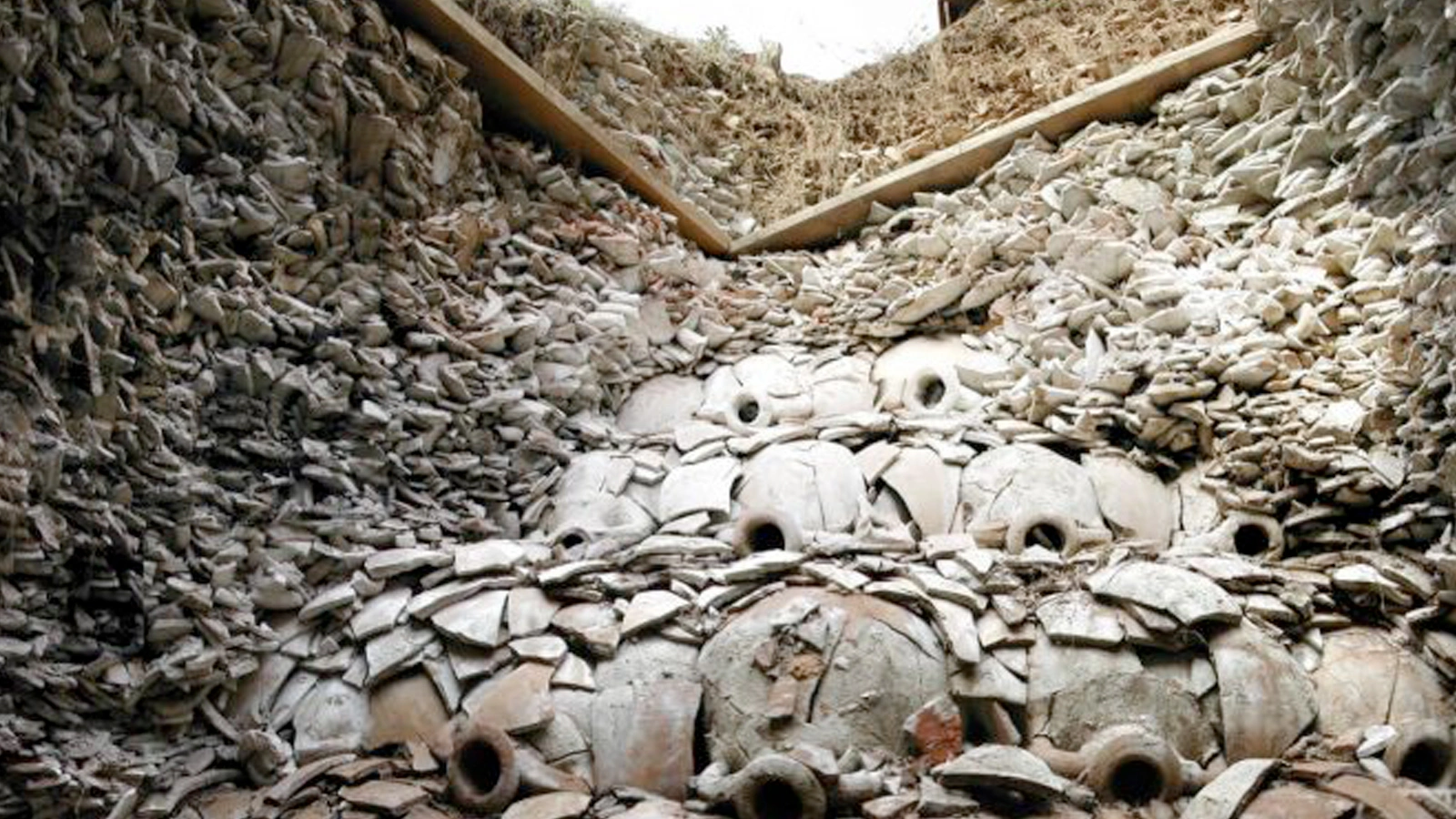
Monte Testaccio, Oil Jars.
Rome has an artificial hill built almost entirely out of garbage, and the garbage happens to be one of the best economic records the ancient world left behind. Monte Testaccio rises 35 metres above the streets south of the Aventine Hill, made up of the broken remains of an estimated 53 million olive oil jars, discarded there over roughly two and a half centuries by a city that had run out of other convenient places to put them.
A Hill Built From Trash
The mound sits close to the eastern bank of the Tiber, near what was once Rome’s main river port, in a district that still carries the name Testaccio today, derived from testae, the Latin word for potsherds. Covering roughly two hectares at its base and running nearly a kilometre in circumference, with an estimated volume of close to 580,000 cubic metres, it is one of the largest deliberate waste deposits known from the ancient world, built up gradually as workers hauled broken pottery to a designated dumping site at the edge of the city, layer after layer, for the better part of two centuries. Its position was no accident. It sat immediately beside the Horrea Galbae, one of Rome’s great state warehouse complexes, where the city’s official reserve of imported olive oil was kept, making the dump a natural extension of the same supply operation that brought the oil into the city in the first place.
Why Olive Oil Needed Such Enormous Jars
Almost all of the fragments in the mound come from a single type of container, the Dressel 20 amphora, named after the German archaeologist Heinrich Dressel, who catalogued thousands of these vessels in the nineteenth century while studying the site. A Dressel 20 held roughly 70 litres of oil, with thick walls, a rounded base, and a globular shape designed specifically to survive the sea crossing from southern Spain without tipping or breaking in the hold of a ship. Most of them were produced in the province of Baetica, along the Guadalquivir river valley between what are now the cities of Seville and Córdoba, one of the most productive olive oil regions anywhere in the Roman world, and shipped from there to feed a capital city of well over a million people.

Rome’s Impossible Recycling Problem
Once emptied, these amphorae presented a genuine logistical headache. Their thick walls tended to break into large, curved fragments rather than small manageable shards, which limited their usefulness as building rubble, and the clay itself had absorbed so much oil during years of use that it could not simply be repurposed to store other food safely. Oil-soaked pottery even reacted badly when mixed into mortar for concrete, weakening rather than strengthening the mix, since the chemical interaction between residual oil and lime produced an unstable, unreliable binding agent. Where other, less porous amphora types found second lives across the Roman world as flowerpots, drainage pipes, or wall filler, the Dressel 20 mostly could not, leaving Roman administrators with a genuinely difficult disposal problem on an enormous scale, one that grew larger every year as long as the demand for Baetican oil kept the ships coming.
An Organized Dump, Not a Random Pile
Excavations carried out in the early 1990s showed that Monte Testaccio was never a haphazard heap. Workers arranged the broken amphorae in deliberate terraces, using nearly intact vessels packed with smaller fragments as retaining walls to hold each layer in place, and poured lime over the debris to neutralize the smell of the rancid oil that still clung to the shards. Access paths and supporting structures were added as the mound grew taller, allowing labourers to keep hauling material to the top of a hill that, over time, had itself become taller than most buildings in the surrounding neighborhood. That level of organization suggests the site was managed by people with a real stake in keeping the operation running smoothly year after year, not simply abandoned to whoever happened to be carrying a broken jar that day.

An Accidental Archive
What makes Monte Testaccio valuable to historians is not simply its size but what is written on the pottery itself. Most Dressel 20 fragments carry tituli picti, painted or stamped inscriptions recording the weight of the oil, the estate or region it came from, and the names of the merchants and officials responsible for shipping and certifying it, a level of bureaucratic detail that would not look out of place on a modern shipping manifest. Dressel’s original cataloguing work, later published in the Corpus Inscriptionum Latinarum, turned thousands of these inscriptions into a searchable record, and ongoing research, including a long-running project based at the University of Barcelona, continues to extract new detail about individual producers, estates, and trade routes from stamps that have survived nearly two thousand years buried under their own broken containers.
Reading Rome’s Economy in Broken Pottery
Because the mound grew in roughly annual layers tied to the city’s state-run food supply system, the annona, which distributed oil and grain to soldiers, state workers, and eventually ordinary citizens, archaeologists have been able to estimate how much oil was arriving in Rome year by year almost as if reading tree rings. Imports appear to have peaked toward the end of the second century AD, when as many as 130,000 amphorae were discarded at the site annually, implying something in the range of 7.5 million litres of oil reaching the city in a single year at the trade’s height. Across the roughly two and a half centuries the site was in active use, researchers estimate that the amphorae broken here once held something on the order of 6 billion litres of oil in total, a figure few other archaeological sites anywhere allow historians to calculate with this kind of precision. It is, in effect, a shipping ledger nobody ever intended to keep, preserved only because throwing away the evidence turned out to be more difficult than throwing away almost anything else the Romans imported.
The dumping largely stopped around the 260s and 270s AD, not because demand for oil disappeared, but because the construction of Rome’s Aurelian Walls cut the city off from convenient access to this particular stretch of riverbank, redirecting supply routes elsewhere. Monte Testaccio was left as it stood, a broken-pottery record of exactly how much oil moved through the Roman Empire at its height, still visible on the Roman skyline today, climbed by visitors along a path still named for the scholar who first learned to read what its shattered layers had to say.

