Sodom’s Sin in Ezekiel 16: A Full Table, a Closed Hand
Biblical History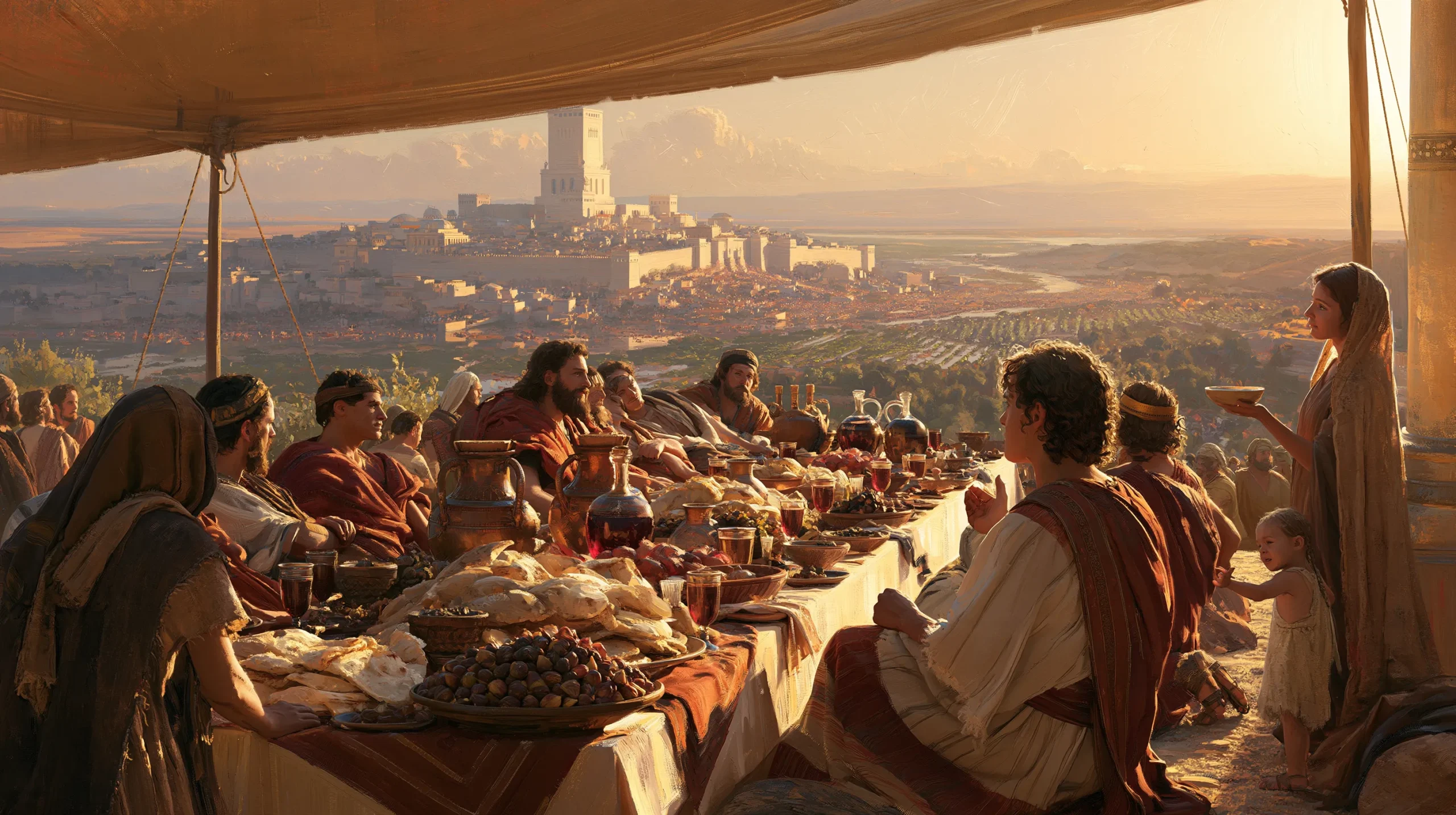
AI reconstruction, not a photograph.
Most people who name the sin of Sodom point to the crowd at Lot’s door in Genesis 19. The prophet Ezekiel gives a different answer. Addressing Jerusalem, he calls Sodom her sister and lists the charge: pride, plenty of bread and easy living, with no help for the poor. This article sets out what Genesis 19 shows, what Ezekiel 16 says and where it sits, what Genesis 13 adds, how other biblical and Jewish texts read Sodom, how readers weigh the evidence, and what can be said.
What Genesis Shows at Lot’s Door
Genesis gives two kinds of evidence. Before the angels arrive, the LORD says “the cry of Sodom and Gomorrah is great” (18:20), and the narrator says “the men of Sodom were wicked and sinners before the LORD exceedingly” (13:13). In chapter 19 the two angels reach the city at evening and Lot takes them in.
Before the guests lie down, the men of the city “compassed the house round, both old and young, all the people from every quarter” (19:4). They call for the visitors “that we may know them” (19:5). Lot goes out and says “do not so wickedly” (19:7), and the crowd “came near to break the door” (19:9). The angels pull Lot inside and strike the men outside with blindness. Everything here is about this one night, and the crowd’s conduct is what most retellings stress. Genesis does not list the crowd’s other habits, and the chapter ends with the cities overthrown and Lot in a cave with his daughters.
Ezekiel Makes Sodom a Sister
Ezekiel 16 is addressed to Jerusalem. It opens with a verdict on her origins, “thy father was an Amorite, and thy mother an Hittite” (16:3), and a proverb to be used against her: “As is the mother, so is her daughter” (16:44). The word comes with the order to “cause Jerusalem to know her abominations” (16:2), and the book places the prophet “among the captives by the river of Chebar” (1:1). The chapter gives no date of its own, and begins only “Again the word of the LORD came unto me”. Ezekiel’s first dated message is from the summer of 593 BC, and his ministry ran, by one count, from 593 to 571 BC.
In the chapter, two cities become Jerusalem’s sisters: “thine elder sister is Samaria”, and the younger is “Sodom and her daughters” (16:46). The charge against Jerusalem is that she copied them and then went further: “thou wast corrupted more than they in all thy ways” (16:47). The prophet then makes a claim that reverses the expected comparison: “As I live, saith the Lord GOD, Sodom thy sister hath not done” as Jerusalem has done (16:48).
The List in Verse 49
The King James Version of verse 49 reads: “pride, fulness of bread, and abundance of idleness was in her and in her daughters”, and “neither did she strengthen the hand of the poor and needy”. The English Standard Version has “pride, excess of food, and prosperous ease”, and the NIV “arrogant, overfed and unconcerned”. The older Amplified Bible Classic has “pride, overabundance of food, prosperous ease, and idleness were hers and her daughters'”. The current Amplified Bible reads the daughters as the dependent towns: “she and her daughters (outlying cities) had arrogance, abundant food, and careless ease”. A summary in a Catholic magazine renders the whole charge as “pride, gluttony, prosperous ease, and failing to aid the poor and needy”. Across the versions, four things recur: pride, plenty, ease and the neglected poor. None of the four describes the crowd at Lot’s door.
Verse 50 continues: “they were haughty, and committed abomination before me”, and then “I took them away as I saw good”. Verse 51 turns to Samaria: “Neither hath Samaria committed half of thy sins”. By verse 52 the ruined cities are held up to the standing one: “they are more righteous than thou”. The comparison is a warning to a city that is still standing.
The Watered Plain
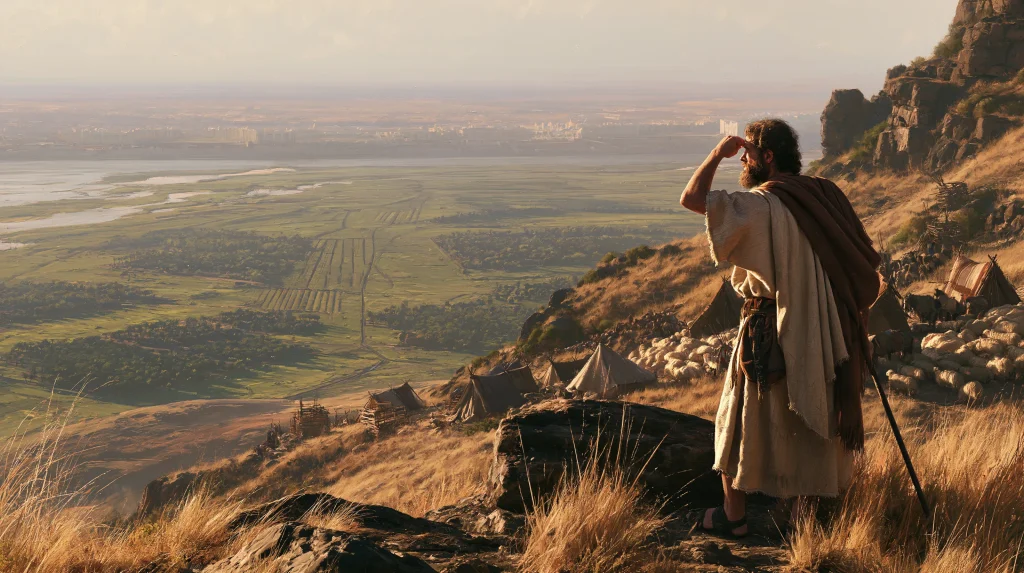
Genesis 13 describes the land the cities stood on. Lot “beheld all the plain of Jordan, that it was well watered every where”, and the narrator likens it to “the garden of the LORD” (13:10). He chose it, and he “pitched his tent toward Sodom” (13:12). When the judgment came, the LORD “overthrew those cities, and all the plain” (19:25), so the well-watered land went with the cities. A reader can connect that watered plain with the “fulness of bread” Ezekiel names, but neither text draws the line.
How Other Texts Read Sodom
Other prophets use Sodom as a standard of wickedness without agreeing on the offence. Isaiah addresses his hearers as “ye rulers of Sodom”. Jeremiah says of the prophets of Jerusalem “they commit adultery, and walk in lies”, and adds that “they are all of them unto me as Sodom”. A reference article on Enter the Bible lists what such texts mention: “neglect of the poor and needy, lies, greed, and luxury”.
In the New Testament, Matthew 10:15 says it will be “more tolerable for the land of Sodom and Gomorrha in the day of judgment” than for a town that rejects the disciples, and Jude 7 says the cities were “giving themselves over to fornication, and going after strange flesh”. Pirkei Avot 5:10 describes the person who says “what is mine is mine, and what is yours is yours” as an average temperament, though in the Sefaria translation “there are some who say that is the temperament of Sodom”.
Readers Weigh the Evidence Differently
Writers who stress violence and sexual wrongdoing point to Lot’s door and to Jude 7, and to Ezekiel’s own “abomination” in verse 50. Mary Healy, writing in a Catholic magazine, argues that Ezekiel’s list is “Not Just Inhospitality” and takes the abomination as probably alluding to Leviticus. Writers who stress neglect point to verse 49. Enter the Bible says that of the nearly thirty references to Sodom and Gomorrah in the rest of the Bible, “only one text explicitly refers to sexual behavior”, and that one seems to concern “sex with angels, the visitors to Sodom”.
Ezekiel himself mentions both pride and abomination, then turns the point on his own people.
What Can Be Said
Genesis 19 describes a crowd at a door, Genesis 13 and 18 describe wickedness and an outcry before it, and Ezekiel 16 lists pride, plenty and a closed hand toward the poor. These do not have to compete: the prophet says Sodom was haughty and did an abomination, and that her comfort came with neglect. Which of them a reader treats as central has varied with the reader.
What the text makes plain is that Ezekiel is not talking about Sodom for its own sake. His sentence on the ruined city is an argument aimed at Jerusalem. An early commentary on Sodom, in other words, begins with a full table and a closed hand.

