The Yemeni Bridge Designed to Be Pulled Apart by Hand
Archaeology & Sites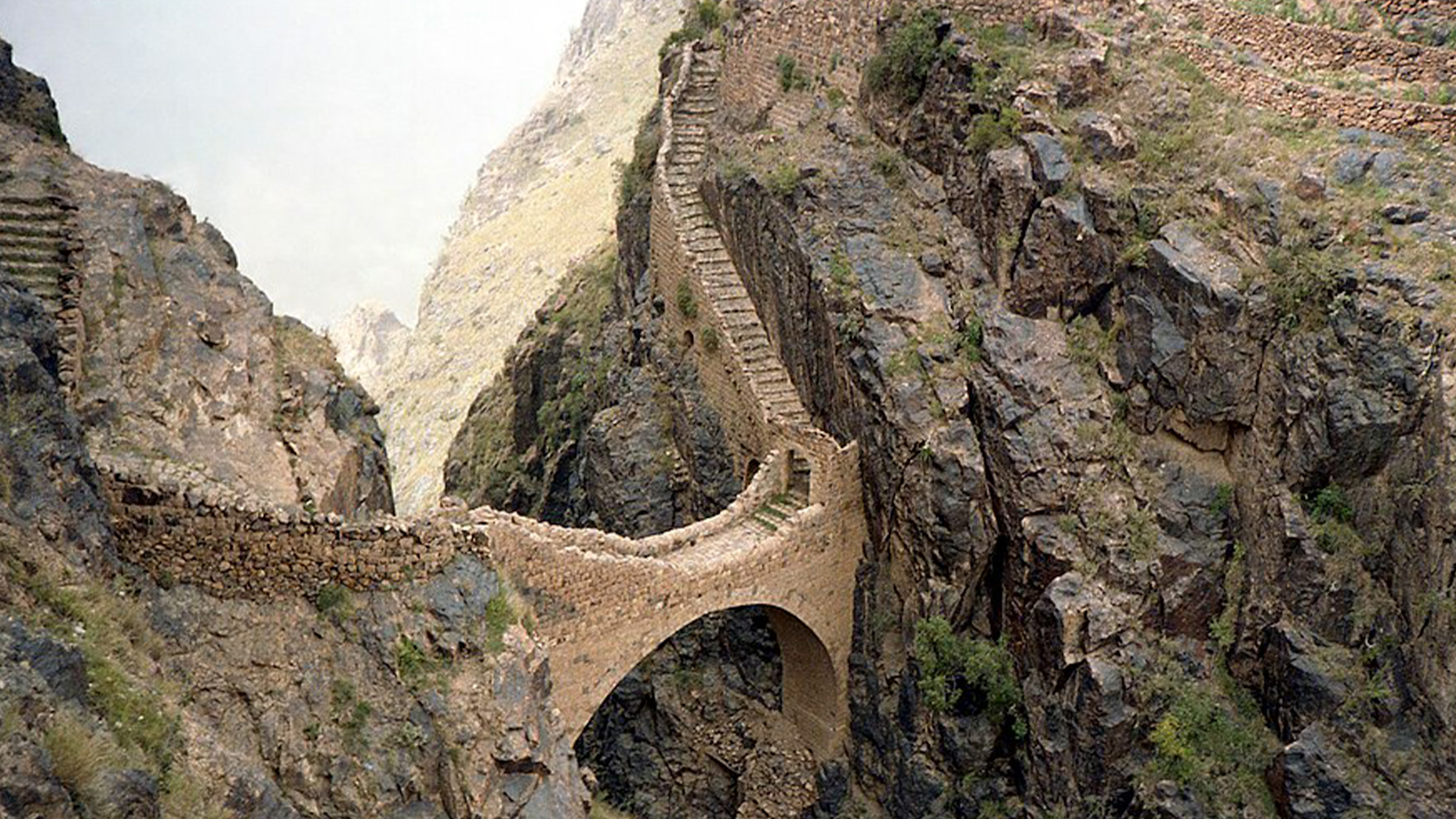
Footbridge in Shaharah, Yemen, CC BY-SA 3.0
High in northern Yemen, a single stone arch spans a gorge nearly 300 feet deep, and for centuries it doubled as a weapon in its own right. The Shaharah Bridge could be pulled apart by hand, and when it was, an entire invading army had nowhere left to go, stranded on bare rock with a sheer drop on one side and a fortified mountain town it could no longer reach on the other.
A Bridge Built After Defeat
The bridge’s origin story starts with a loss. Ottoman forces invaded Yemen in the 1500s and overran Shaharah, a fortified settlement perched high in the mountains of what is now Amran Governorate, along with much of the surrounding highlands. Sometime after local forces regained their independence in the following century, in a period of ongoing conflict between Yemeni tribal and religious authorities and Ottoman garrisons that continued on and off for generations, the town’s leader, remembered as Al-Usta Saleh, ordered a new crossing built between the two mountain peaks that made up the settlement, one that could be destroyed in an instant if invaders ever returned. He hired an architect, Salah al-Yaman, to design and oversee construction of it. The result took roughly three years to complete and reportedly cost around 100,000 French riyals, an enormous sum for a mountain village in the seventeenth century, and a clear sign of how seriously the town’s leadership treated the threat of a repeat invasion.
An Engineering Puzzle in Limestone
What Salah al-Yaman produced was a single stone arch, about 65 feet long and 9 feet wide, spanning a canyon roughly 300 feet deep between two peaks known as Jabal al-Emir and Jabal al-Faish, at an elevation high enough that the whole structure sits close to 2,600 metres above sea level, among the higher inhabited settlements anywhere in the Arabian Peninsula. Local stonemasons built it from limestone quarried in the surrounding mountains, fitting the blocks together with the precision needed to bear the arch’s own weight without mortar, a technique suited to a region where hauling cement up a mountain simply was not practical, and where the stone itself was already close at hand. Even now, the exact building methods used to raise a stone arch across a canyon that deep, with seventeenth-century tools and no modern scaffolding, are not fully understood, and local tradition offers more than one legend to explain how the workers managed it, including stories of smaller support bridges built beneath the main span to help move material into place, remnants of which are still said to survive in the gorge below.

A Crossing Built to Come Apart
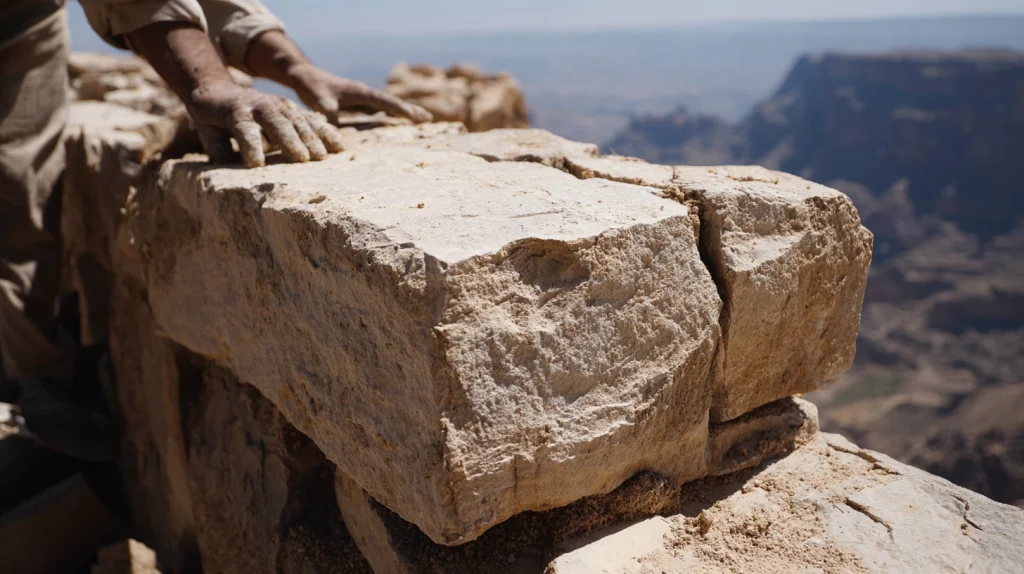
What set the finished bridge apart from an ordinary mountain crossing was what happened at its center. Specific stones within the arch were fitted so they could be pulled free by hand rather than cemented permanently in place, allowing defenders to dismantle a section of the bridge on short notice, in a matter of minutes rather than the hours it would take to destroy an ordinary span. With those stones removed, the crossing became impassable, and since the bridge was the only direct route into Shaharah, any force that had made it partway across the gorge would find itself stranded on the wrong side, unable to advance and unable to easily retreat, exposed on bare rock above a drop of nearly three hundred feet. It turned what could have been a permanent vulnerability, the one fixed path into an otherwise inaccessible town, into something the town itself controlled, deciding when the crossing existed and when it simply did not. Reassembling the bridge afterward would have been just as deliberate a decision, made once the danger outside the gorge had genuinely passed.
Not the Haraz Mountains
Shaharah is sometimes mislocated in the Haraz range, a separate and better-known mountain region southwest of the capital, Sana’a, associated with terraced coffee farms and villages like Al-Hajjarah, and far more frequently visited by outside travelers and written about in guidebooks. Shaharah itself sits considerably farther north, in the Ahnum mountain range of Amran Governorate, at an elevation of roughly 2,600 metres, a little over eighty miles from the capital as the road winds. The confusion is understandable given how many of Yemen’s mountain fortress towns share a similar profile, stone villages built high enough to be defended by geography alone, with narrow, easily blocked approaches and centuries of local architecture adapted to exactly that kind of terrain, but Shaharah’s bridge belongs to its own distinct range, a good distance from the coffee terraces travelers more often associate with Yemen’s highlands.
Why Isolation Was Already a Defense
Even without the bridge, Shaharah would have been difficult to take. Its position atop steep, isolated peaks limited any approach to a handful of narrow routes, the same kind of terrain that made mountain strongholds across Yemen’s highlands so hard for outside forces to hold onto for long, since supply lines and reinforcements had to climb the same difficult ground defenders already knew intimately. A besieging force could spend days simply reaching the base of the mountains, and once there, would still face terrain that gave every tactical advantage to whoever already lived on top of it. The bridge did not create that advantage. It added a final, deliberate layer on top of it, converting the settlement’s one unavoidable weak point, the crossing that let people and goods move between its two halves, into something that could be switched off entirely whenever the town needed it to be, at the moment an outside force was most exposed and least able to respond.
Still Standing, Still Crossed
The Shaharah Bridge remains in place today, centuries after Al-Usta Saleh first ordered it built, and it is still the route local residents use to move between the two halves of the town, a working piece of seventeenth-century infrastructure rather than a ruin cordoned off for visitors. It survives now mainly as a landmark and a piece of engineering history rather than as an active line of defense, since the kind of conflict it was designed for belongs firmly to the past, but the design itself, a bridge engineered from the start to be taken apart by the people who depended on it, remains one of the more direct physical expressions anywhere of a community building its own leverage into the landscape it lived in. Few structures anywhere are quite so honest about the fact that their builders expected, one day, to need to destroy them, and then to put them back together again once the danger had passed.

