Guatemala’s ‘Caucasian’ Stone Head Points to a 1936 Carving
Unexplained & Claims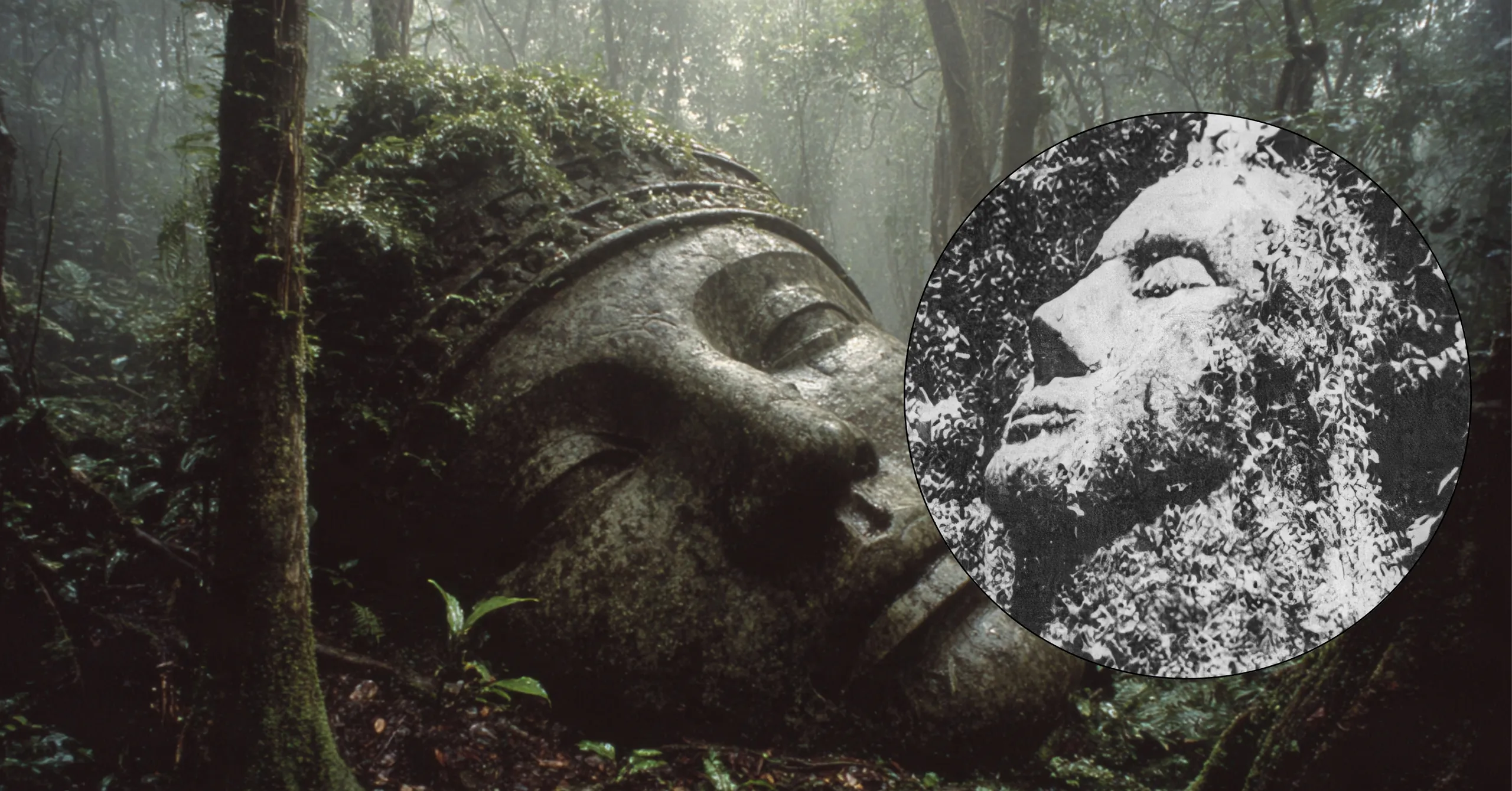
AI reconstruction, not a photograph.
A photograph of a huge stone head, said to lie in the jungles of Guatemala, reached a Guatemalan lawyer in 1986 or 1987, and the head itself is reportedly gone. The story built on that picture calls the face Caucasian. A 1974 report, as summarised by the researcher Jason Colavito, describes a pumice head carved in 1936 that he says matches the photograph. The match has not been shown side by side, and this article follows the chain from the first picture to the film.
One Picture, Two Dates
The head is known from a single picture. Its face is described as having thin lips and a large nose, turned toward the sky, with features some call Caucasian and unlike those of the pre-Hispanic peoples of the Americas. That is a viewer’s impression of a photograph, not a measurement, and the picture gives no scale: one retelling puts the head at 4 to 6 metres tall, while a promoter claimed 17 in 2011.
The photograph reached Dr. Oscar Rafael Padilla Lara, a Guatemalan lawyer and notary with a doctorate in philosophy and an interest in UFOs, according to a Viewzone page. It dates the receipt to 16 August 1986 and says the picture was first printed in 1987 in Ancient Skies, the newsletter of the Ancient Astronaut Society. Ancient Origins dates the receipt to 1987. A note said the head lay somewhere in the jungles of Guatemala and that the landowner took the picture in the 1950s. Colavito reports that the landowner died without naming the place.
A Family Name and Ten Kilometres
The place names came later. The Viewzone page says Padilla showed the picture to a relative, who thought the statue stood on land belonging to the Biener family, though not which property. Ancient Origins, in a 2013 article, puts it more firmly: Padilla found the Biener family, owners of the property, about ten kilometres from a small community in La Democracia, in southern Guatemala.
Padilla’s own timeline moves. Colavito reports that he later said he had located the site near La Democracia around 1990, after fifteen years of searching, and that he gave archaeologists no documents and no further pictures. A letter of 6 June 1991 quoted by Viewzone says, “I have located it and seen it.” No second picture of the head appears in the sources used here.
Destroyed, With Nothing Left to Check
Padilla said the head was gone. Viewzone quotes him: “It was destroyed by revolutionaries about ten years ago.” In the telling, anti-government rebels used it for target practice, its eyes, nose and mouth were lost, and fighting in the region kept him from returning.
The explorer and author David Hatcher Childress read Padilla’s article and flew to Guatemala before 1991 to meet him. Colavito says Padilla pointed to a spot on a map but would not go there, and dated the destruction to 1981. Childress told the story in World Explorer in 1991 and reprinted it in Lost Cities of North and Central America in 1992. He never saw the head.

The Film and the Letter
In 2011 the picture resurfaced in publicity for Revelations of the Mayans: 2012 and Beyond. TheWrap reported on 26 October 2011 that its producer, Raul Julia-Levy, offered a photograph he said was taken in southern Guatemala in the 1930s, and described the head as now hidden in the United States, which sits awkwardly with reports that it was destroyed. He also supplied a letter from a Guatemalan archaeologist, Hector E. Mejía, dating the monument to 3500 to 5000 BC and saying it “was created by an extraordinary and superior civilization.” TheWrap’s report carries no on-record statement from any Guatemalan government body backing the producer. The claim of extraterrestrial contact was the film’s, not a finding.
Mejía is reported to have said afterwards that the letter had been altered, that he never examined the head in person and that the photograph looked fake. That comes from Colavito, who cites a Facebook post that could not be opened here, and a 2011 blog post reports that he thought the photograph fake. Ancient Origins says the letter’s authenticity is questioned and that publishing it led sceptics to see a publicity stunt. The archaeologist Ken Feder, answering the film’s wider claims of alien contact, called them “wholly and utterly devoid of any confirming evidence.” Production stopped in April 2012 amid a contract dispute, and a January 2013 report says an arbitrator ruled against Julia-Levy. Whether the finished film ever reached audiences is not clear from the sources used here.
La Democracia’s Own Heads
La Democracia, in Escuintla, is known for heads of its own. Ancient Origins calls them Olmec, dates the Olmec civilisation to 1400 to 400 BC and says the head in the photograph does not share their features or style. Wikipedia credits them instead to the Monte Alto culture and calls them Olmec-influenced. It says Monte Alto was occupied as early as 1800 BC and “perhaps predates the Olmec.” The heads were crudely shaped from large rounded basalt boulders and stand in the town park and outside the regional archaeology museum.
A difference in style says little about age by itself. A head carved in soft pumice in the twentieth century would also differ from basalt boulders worked thousands of years earlier. Colavito rejects Childress’s reading of the La Democracia heads as one kind of face and the giant head as another, calling such readings relics of Victorian racial theory.
A Pumice Head Near Las Victorias
Colavito traces the picture to an older record. He cites Lee A. Parsons, an American archaeologist, whose paper A Pseudo Pre-Columbian Colossal Stone Head on the Pacific Coast of Guatemala appeared in the proceedings of the 41st International Congress of Americanists, held in Mexico in 1974.
In Colavito’s summary, Parsons reported a head carved from soft volcanic pumice by a farm administrator near Las Victorias in April 1936, as a memorial to his dead wife, with a dated plaque. A Carnegie Institution survey in 1941 and 1942 saw it and the plaque. Parsons visited in 1970 and found it eroded and covered in vines, with the plaque gone. Colavito says it had weathered into a shapeless form by 1970 and broken apart by 1990, and argues that pumice rules out great age. A 2013 update on the blog Haecceities gives the same year and memorial purpose but says an estate owner ordered it.
Parsons’s paper was not available for this article, so all of this comes at second hand. Colavito says Parsons’s description matches the photograph, that most later writers agree they show one statue, and that the photograph could be one of the 1941 survey pictures. A description matched to a picture is not two pictures compared.

What the Record Does and Does Not Say
The record supports a photograph first printed in 1987, an account that changes in its details and no second picture. The photograph reached Padilla in 1986 or 1987. Its own date is the 1950s in the note and the 1930s in the promoter’s claim. The head was destroyed about ten years before Padilla reached it, or in 1981, depending on the teller. Childress never saw it, and nobody has produced it.
It does not settle what the head is. Colavito’s summary of Parsons points to a pumice carving of 1936, which would make the face a twentieth-century memorial and not an ancient work, but that rests on a paper not seen here and on a match of description to picture. Even the maker differs between retellings. Until the 1974 paper and the photograph are set side by side, the firmest statement is narrower than the legend: one picture, a chain of retellings and an older report that appears to fit it. A viewer’s reading of a face is not evidence of who carved it.

