Tree Rings Date the Sweet Track’s Timbers to 3807 BCE
Archaeology & Sites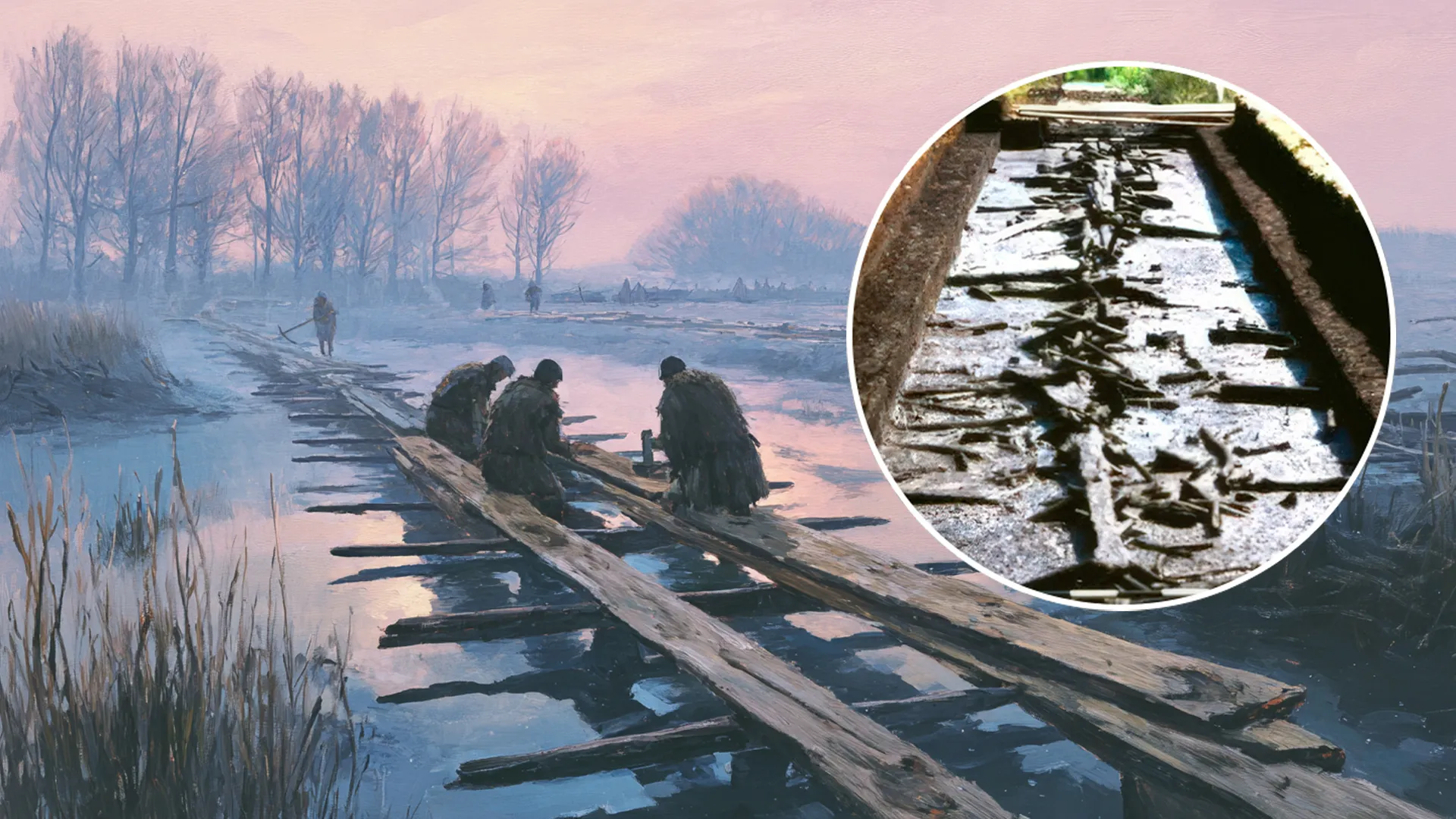
AI reconstruction, not a photograph.
Tree rings place the felling of the Sweet Track’s timbers in the winter of 3807 to 3806 BCE, while radiocarbon dates for the same walkway span 4050 to 3800 BCE. The track was a raised path of split oak planks that crossed about two kilometres of reedswamp in the Somerset Levels, in southwest England. The sources used here name no builders beyond Neolithic communities and give no reason for the route, so what they support is the craft, the dating and the planning.
A Walkway Across a Reedswamp
The Sweet Track ran north to south in the Brue valley, west of Glastonbury, between the island of Westhay and the base of the Polden ridge. Its length depends on the source. Historic England and the British Museum say about two kilometres, Wikipedia about 1.8 kilometres and the World History Encyclopedia about 1.6. Richard Brunning, in a Historic England research article, adds that the route crossed wet woodland as it neared the hard ground of the southern island.
A peat digger named Ray Sweet found a plank while cleaning a trench, and the track took his name. Wikipedia and Country Life give 1970 for the find, while Brunning’s article gives 1973, the year Wikipedia says large excavations began. John and Bryony Coles excavated the track from 1973 to 1989. Historic England adds that over half of the recorded prehistoric trackways in England come from the Somerset Moors.
How Tree Rings Fix a Date
Dendrochronology dates wood by matching its annual rings against ring sequences already tied to calendar years. The standard report on the Sweet Track is a 1990 paper in Antiquity by Hillam and colleagues, including John and Bryony Coles. Its abstract, the only part seen here, describes building well-replicated oak chronologies and placing them in time against Irish and north German sequences, and says the work dated the track to the year of its building.
The outer ring gives the date its edge. Brunning writes that several planks kept their last growth rings, which let researchers date the felling to a season: the winter of 3807 to 3806 BCE or early spring 3806 BCE. Historic England’s listing says winter or early spring, and Country Life says early spring 3806. The British Museum and Brunning add that repairs continued until at least 3800 BCE.
Radiocarbon is far looser. Historic England’s listing gives radiocarbon dates for the Sweet Track from 4050 to 3800 BCE, a span of centuries against a single winter.
Split Oak on a Frame of Pegs
The walkway had two parts. The frame was a set of rails laid end to end, with pairs of pegs driven into the soft ground at a slant and crossing over each rail. The deck was a line of planks wedged between the peg tops, some held by vertical pegs, raised about 40 centimetres above the rails, according to Historic England and the British Museum.
The planks were mainly oak. Wikipedia gives them as up to 40 centimetres wide, about three metres long and under 5 centimetres thick, cut from oaks up to 400 years old and about a metre across, and says stone axes, wooden wedges and mallets were used to fell and split the timber. Sources list the planks as oak (a Historic England listing), oak and ash (Brunning, and the replica described by Country Life) or oak, ash and lime (the British Museum and the World History Encyclopedia).
The rails and pegs are where the sources diverge most. The British Museum and the World History Encyclopedia say hazel and alder. Wikipedia gives rails as mostly hazel and alder and pegs as ash, oak and lime, and a Historic England listing names oak for both. No single source gives the rails and pegs as ash, alder and lime, though that list draws on the same pool of species.

Prepared on Dry Land
The British Museum says the parts were prepared on dry land and brought into the wet area. Historic England estimates about 2,000 metres of rails, 6,000 pegs and 4,000 metres of planking for the whole track. Labour estimates differ. Wikipedia reports Coles’s view that ten men could assemble it in a day, and Historic England puts the whole task at a few weeks of work, with two groups of at least six adults possibly building it in a day.
Felling and building were close in time. The listing says the track was probably built in one episode soon afterwards. That points to organised work, though the sources do not say how the labour was arranged, so planning is an inference from the dates.
An older line lay beside it. The Post Track, felled in 3838 BCE, about 30 years earlier, followed the same route, with posts about every three metres linked by heavy ash or lime planks. Historic England’s listing says it was probably used for access while the Sweet Track was built, then dismantled and its timber reused. The World History Encyclopedia presents that role as a possibility.
Why the Peat Kept It
Peat buried the track soon after it was built, Historic England says, and the wet, oxygen-poor ground slowed decay. Brunning’s monitoring found these anoxic conditions at track level in every monitored year, which he credits to a high water table from reserve management and a nearby reedbed. The wood was very soft when recovered, and Wikipedia says conservators replaced its water with polyethylene glycol over about nine months.
The listing adds that pollen, plant, woodworking and beetle analyses have been carried out in the area, and that drainage and intensive peat cutting over the past 200 years have changed water levels. Brunning’s three years of monitoring at Shapwick Heath found no significant drying threat, even in the dry summer of 2018, but he notes that hotter, drier summers could change that.
The track itself did not last. Brunning reports a proposed lifespan of 9 to 12 years, a proposal and not a measured figure, and Wikipedia says rising water probably ended its use.
What Was Left Beside the Track
Objects lay beside the track. Brunning lists polished stone and flint axes, flint arrowheads, pottery, a wooden bowl, a toy axe and yew pins, plus a polished jadeite axe from the Alps. He calls it “the earliest structure in the UK associated with such ritual offerings.” The World History Encyclopedia cautions that whether such objects were deliberately buried as offerings or simply lost is unknown.

What the Record Does and Does Not Say
The record supports a raised plank walkway of split oak on a frame of pegs and rails, whose timbers were felled in the winter of 3807 to 3806 BCE and which was repaired until at least 3800 BCE. It does not say who built it or why. The World History Encyclopedia notes that mounds at Westhay suggest a settlement, and Country Life suggests a spiritual as well as a practical purpose. Both are suggestions, not findings.
“Oldest” is also less safe than it looks. Brunning calls the track “the UK’s oldest wooden trackway,” yet a timber platform or trackway at Plumstead in London, reported in 2009, was radiocarbon-dated to nearly 6,000 years ago. English Heritage’s Mark Stevenson described it as slightly earlier than the earliest Somerset Levels trackways. A radiocarbon date carries a wider range than a tree-ring year, which is why the Sweet Track’s date still stands apart.
Dates and counts shift between sources: the length, the year of the find and the species of the rails and pegs. What holds is the craft, the date and the planning, kept by peat for nearly 6,000 years.

