Why Eve Shows No Surprise When the Creature Speaks
Biblical History
AI reconstruction, not a photograph.
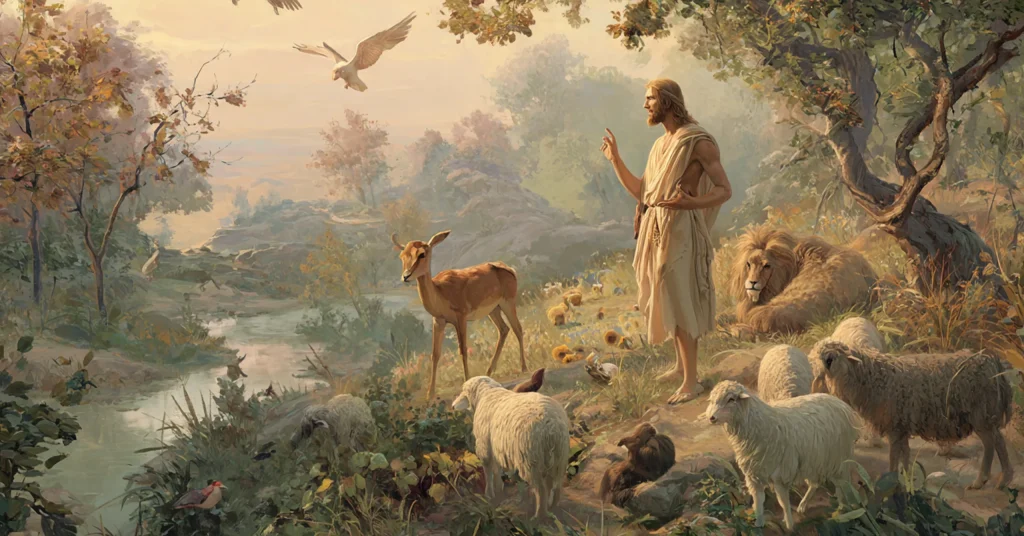
Genesis 3 opens with a talking creature and a woman who answers it as if nothing were unusual. The creature asks, “Yea, hath God said, Ye shall not eat of every tree of the garden?” (3:1), and Eve replies at once. She does not gasp, hesitate or ask how a creature can speak. The chapter gives no date for the scene and no explanation for her calm, and readers have been supplying one for a very long time. This article sets out what the text records, how the Bible handles another speaking animal and what three groups of readers make of the silence.
What Genesis 3 Records
The narrator introduces the creature before it speaks: “more subtil than any beast of the field which the LORD God had made” (3:1). That wording places it among the animals. It then addresses the woman, and “the woman said unto the serpent” (3:2) in reply. The talk runs through verse 5, and the exchange has the shape of an ordinary conversation. Each side answers the other, and neither stops to ask how the other can talk.
Her reply runs through verse 3. She says the fruit of the trees may be eaten, repeats the ban on the tree in the middle of the garden and adds that they must not touch it. The King James text of the command in Genesis 2:16-17 has no such clause. The creature contradicts God in verse 4, and in verse 6 the woman sees “that the tree was good for food” and eats.
Notice what the narrator chooses to report. In verse 6 it gives her reasoning at the tree: it was good for food, pleasant to the eyes and desired to make one wise. About the speech it gives nothing. There is no pause, no remark that the creature was unusual and no hint that speech was new. Earlier, in Genesis 2:19-20, the animals are brought to Adam and he names them, and the text records no word from any of them. That chapter neither shows animals speaking nor rules it out.
The Other Speaking Animal
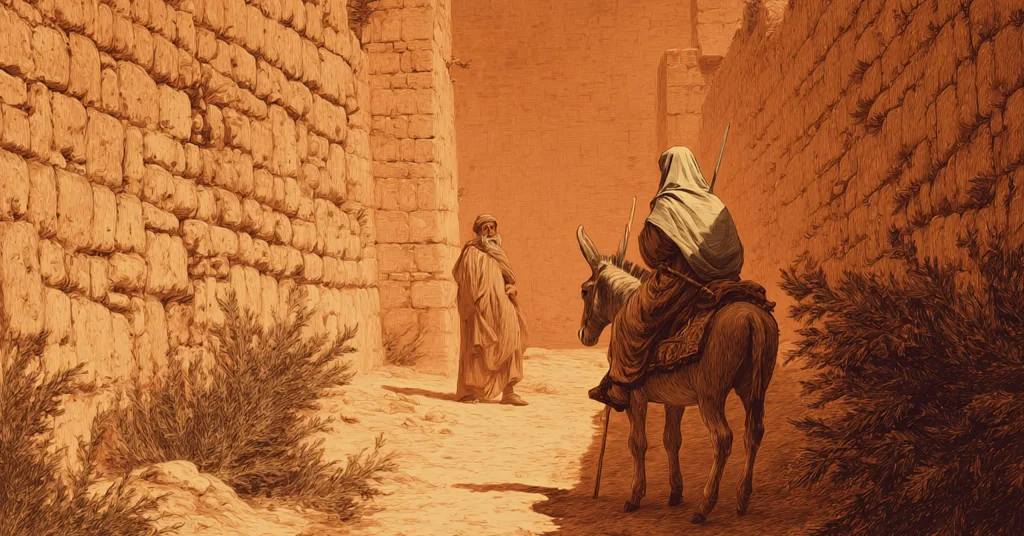
Numbers 22 is the usual comparison. Balaam’s donkey sees the angel of the LORD in the road and balks three times, and each time Balaam strikes her. Then “the LORD opened the mouth of the ass” (22:28), and she asks why she has been beaten these three times. The text names the cause. A New Testament letter later recalls the scene as “the dumb ass speaking with man’s voice” (2 Peter 2:16).
Gerhard von Rad, in a 1973 commentary as summarised on Wikipedia, counts these as the only two speaking animals in the Torah. The scenes differ in one way that readers notice. The donkey’s speech is introduced as an act of God, and the later letter treats it as striking. The serpent’s speech has no introduction at all.
The comparison has a limit, though. Even in Numbers 22 the human answers at once. Balaam replies in the next verse, “Because thou hast mocked me” (22:29), and the text records no astonishment from him either. A missing reaction is therefore not proof, by itself, that the speech was ordinary.
What Early Jewish Writers Did With It
Jewish writers from the centuries around the turn of the era mostly did not treat the speech as a puzzle. Jubilees, known in R. H. Charles’s 1913 translation, says that on the day Adam left the garden the mouths of the beasts, cattle and birds were closed, because “they had all spoken one with another with one lip and with one tongue” (3:28). The idea is that animals once shared a language, and that it ended with the expulsion.
Josephus, writing in the first century AD, says in William Whiston’s translation that at that time “all the living creatures had one language,” and that the serpent lived together with Adam and his wife and showed an envious disposition. Philo of Alexandria is more guarded. In C. D. Yonge’s translation of On the Creation, he writes “It is said” that the old, earthborn reptile “uttered the voice of a man,” and in the same passage he says Moses “was speaking in an allegorical spirit.”
Jubilees and Josephus place animal speech in the first age and end it there. Philo passes the report on and reads the garden as symbol. The chapter says none of this itself. These retellings answer a question it does not ask, and they show that early readers either gave the speech a simple setting or moved past it to the meaning of the story.
First Reading: The Garden Made It Normal
The first reading says Eve had no reason for surprise because nothing in her world was ordinary yet. In Genesis 2:7 the LORD God “formed man of the dust of the ground,” and the woman is later built from the man’s rib (2:21-22). A devotional article on Christianity.com offers this as an inference and not a fact: in a world where living beings came from dust and a rib, a talking serpent might seem less startling, and Eve may have cared more about what the creature said than about the fact that it spoke.
Jubilees and Josephus fit this reading, since they treat shared speech as part of the original order. Its weakness is that the chapter itself gives no sign of a language shared among animals. Genesis 2:19-20 shows Adam naming them and records no reply. The idea of a common tongue comes from later storytelling, not from the text.
Second Reading: Not an Animal at All
The second reading says her calm hints that she did not see an animal. Later tradition leans this way. Revelation 12:9 speaks of “that old serpent, called the Devil, and Satan,” and Wikipedia’s survey says the identification with Satan developed after Genesis, with the Wisdom of Solomon possibly the first text to make it. Genesis 3 never names Satan.
Early Jewish readers did not agree on what the creature looked like. Adolfo Roitman’s 1995 article in the journal Tarbiz, as described in an abstract, sorts their pictures into four groups. Some gave the creature four legs, some gave it human-like hands and feet, some made it dragon-like with wings, and one rabbi suggested a camel. The human limbs and dragon wings go beyond an ordinary snake.
The text pulls the other way. The narrator counts the creature among the beasts, and in 3:14 the LORD God tells it that it is “cursed above all cattle, and above every beast of the field.” Von Rad, again as summarised on Wikipedia, took it to be a created animal whose one mark of difference was its cleverness. Readers who want a being of another kind must read past the narrator’s own words.
Third Reading: An Old Story in Few Strokes
The third reading treats the silence as a feature of style. Genesis 3 is short. It gives no tone of voice and no description of the creature beyond its cleverness. It reports what Eve judged at the tree but not what she felt on hearing the voice. On this view, asking why she was not surprised imports the expectations of a modern novel into a story that tells only what its plot needs.
This reading is the hardest to test, because it makes the fewest claims about the text. No source used here names a particular scholar who argues it in exactly this form, so it is best held as the reading that asks the least of the chapter.
What Can Be Said
The creature speaks, the woman answers and the chapter moves on without comment. All three readings are interpretations. Each draws support from outside Genesis 3: ancient retellings for the first, later tradition and Jewish pictures of the creature for the second, and the economy of ancient storytelling for the third. None of them comes from the chapter itself, which records Eve’s replies and says nothing about what she expected, felt or understood.
Whether the silence is a clue or only the habit of a spare narrator is left to the reader.

