Did the Giants Fight Over Metal? What the Old Texts Say
Texts & Traditions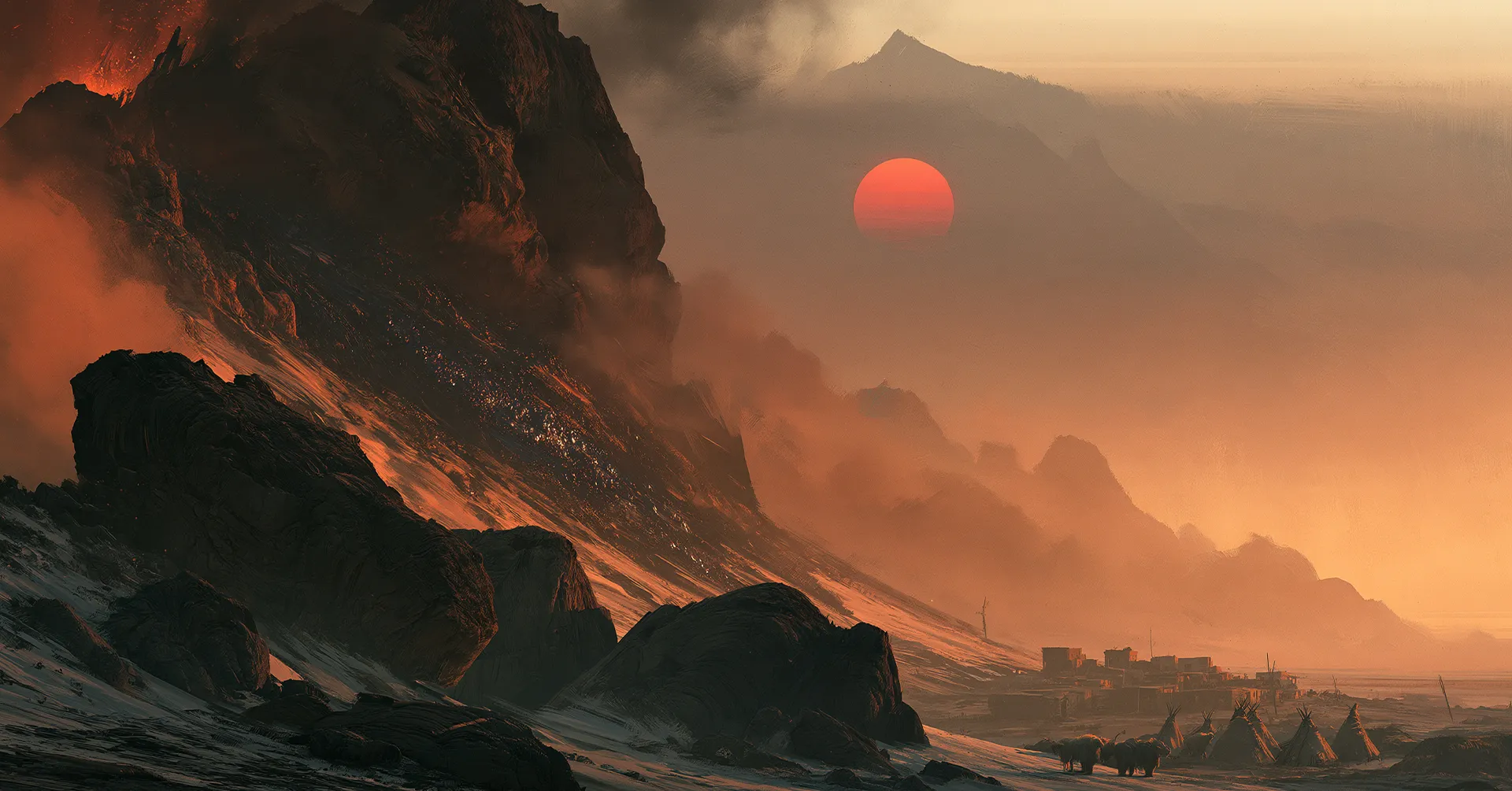
AI reconstruction, not a photograph.
In the Book of Giants and the texts around it, the giants end by killing one another, but the sources do not say the killing began over a metal. A modern retelling dates the first battle after Enoch’s warning and gives it a cause: a cache of strange metal, harder than iron and lighter than bronze, claimed by Hahyah and wanted by a group loyal to Gilgamesh. It ends with a week-long fight that forms a lake and a son who kills his father. This article sets out what the ancient texts say about giants fighting giants, where weapons and metal enter the story, what is known of Gilgamesh and the family names, and which details belong only to the retelling.
Giants Against Giants
The idea that the giants destroy one another is old. In 1 Enoch 10:9 Gabriel is told to “send them one against the other that they may destroy each other in battle”. Jubilees 5:2 says that “they began to devour each other”, and verse 9 says that God sent a sword among them so that “they began to slay each other till they all fell by the sword”. James Davila’s summary of the Book of Giants has the four archangels eventually incite the giants to fight each other, and his account of the giants’ responses ends with them falling out among themselves and killing one another.
In all of these the war is a judgment. It is ordered, sent or provoked from heaven. A reference entry on the book says that the Manichaean version describes “fierce battles” between God’s archangelic hosts and the giants, who are subdued only with difficulty, and Wikipedia says that edition has a complete ending. None of these pages gives a quarrel over a resource as the first cause.
Where the Metal Comes From
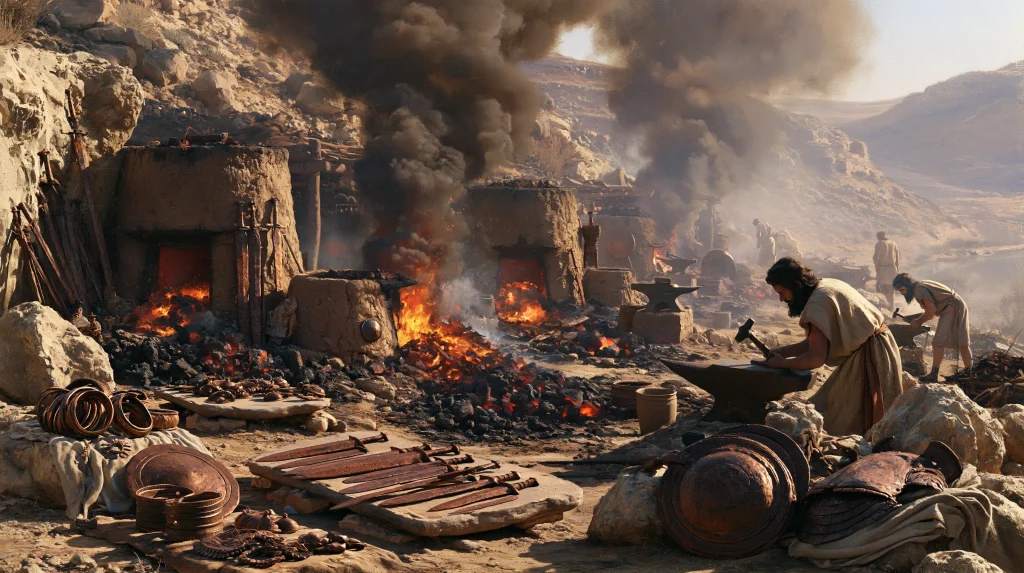
Weapons and metal do appear in the older Enoch material, but as a teaching. The Enoch text consulted says in 8:1 that Azazel “taught men to make swords, and knives, and shields, and breastplates” and “made known to them the metals of the earth”. Here the metals are an ordinary part of the earth, and the gift is the skill of working them. The page names no special ore and no deposit, and it makes no distinction between kinds of metal. It adds that Azazel also taught the working of bracelets and ornaments, so the knowledge is wider than weaponry. The earlier harm in 1 Enoch 7 is to food and flesh, not to ore: the giants first consume what people have made.
That leaves the retelling’s cache with an echo but no source. A metal valued above iron could be the story’s way of dramatising 1 Enoch 8:1, in which forbidden knowledge becomes the occasion for bloodshed. That is an interpretation. The text consulted does not describe a mine, a cache, a claim to territory or a battle fought over any of them.
Gilgamesh Among the Giants
Gilgamesh does appear in the book. Davila says that he is a giant who, with Hobabish, sends a message that cheers the others after Enoch’s warning, and that a fragment has him discussing “your dream”, presumably Ohyah’s. Davila also notes that the name shows the author’s familiarity with the Epic of Gilgamesh. The pages consulted do not say what Gilgamesh does after his message, so any later role for him has to be imagined. Wikipedia says the names of Gilgamesh and Humbaba are linked with the Watchers and giants in both the Qumran and the Manichaean editions, and that the Hobabish spelling occurs on its page only in a quotation from Beyer.
The retelling gives Gilgamesh a following that finds the metal and wants it for weapons. No page consulted describes such a group. The same is true of the quarrel it ascribes to Ohyah and Hahyah. In Davila’s account they are brothers and sons of Shemihazah who relay their dreams to the assembly, and in the Manichaean version they are renamed Sam and Nariman. Nothing in these pages puts them on opposite sides of a war.
Fathers and Sons
The father in the retelling is Barakel, and the dead father’s son is Barakel the Younger. The pages consulted know only one Baraq’el, a Watcher, and say that his son is Mahaway, the messenger who flies to Enoch. The Enoch chapter on the Watchers’ teaching has a Baraqijal who “taught astrology” (8:3), a name the page spells differently. It is likely the same Watcher, but the pages do not say so.
No page consulted mentions a giant who kills a Watcher, a son who kills his father or a rage at being born into a doomed existence. Wikipedia and Davila say only that the giants were the offspring of the Watchers and women, and that they enslaved humans, slaughtered them and damaged the natural order. Wikipedia lists violence and exploitation among their abuses. The scene of patricide is the retelling’s own, and it fits a book about doomed families only in general terms.
Humans in the Crossfire
The humans are not bystanders in the older texts. In 1 Enoch 7 the giants “consumed all the acquisitions of men”, then “turned against them and devoured mankind”, and “began to sin against birds, and beasts, and reptiles, and fish”, and to “devour one another’s flesh, and drink the blood” (7:3-5). Davila adds that humans call on God and the archangels, and the archangels’ action against the giants follows in his summary of the plot.
The retelling has the surviving humans hide in caves and hope the giants will destroy themselves, then lose whole settlements as the giants turn their hunger on the nearest prey. The hiding places and the hope are not in the pages consulted. The pattern of ruin is, since the giants eat what is at hand, human and animal, and later turn on each other.
How the War Ends
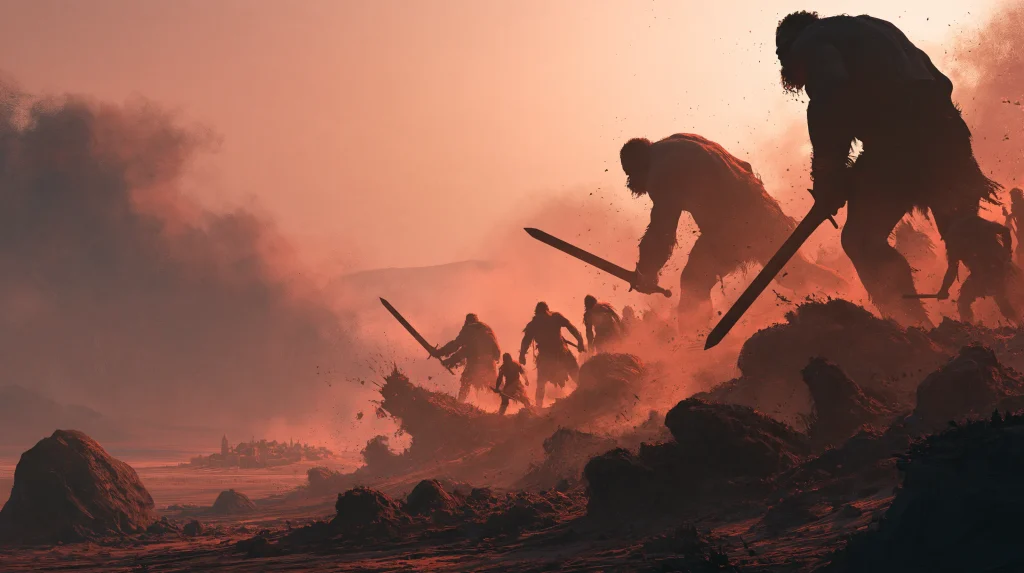
In the surviving texts the war between the giants ends with the giants dead, and the Watchers are dealt with separately. Jubilees 5:9 says that “they all fell by the sword”, and in verse 6 an angel reports that God “bade us to bind them in the depths of the earth”. In 1 Enoch 10:11 Michael is told “Go, bind Semjaza and his associates who have united themselves with women”. In the Manichaean ending Wikipedia says four angels linked to Michael, Gabriel, Raphael and Uriel subdue the demons and their offspring. Genesis 6:4 says only that “There were giants in the earth in those days”, and the flood follows. The Qumran fragments break off before any such ending, so the Manichaean edition and the Enoch and Jubilees traditions have to fill the gap. The reference entry says hints in the surviving Qumran text suggest the flood was eventually described, so the Qumran copies may once have told the giants’ end, but nothing of it remains. A lake formed by a week-long battle, a dozen fallen giants lying like mountains and a sound carrying for hundreds of miles are not in them.
What Can Be Said
What the texts state plainly is narrow: the giants end by killing one another, at heaven’s prompting, after a long record of killing humans. The first battle, the strange metal and the death of Barakel are the retelling’s. They answer a question the sources leave open, which is why giants already given to violence would turn on one another, and the sources give the reason as heaven’s judgment.

