How a Cable Trench Uncovered the World’s Oldest Gold
Origins & Prehistory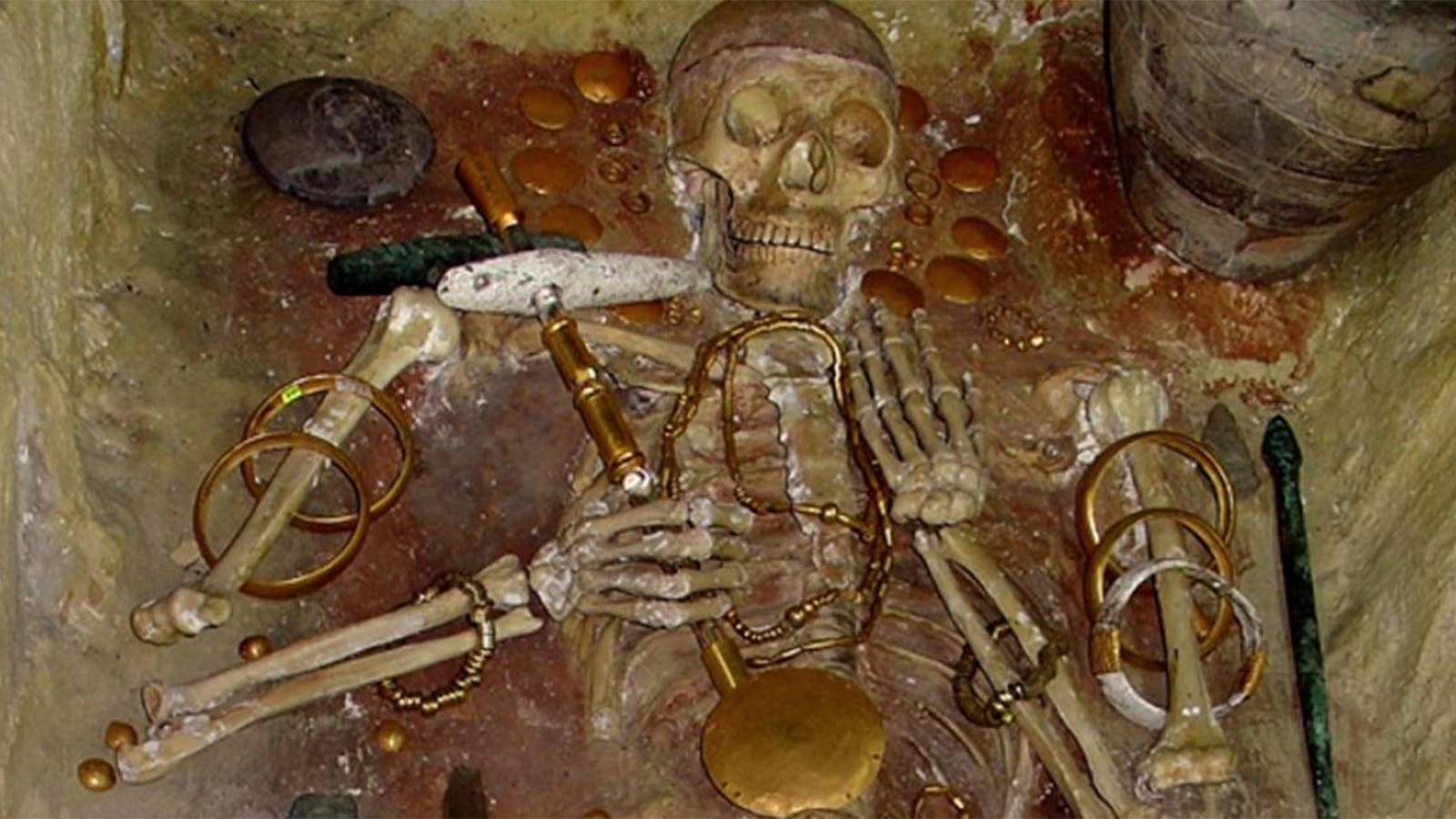
A tomb from the Varna necropolis (Bulgaria), circa 4600 BC.
In October 1972, an excavator operator named Raycho Marinov was cutting a trench near Varna, Bulgaria, to lay an electric cable, when his machine turned up small squares of shining yellow metal. What he had struck was the edge of a cemetery that would change how archaeologists understand the earliest use of gold anywhere on Earth.
An Accidental Discovery Beneath a Cable Trench
Marinov noticed bracelets of the same yellow metal, greenish corroded objects, and flakes of worked flint scattered in the disturbed soil. He reported the find to the local museum, and what followed was a rescue excavation that ran, under different directors, for close to two decades. Museum curator Mihail Lazarov led the first phase of work from 1972 to 1976, and archaeologist Ivan Ivanov continued it until 1991, gradually expanding the dig across some three thousand square metres of the western industrial zone on the outskirts of the city. Between them, they uncovered a cemetery today known as the Varna Necropolis, one of the most important prehistoric burial sites ever found in Europe, sitting on the northern shore of Lake Varna, a few kilometres from the city centre. Roughly thirty percent of the site’s estimated area is still thought to remain unexcavated even now.
Gold Older Than Egypt’s Pyramids
What made the site extraordinary was not just its size but its age. The objects recovered from Varna’s graves date to roughly 4600 to 4200 BC, a range later radiocarbon work has narrowed further, to somewhere around 4569 to 4340 BC. Either way, that places this gold centuries before Egypt’s pyramids were built, and well before worked gold appears in any real quantity almost anywhere else in the world, including the early urban centers of Mesopotamia. Archaeologists studying the site have described the weight and number of gold objects at Varna as exceeding, by several times over, the combined gold recovered from every other excavated site of the same millennium worldwide, Mesopotamia and Egypt included. More than 3,000 individual gold ornaments have come out of the necropolis so far, weighing roughly 6 kilograms in total, a figure that still stands as the largest known assemblage of gold from anywhere on the planet at that early date.
A Cemetery of Unequal Wealth
Excavators eventually uncovered 294 graves across the site. Not every grave held gold, and the graves that did were not equally furnished. Some contained only a handful of small beads or rings. Others held elaborate collections of gold plaques, bracelets, and ceremonial objects, arranged with what looks like deliberate care rather than casual deposit. A number of graves, referred to as cenotaphs, contained no human remains at all, only rich collections of grave goods, and a few of these symbolic burials held clay masks in place of a face, laid where a skull would otherwise have rested. Those empty, symbolic graves turned out to be among the richest in gold at the entire site.
Grave 43 and the Man Who Outweighed the World in Gold
The single most famous burial, numbered Grave 43, was excavated near the end of 1974, in the central part of the necropolis. It belonged to a man in his forties, unusually tall for the period at roughly 1.70 to 1.75 metres, buried on his back with close to 990 separate gold objects placed on his body, amounting to about 1.5 kilograms of gold. Beads, rings, and decorations covered his arms, chest, and hair, along with a gold sheath worn over the pelvis. Beside him lay copper axes and a perforated stone mace-head that archaeologists have interpreted as a ceremonial scepter, a plausible mark of authority or rank. Pottery placed in the grave was also unusually fine, fully fired and carefully decorated with incised lines and inlaid graphite, in contrast to the smaller, poorly fired miniature vessels found in many of the surrounding graves. Taken together, this one burial is widely cited as containing more worked gold than has been recovered from the entire rest of the world for that same era.

Grave 43 was originally described as the burial of a prince or ruler, and that reading still shows up in most popular accounts of the site. More recent scholarship has floated an alternative: given the tools buried alongside him, some archaeologists now suspect this may instead have been the grave of a master metalsmith, someone whose standing in this community came from mastery of a difficult new craft rather than from inherited political office. The debate remains unresolved, and either reading points to the same underlying fact, that gold at Varna was tied closely to personal status, whatever form that status actually took.
What the Empty Graves Hint At
The site’s cenotaphs complicate the picture further. Grave 36, one of the symbolic burials with no body inside it, contained more than 850 gold items on its own: a tiara, earrings, a necklace, a breastplate, bracelets, a belt, a gold hammer-shaped scepter, a small gold model of a sickle, and dozens of gold plaques shaped like animal heads. Whatever these graves were meant to commemorate, whether an absent leader, a lost body, or a purely symbolic figure, the community was willing to bury genuine wealth for the sake of the gesture alone.
A Society Already Built on Rank
The Varna culture that produced all of this belonged to the Copper Age, a society settled along the Black Sea coast that had already developed advanced metallurgical skill, extracting, shaping, and finishing gold with techniques that would not become common in most other regions for a very long time afterward. The uneven distribution of gold across roughly 300 graves, some richly furnished, most modest, and a handful containing no body at all, points to a community already organized around rank and status well before writing existed anywhere to record such distinctions directly. It is a strange kind of historical evidence to work from, wealth measured out in beads and plaques rather than in decrees or names, but it is remarkably legible all the same: whoever these people were, they already understood gold as something worth displaying, hoarding, and burying to mark a person’s place among their neighbors. Researchers continue to study the necropolis for what it can reveal about early trade networks, since neither the gold nor several of the exotic materials buried alongside it, including spondylus and dentalium shell likely sourced from distant seas, occurred naturally anywhere near Varna itself, and about the belief systems that first attached deep meaning to a metal that, at this cemetery on the Black Sea coast, clearly meant a very great deal indeed.

