Everything That Breathed Died: What Genesis 7:21-23 Says
Biblical History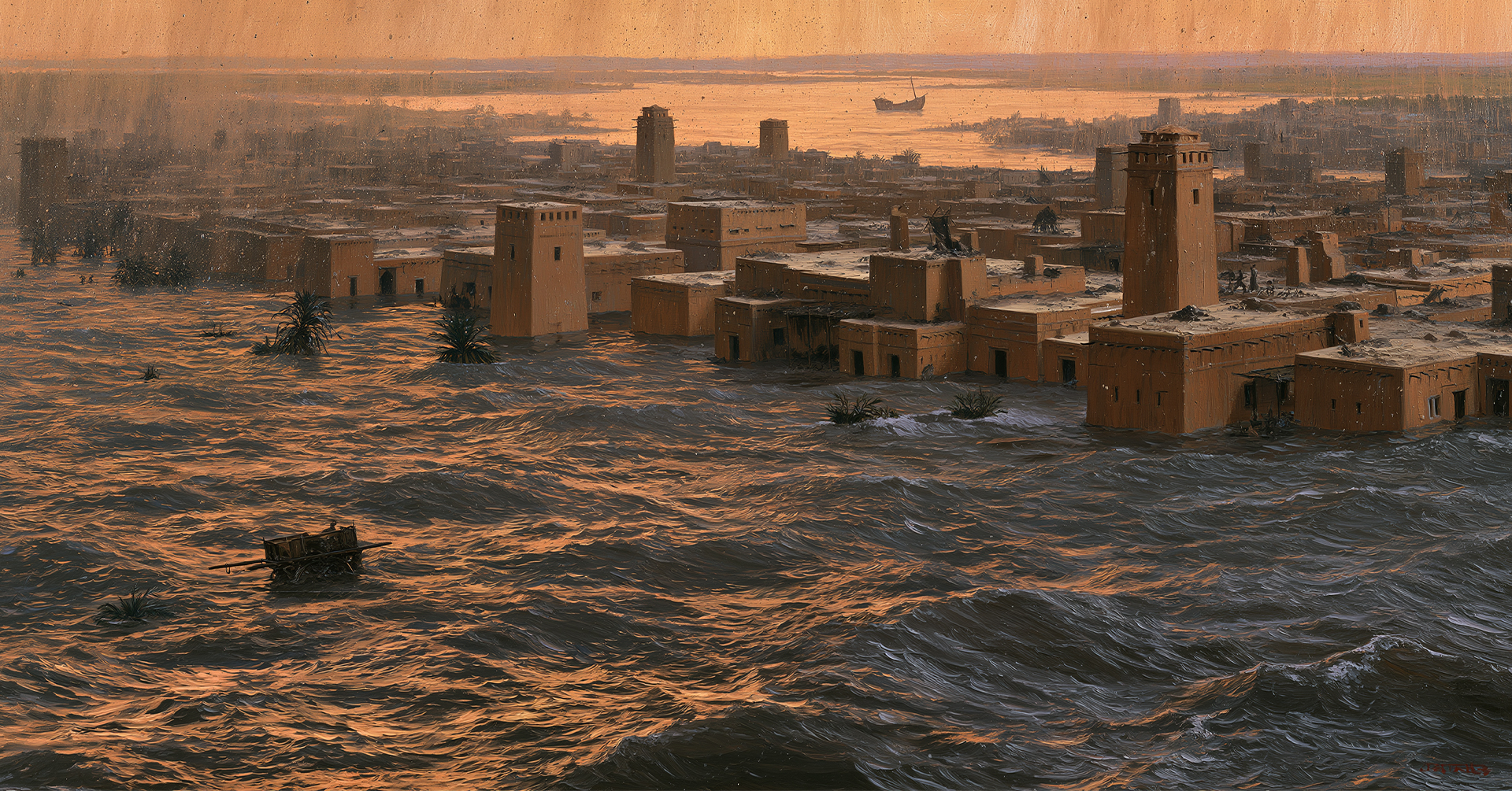
AI reconstruction, not a photograph.
Genesis 7:21-23 records the death of nearly every living thing on dry land in three verses. The King James Version says that “all flesh died that moved upon the earth” and that “Noah only remained alive, and they that were with him in the ark”. The passage gives no count of the dead, no scene of the water rising through a town and no last moment of any person. This article sets out what the three verses say, how other ancient flood stories describe the dead, what the key phrase in verse 22 means, how large the flood was meant to be and what later writers added.
Three Verses of Death
Verse 21 lists the dead: “both of fowl, and of cattle, and of beast, and of every creeping thing”, and last of all “every man”. Verse 22 says that everything “in whose nostrils was the breath of life” died, “of all that was in the dry land”. Verse 23 widens the sentence to “every living substance” and ends with the survivors.
The order of the list also changes. Verse 21 puts man last, and verse 23 puts him first: “both man, and cattle, and the creeping things, and the fowl of the heaven”. The text does not say why.
The verbs change. Verses 21 and 22 say the creatures died. Verse 23 says that “every living substance was destroyed which was upon the face of the ground”, and a page on Livius.org renders the same clause “He blotted out every living thing”. The King James Version also uses “destroy” in God’s announcement at 6:7 and in his warning at 7:4 that “every living substance that I have made will I destroy” from the earth. The Bible Hub lexicon lists all three verses under one Hebrew verb, and Brown-Driver-Briggs places them under the sense of exterminating mankind or all existing things. Verse 23 therefore reads as the announced decision carried out.
What the Narrator Leaves Out
The verses give no count, no town, no cries and no last words. The story moves at once to the survivors: the waters “prevailed upon the earth an hundred and fifty days” (7:24), and then “God remembered Noah” (8:1).
Mesopotamian accounts linger on the dead. In Maureen Gallery Kovac’s translation of Gilgamesh Tablet XI, as presented on Livius.org, the goddess Ishtar “shrieked like a woman in childbirth” and laments that her people “fill the sea like so many fish”. The gods sit “weeping, sobbing with grief”. The survivor Utnapishtim says that “all the human beings had turned to clay” and that “I fell to my knees and sat weeping”. A Grand Valley State University page that draws on Stephanie Dalley’s translation of Atrahasis says the goddess weeps for dead humans who “clog the river like dragonflies”. Wikipedia lists the Gilgamesh flood tablet K.3375 as Neo-Assyrian and made in the seventh century BCE. Genesis records no grief at the moment of the deaths. The comparison shows that the texts handle the dead differently, not that one writer felt more than another.
The Breath of the Spirit of Life
Verse 22 uses an unusual phrase. The King James Version, the ESV, the NRSV and the NIV give “the breath of life”, but the ASV, the NASB, the NKJV and the JPS Tanakh of 1917 give “the breath of the spirit of life”, according to a Bible Hub comparison page. A translators’ commentary calls it “the only place in the Old Testament where” breath and spirit are “joined in this way”. It says the phrase appears to merge wording from Genesis 2:7 with wording from 6:17 or 7:15, that some interpreters think the word for “spirit” was added by later editors, and that the Septuagint and the Vulgate omit it. The sense is clear, it says, “everything that breathes”. The Anchor Bible’s “the faintest breath of life”, it adds, has no parallel elsewhere.
The echo of creation is plain in the King James Version. In Genesis 2:7 God “breathed into his nostrils the breath of life”, and in 7:22 it is that breath, in those nostrils, that stops. The same words mark both fates. In 6:17 God announces that he will “destroy all flesh, wherein is the breath of life”, and in 7:15 the animals enter the ark “two and two of all flesh, wherein is the breath of life”.
Source critics who divide the flood story do not divide these verses alike. Wikipedia’s table gives 7:22-23 to the Yahwist and 7:18-21 to the Priestly source, while Jona Lendering’s table on Livius.org gives 7:21-22 to the Priestly source and only 7:23 to the other. Wikipedia adds that some scholars question whether two sources exist at all.
A Reversal of Creation
Verse 22 belongs to a larger pattern. In 7:11 “all the fountains of the great deep” are broken up and “the windows of heaven were opened”. In Genesis 1:7 God had divided “the waters which were under the firmament from the waters which were above the firmament”. The flood lets both bodies of water through. Wikipedia calls the story “a reversal and renewal of God’s creation of the world”, says the opened fountains return the world to “watery chaos”, and adds that the order of destruction mirrors the order of creation. That is an interpretation, though the language of 7:11 supports it.
How Big Was the Flood?
Verses 19 and 20 say that “all the high hills, that were under the whole heaven, were covered”, that the waters prevailed “Fifteen cubits upward” and that “the mountains were covered”. The Hebrew word usually translated “earth” is eretz, which can also be read as “land”. David Instone-Brewer, writing in Premier Christianity on 26 November 2021, says it “could mean ‘planet’ or ‘earth’” but “more often means ‘land’ or ‘country’”. He argues that in Genesis 8:9, where “the waters were on the face of the whole earth”, it “must mean ‘the land’”. He reasons that Noah had already seen Ararat, so the flood could not have covered every mountain on the planet.
Wikipedia says that “a global flood as described in this myth is inconsistent” with several scientific fields, and that “some Christians have preferred to interpret the narrative as describing a local flood”. Others read the wording as global. The verses say “all flesh” and “every living substance”, and whether that covers the planet or the writer’s known world turns on how one word is read. The text does not settle it.
What Later Writers Added
Genesis records no crowds at the ark and no one begging to be let in. Later writers supply warnings and crowds. Second Peter 2:5 calls Noah “a preacher of righteousness”. In Matthew 24:38-39 people go on “eating and drinking, marrying and giving in marriage” until “the day that Noe entered into the ark”, the King James spelling of Noah, and “knew not until the flood came, and took them all away”. Hebrews 11:7 says that by building the ark Noah “condemned the world”.
Rabbinic tradition goes further. Wikipedia’s article on Noah in rabbinic literature says Noah urged the people to repent and that they “ignored and mocked at him”. Citing the Tanhuma, Genesis Rabbah 32:14 and Sefer haYashar, it says that people “assembled in great numbers around the ark” and tried to break in, and that “they were destroyed by the lions and other wild animals”. The Jewish Encyclopedia says that Noah and Methuselah announced that “one hundred and twenty years would be given to men for repentance” and that “the wicked made sport of him and his work”. It adds that the Talmud holds that the generation “was judged with boiling water”. These are expansions of the story, not Genesis.
What Can Be Said
What the text states plainly is narrow: everything that breathed on land died, and Genesis tells it without comment. The size of the flood, the cries of the dying and the crowd at the ark are questions for other sources.

