Why God Grieved Before the Flood: What Genesis 6:5-6 Says
Biblical History
AI reconstruction, not a photograph.
Genesis 6:5-6 gives the reason for the flood in two verses. The King James Version says that “God saw that the wickedness of man was great in the earth”, that every thought of the heart “was only evil continually”, and then that “it repented the LORD that he had made man on the earth”. The verses name no crime, no place and no person. This article sets out what they say, what they leave unsaid, how a grieving God fits with other passages, and how the same diagnosis returns after the flood.
The Verdict in Two Verses
The verses move in three steps. In verse 5 God sees, and what he sees is wickedness on a great scale. The survey then goes inward, from deeds to the thoughts of the heart. Verse 6 gives God’s reaction, and verse 7 the decision: “I will destroy man whom I have created from the face of the earth”, with beast, creeping thing and birds included. Verse 8 supplies the single exception: “Noah found grace in the eyes of the LORD”.
The King James Version’s “imagination” renders a Hebrew noun that the NRSV translates as “inclination” in Genesis 8:21, where it reads “the inclination of the human heart is evil from youth”. That noun, yetzer, gave later Jewish thought the term yetzer hara, the evil inclination. Wikipedia says the term “is drawn from the phrase” about the inclination of the heart, which occurs “in Genesis 6:5 and Genesis 8:21”.
What the Text Leaves Unsaid
Neither verse says what the wickedness was. Verse 11 adds that “the earth was filled with violence”, and verse 12 that “all flesh had corrupted his way upon the earth”, but neither gives a list of crimes. The flood account names Noah and his sons Shem, Ham and Japheth (6:10) and no one else, and it describes no city. Other texts itemise a city’s sin when they want to: Ezekiel says of Sodom that “pride, fulness of bread, and abundance of idleness was in her”, and that she did not strengthen “the hand of the poor and needy” (16:49). Genesis 6 offers no such list.
The nearest examples are earlier. In Genesis 4 Cain “rose up against Abel his brother, and slew him” (4:8), and Lamech tells his wives “I have slain a man to my wounding” (4:23). The same chapter also shows people building and making things: Cain “builded a city” (4:17), Jabal is father of those who “dwell in tents” (4:20), Jubal handles “the harp and organ” (4:21) and Tubalcain instructs “every artificer in brass and iron” (4:22). Alan Cooper of the Jewish Theological Seminary observes that the Torah does not spell out the flood generation’s corruption, and that the violence nearest to it is Cain’s murder of Abel and Lamech’s taunt song.
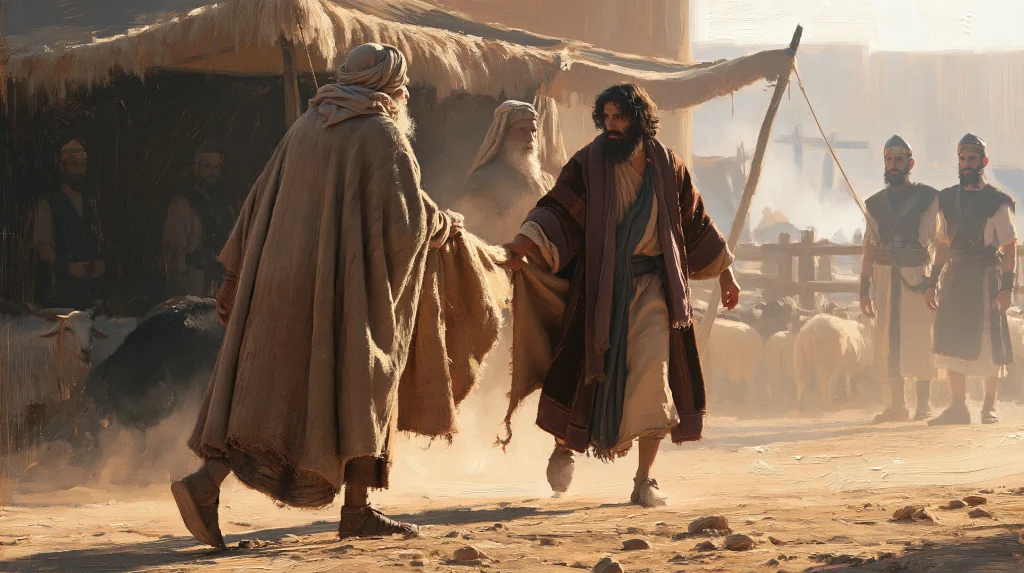
Retellings fill the gap with scenes of cruelty and deceit, and the picture at the head of this article is one of them: a crowded lane, a shove, a frightened woman. It is imagined. The text contains no such scene.

A God Who Grieves
The most unsettling detail is the reaction. The King James Version has “it repented the LORD” and “it grieved him at his heart”. The Hebrew verb behind “repented” is nacham, which the Bible Hub lexicon entry summarises as “To comfort, to repent, to relent, to be sorry”. Brown-Driver-Briggs, quoted there, lists Genesis 6:6 under a sense glossed “be sorry, rue, suffer grief, repent”. The range runs from sorrow to a change of course, and the pairing with a pained heart tilts the verse toward sorrow. The word “heart” also links the two verses: the thoughts of man’s heart are evil in verse 5, and God is grieved at his own heart in verse 6.
Mary Brett Koplen, in a Jewish Theological Seminary commentary, reads the verse that way and writes “God is heartbroken”. She notes that Rashi, the medieval commentator, compares God’s grief with David’s grief for Absalom, where the same root is used. In the King James Version that verse is 2 Samuel 19:2, where the king “was grieved for his son”.
Does God Change His Mind?
Other passages say that he does not. Balaam says that “God is not a man, that he should lie” and not “the son of man, that he should repent” (Numbers 23:19). Samuel says that “the Strength of Israel will not lie nor repent”, because “he is not a man, that he should repent” (1 Samuel 15:29).
The difficulty is built into 1 Samuel 15 itself. The chapter has God say “It repenteth me that I have set up Saul to be king” (15:11) and ends with the statement that “the LORD repented that he had made Saul king over Israel” (15:35), with the denial in between. The same verb works elsewhere. After Moses pleads, “the LORD repented of the evil which he thought to do unto his people” (Exodus 32:14), and when Nineveh turned, “God repented of the evil, that he had said that he would do unto them” (Jonah 3:10).
Readers have taken two broad routes. The Greek-speaking Jewish philosopher Philo of Alexandria, who lived from between 15 and 10 BCE until between 45 and 50 CE according to Britannica, wrote a treatise on the unchangeableness of God that takes up this passage. In C. D. Yonge’s translation he has God say “I was indignant that I had made them”, and argues that the clauses in the other order would suit “a person who repented of what he had done”, which he calls “an idea which is inconsistent with the nature of God, which foresees everything”. Such language, he says, is used “for the sake of admonishing those persons who could not be corrected otherwise”. For Philo it is a teaching device. Koplen takes it as real sorrow. The verses themselves do not choose between the two, and the tension stays standing.
The Same Diagnosis After the Flood
After the flood Noah builds an altar and offers burnt offerings, and the LORD says “in his heart” that he will “not again curse the ground any more for man’s sake” (8:20-21). The reason follows: “for the imagination of man’s heart is evil from his youth”. The diagnosis is the one given in 6:5, with “from his youth” added, and the response is the opposite.
Translators disagree on how the clause connects. The King James Version, the ESV and the NRSV read it as “for”, which makes the evil heart the reason for mercy. The NIV reads “even though every inclination of the human heart is evil from childhood”, and the NKJV “although”. A Bible Hub comparison page lists both groups, and its Pulpit Commentary note says that rendering the Hebrew particle as “although” is doubtful. Whether the diagnosis explains the end of the flood as well as its beginning therefore depends on one small word.
Later readers heard the repeated phrase as a statement about human nature. Wikipedia describes the yetzer hara in rabbinic texts as “a fundamental force driving humans toward sin”, an inclination “viewed as an inherent aspect of human nature”. The verses themselves say only that the heart’s inclination is evil, and they give no account of where it comes from.
Genesis is not the only ancient flood story, and the motive differs. Wikipedia’s article on the Gilgamesh flood myth dates a tablet of Atrahasis to 1646 to 1626 BC. A Grand Valley State University page that draws on Stephanie Dalley’s translation gives the grievance behind the gods’ measures against humankind as noise: “The noise of mankind has become too much”. In Genesis no noise is mentioned, and the reason given is wickedness, with violence named in 6:11.
What Can Be Said
The text gives no list of crimes, no scene of the wickedness and no explanation of how a grieved God squares with a God who does not repent. Readers argue those points from a few words, and the argument is old. What the text gives plainly is narrow: a verdict of total corruption, a grieved God and one exception.

