The Smiting Pose of Egyptian Kings: A Duty, Not a Battle
Ancient Near East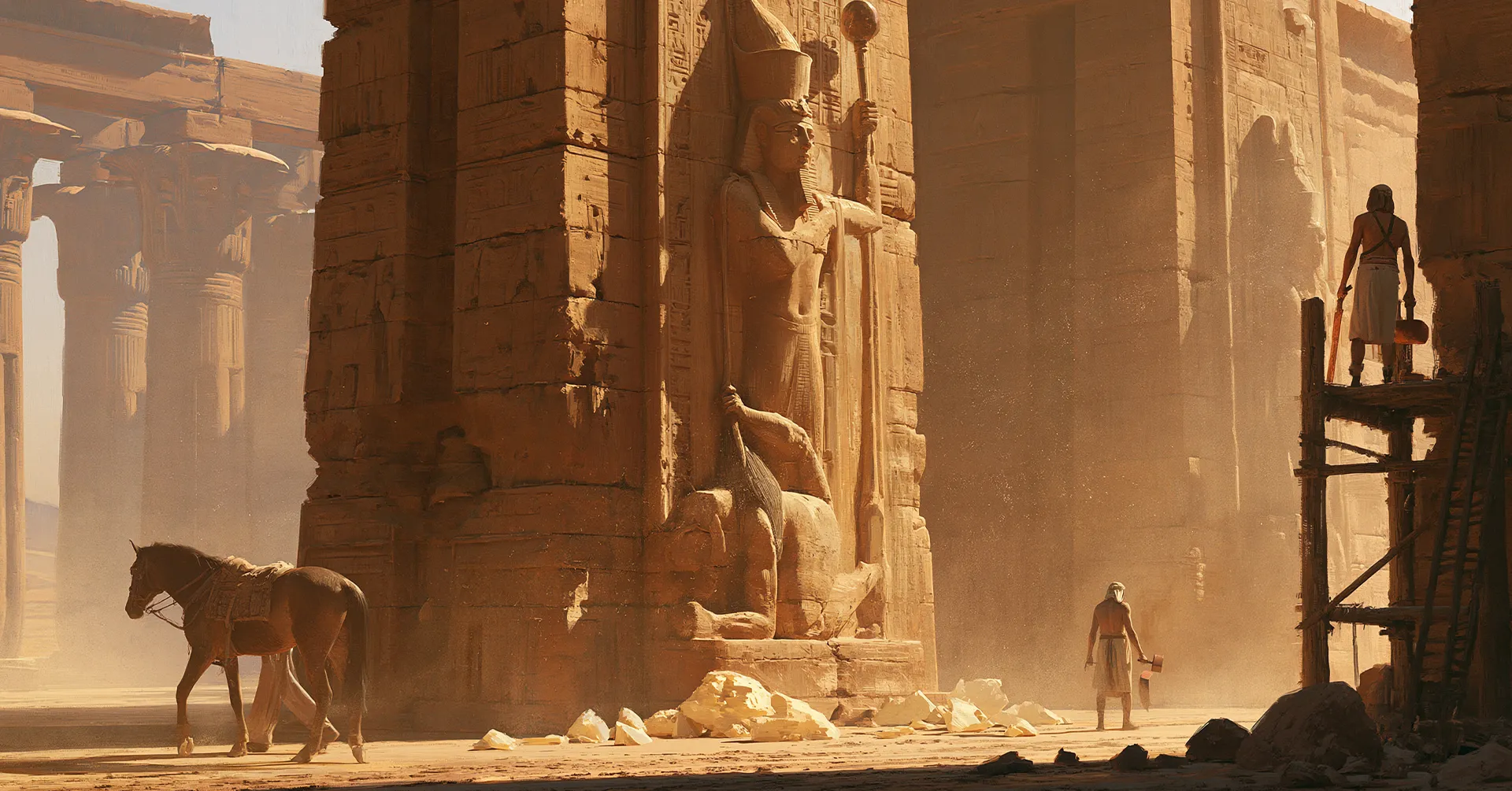
AI reconstruction, not a photograph.
A king with a raised arm gripping a bound enemy by the hair is one of the most repeated pictures in Egyptian art. At Qantir, in the Nile Delta of Egypt, the palace of Ramesses II was decorated with images of defeated enemies in the thirteenth century BCE. Several scholars read the smiting scene less as a record of one battle than as something a king was expected to do. This article sets out where the scene came from, what survives at Qantir, what the carvings leave out about Ramesses II and what they cannot show about real captives.
A Scene Older Than Ramesses II
The pose is far older than Ramesses II. Ancient Egypt Online places the Narmer Palette at “the end of Dynasty 0 or the beginning of Dynasty 1”, and describes the king on its back as “ready to strike down a foe whom he grabs by the hair”. A page on a painted limestone block from Memphis, now in the Egyptian Museum in Cairo (JE 46189) and dated to the reign of Ramesses II, says the motif has been “known since the 1st Dynasty”. On the block the king holds three prisoners by the hair in his left hand, with an axe in his right, “about to strike them”.
What the scene meant is less settled than how it looks. The page on the Narmer Palette cautions that it is “often stated as fact” that the palette commemorates Narmer’s victory and the unification of Egypt, but says there is no firm evidence for that. It suggests instead that the palette may depict “the ritual re-enactment of the act of unification”.
An announcement for a 2017 lecture by Laurel Bestock of Brown University, given at Charles University in Prague, calls icons of violence among the “earliest, most consistent, and most recognizable pictures” linked to Egyptian kings. It treats their link to real events as disputed, and says the talk argues that, whatever that link, such images “acted as an important tactic in developing and cementing concepts of kingship”. A picture repeated that consistently is difficult to read as a report of a single event.
Enemies at Qantir
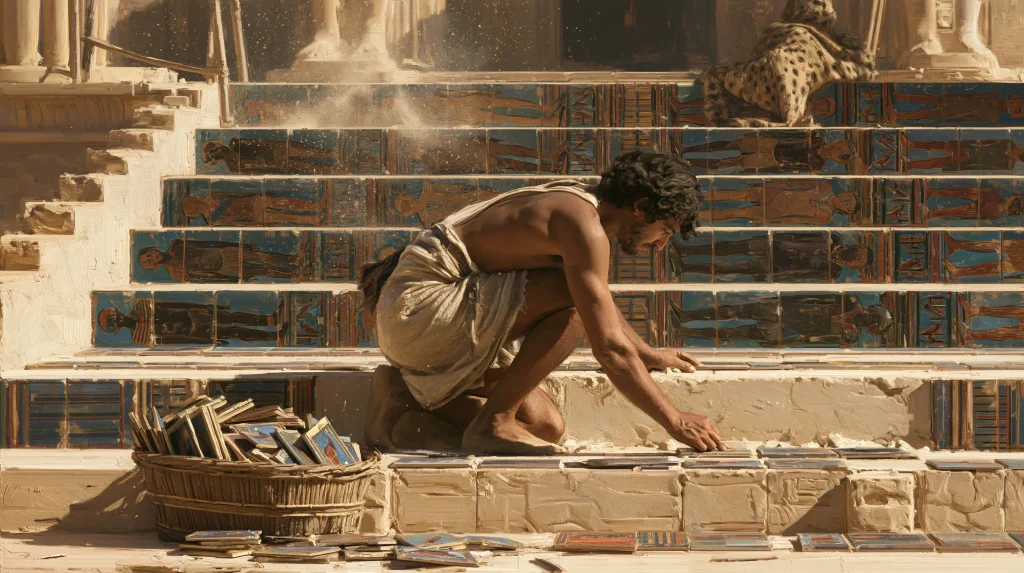
The Metropolitan Museum of Art holds faience tiles from the palace of Ramesses II at Pi-Ramesses, dated by the museum to about 1290 to 1224 BCE. Its record for one tile says it belongs to the steps leading up to the throne platform, which were decorated with “prostrate foreign captives alternating with representations of the Nine Bows”. This tile shows the head of a Nubian, and other fragments from the same steps show the feet of a Syrian and a Libyan identified by his spotted cloak. A second tile, the museum says, “is part of a relief depicting a bound Hittite”.
A 2023 exhibition of finds from Qantir at the Egyptian Museum in Cairo showed more. The Egyptian Gazette reported that a limestone stela of Ramesses II “depicts him executing one of his royal duties”, which it describes as keeping order in the world through war and the taking of captives. The report does not describe the carving itself, so whether the king is shown striking an enemy is not stated. It adds that glazed-faience tiles on display show foreigners: Nubians in the south, Libyans in the west and Asians in the northeast.
The Stables and the King’s Name
The stables were large. The Piramesse exhibition website says the site “could be used by at least 460 horses”, and a Berlin reconstruction project says the stables stood on the banks of a canal and the main hall was decorated with palm columns. On chariots the exhibition website is explicit: “No traces of chariots were discovered within the stables themselves”. Workshops where chariots “might have been constructed” lay a few hundred metres to the west.
The king’s name appears with horses as well. According to the Egyptian Gazette, coloured images on lintels show horses in front of the name of Ramesses II. None of the pages consulted describes the stable entrance, columns bearing the king’s cartouche or a relief of him conquering enemies on the stables, so an account that puts four such columns at the entrance is left unconfirmed here. A reasonable reading is that the king’s name on a working building marked it as his own, but no source states this.
A Statement of Order
Joachim Śliwa’s 2011 article on a scene from Aksha, in Nubia, where Ramesses II had a temple, follows what its abstract calls the “most popular conception”: the victorious ruler’s superiority set against the enemy’s humiliation. The abstract also presents the scene as a visualisation of consolidating the cosmic order, maat, against “the powers of evil and chaos”. On that reading a king who crushes disorder keeps Egypt safe, so the pose did not need a battle nearby.
A Louvre notice on a small stela from Deir el-Medina, from the reign of Ramesses II, adds a religious reading. The king is “shown victorious”, with a club raised and his enemies held by the hair, and the notice calls the scene “above all a symbol of the presence of the god himself”, not merely “a reassuring picture of the pharaoh vanquishing Egypt’s enemies”.
The Wikipedia entry on Montu, a warrior god, says Ramesses II “proudly called himself ‘Montu of the Two Lands’”, and quotes a Kadesh account saying he “raged at them like Montu, Lord of Thebes”. A title taken for himself suggests the warrior image was a deliberate choice.
A Peacemaker in a Warrior’s Pose
Read literally, the carvings would make Ramesses II a relentless conqueror and hide the rest of his career. Wikipedia dates his treaty with Hattusili III of the Hittites to about 1259 BCE and its ratification to the 21st year of his reign, 1258 BCE. It has clauses on non-aggression, alliance and the return of refugees and criminals, and Wikipedia calls it “the oldest known surviving peace treaty”.
The same page says Ramesses had failed for about 15 years to regain his lost Syrian territory, and argues that he turned to diplomacy. Trevor Bryce is quoted as saying that Late Bronze Age treaties were made “for reasons of expediency and self-interest”. The page adds that Ramesses presented the settlement as a win over the Hittites, although Hattusili had approached him first, and that depictions at the Ramesseum show the Hittite king seeking the settlement from a position of submission. A page on the Ramesseum, whose entrance pylon shows the king “grasping enemies by the hair whilst smiting them”, says no monument records “a single governmental setback” and calls the murals “a very early form of mass persuasion”. The carvings told the story from the king’s side.
Types, Not Individuals
The darker side lies in what the pose assumed: that enemies existed to be shown beaten. The victims in such reliefs are types, not named individuals. On the Cairo block, the enemies’ features, hairstyles and beards mark them as Nubians, Libyans and Syrians, and on the Qantir steps the surviving fragments show a Nubian’s head, a Syrian’s feet and a Libyan identified by his spotted cloak.

The Nine Bows work the same way. Wikipedia says that “there were no other generic representations of foreigners”, that “there is no true list of the nine bows”, and that nine may express “the totality of foreign lands”. A pedestal of Ramesses II puts the bows under the king’s feet, with rings naming groups such as “Libyan people” and “Asiatic groups”, and the page says such placement meant the enemy was “trampled or entirely under control”. Each figure stands for a people, not a person, so the images cannot show how real captives were treated.
What Can Be Said
The smiting scene is old, formal and repeated, and the objects from Qantir fit a long habit of showing the king’s enemies under his control. None of the Qantir objects described here is tied by the sources consulted to a particular battle, and none records what became of the people shown. What can be said plainly is narrow: a carved ritual of violence decorated a king’s monuments, and it records a duty, not a battle.

