This Child’s Skull May Be Human and Neanderthal Both
Origins & Prehistory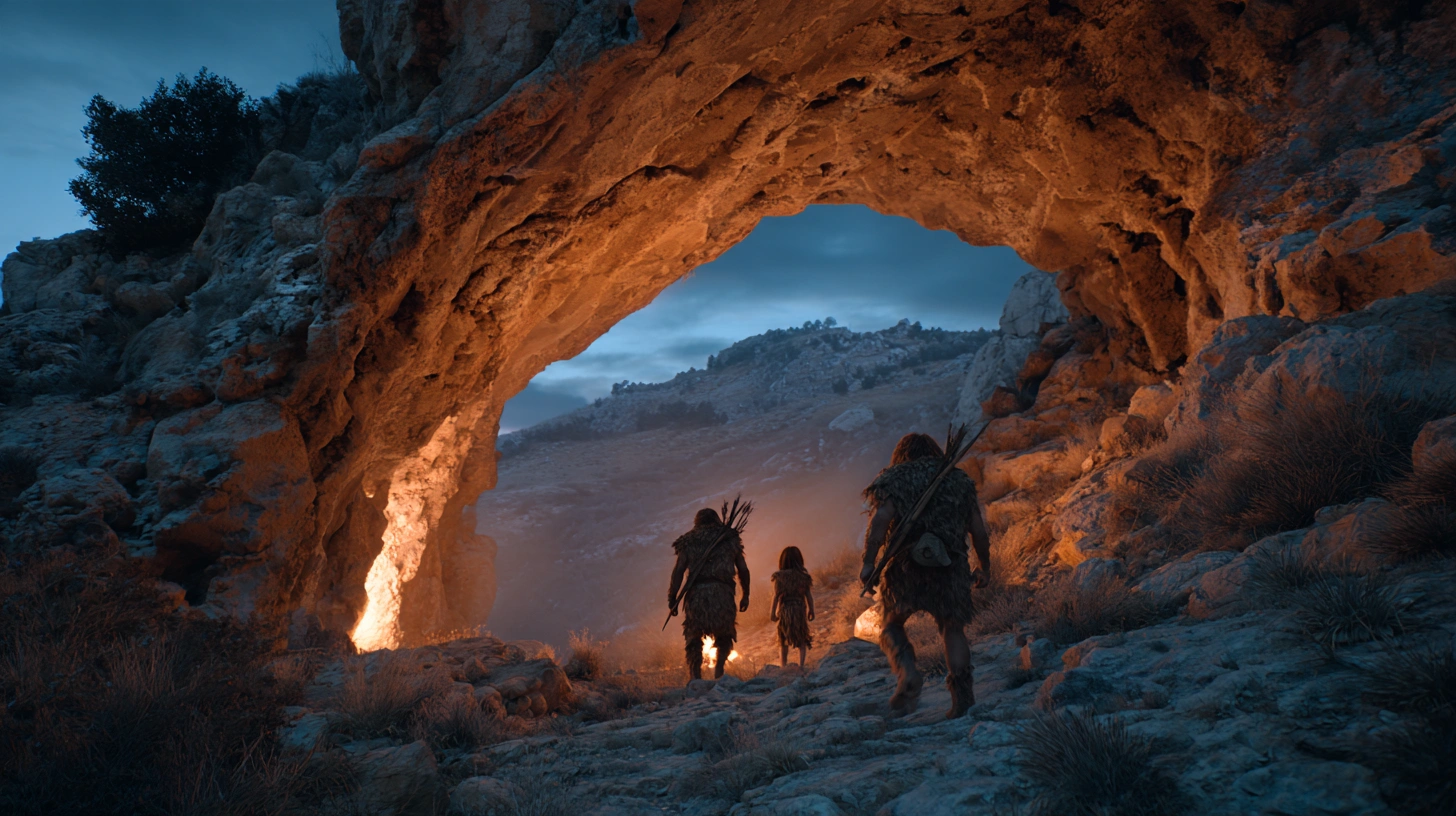
AI reconstruction, not a photograph.
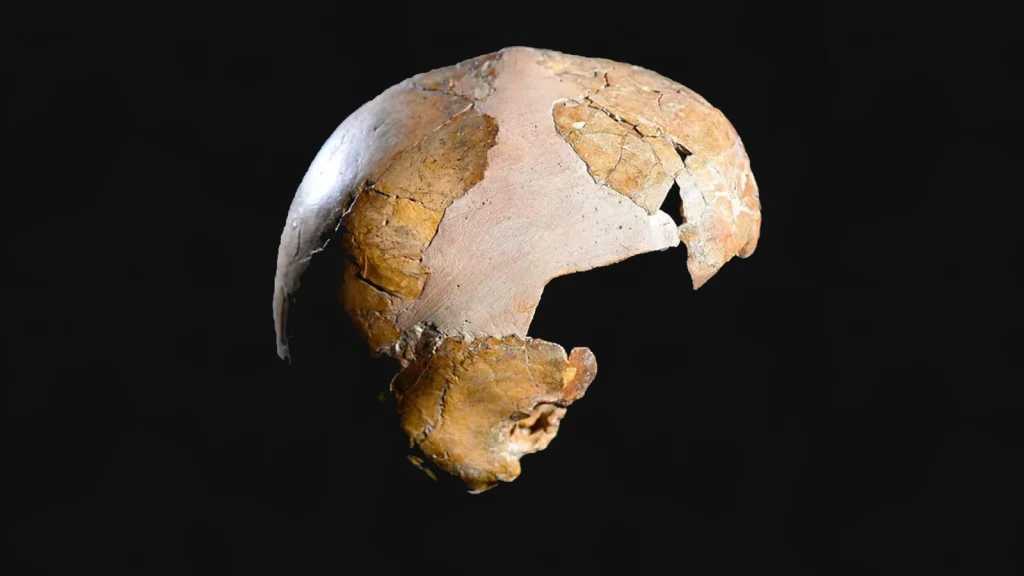
A child’s skull excavated on Mount Carmel nearly a century ago may be rewriting how early Homo sapiens and Neanderthals interbred, and when. A study published in July 2025 in the journal L’Anthropologie argues that the skeleton known as Skhul I shows a genuine mix of features from both species, pushing the earliest solid evidence of contact between them back by tens of thousands of years, deep into a period long before either group is generally thought to have met, let alone interbred.
A Child Buried Nearly a Century Ago
Skhul Cave sits on Mount Carmel in northern Israel, just south of Haifa, and was excavated beginning in 1929 by a team working under the British archaeologist Dorothy Garrod, with fieldwork carried out on the ground by Theodore McCown, work that eventually turned up the remains of several adults and children across multiple excavation seasons. Among the remains recovered there was the partial skeleton of a child between roughly three and five years old, cataloged as Skhul I. The site holds a particular significance beyond this one skeleton: it is considered one of the earliest known examples of deliberate, organized human burial anywhere in the archaeological record, a status that made the identity of everyone buried there a matter of real scientific importance rather than idle curiosity. At the time, the child’s rounded skull vault led researchers to classify the remains as early Homo sapiens, though McCown himself described the Skhul individuals more cautiously, as specimens caught, in his own words, in the throes of evolution, a phrase that has aged unusually well given what researchers now suspect nearly a century on.
What Modern CT Scanning Found
The new analysis, led by Israel Hershkovitz of Tel Aviv University and Anne Dambricourt-Malassé of France’s CNRS, used high-resolution CT scanning to look inside the skull and jaw without disturbing the decades-old plaster repairs holding the ancient fragments together. The scans let the team build detailed three-dimensional models of internal structures that earlier researchers, working with the imaging technology of the 1930s, simply had no way to examine, and to compare those models directly against a wide range of other Homo sapiens and Neanderthal remains. What they found was a genuine split. The braincase, or neurocranium, matched the rounded profile typical of Homo sapiens, consistent with the general brain shape associated with modern humans. But the mandible, the internal structure of the ear, and the pattern of blood vessel channels running through the skull all showed features the researchers describe as more characteristic of Neanderthals, a mismatch between the outside of the skull and what its interior revealed that earlier researchers, without CT imaging, had no way to detect.
Rewriting the Interbreeding Timeline
Skhul I is dated to roughly 140,000 years ago. Genetic studies of modern human DNA have long shown that people with non-African ancestry carry small traces of Neanderthal DNA, typically one to three percent of the genome, evidence usually tied to interbreeding that most researchers dated to somewhere around 50,000 to 60,000 years ago, as early Homo sapiens populations expanded out of Africa and into regions Neanderthals already occupied across Europe and western Asia. If the Skhul I skull really does reflect mixed ancestry, it would place meaningful contact between the two populations in the Levant something like 80,000 to 90,000 years earlier than that widely accepted window, making this one of the oldest physical traces of interbreeding proposed anywhere in the fossil record and suggesting the two populations may have crossed paths, and interbred, more than once across tens of thousands of years rather than in a single decisive wave of contact.
Not Everyone Is Convinced
The study has not gone unchallenged. No ancient DNA has been recovered from Skhul I, a specimen this old rarely preserves genetic material well enough to sequence in the warm, dry conditions of a Levantine cave, which means the argument rests entirely on comparative anatomy rather than direct genetic confirmation. Paleoanthropologists outside the research team have responded with a mix of interest and caution. Chris Stringer, a prominent researcher on human origins, has suggested that even without confirming a direct first-generation hybrid, the mixed features could still reflect some degree of gene flow between the two populations further back in the family tree, rather than a single interbreeding event involving this particular child’s immediate parents. John Hawks, another researcher who works on ancient hominins, has said the new scans genuinely advance understanding of the skull’s anatomy but stop short of settling the question definitively, since anatomy alone can suggest a hybrid origin without proving one beyond doubt. A few researchers have floated an alternative explanation entirely, that the unusual combination of traits could instead point toward a distinct, not yet fully identified hominin lineage native to the region, rather than a straightforward cross between two well-known species whose fossils are already familiar from sites elsewhere in Europe and the Near East.
Why the Cave Itself Raises the Stakes
The debate over Skhul I carries weight well beyond one child’s anatomy, because of what the cave itself represents. For decades, one common assumption in paleoanthropology held that intentional burial, treating the dead with deliberate ritual care rather than simply abandoning them, was a behavior unique to Homo sapiens, a marker of cognitive complexity not shared by other hominins. Skhul Cave’s status as one of the earliest known organized burial sites made it a key piece of evidence for that argument. If the child buried there carried meaningful Neanderthal ancestry rather than being straightforwardly Homo sapiens, it complicates any simple claim that burial practice, and the symbolic thinking behind it, belonged exclusively to modern humans from the very start.
A Crossroads Written Into the Bones
None of this settles the question of exactly how modern humans and Neanderthals related to one another in the Levant some 140,000 years ago, and the study’s authors are careful to frame their conclusion as a plausible reading of the evidence rather than a final answer. Further scrutiny, additional comparative fossils, and possibly new imaging methods will likely shape how confidently researchers can describe Skhul I in the years ahead. But the broader picture the Skhul remains point toward, a region acting as a genuine crossroads where different hominin populations met, mixed, and buried their dead together long before the more famous interbreeding events genetics has already documented, is likely to keep researchers returning to this one small skeleton for years to come, nearly a century after it was first pulled from the ground on Mount Carmel.

