She Saved a Library, Then Refused to Save Herself
Vikings & Norse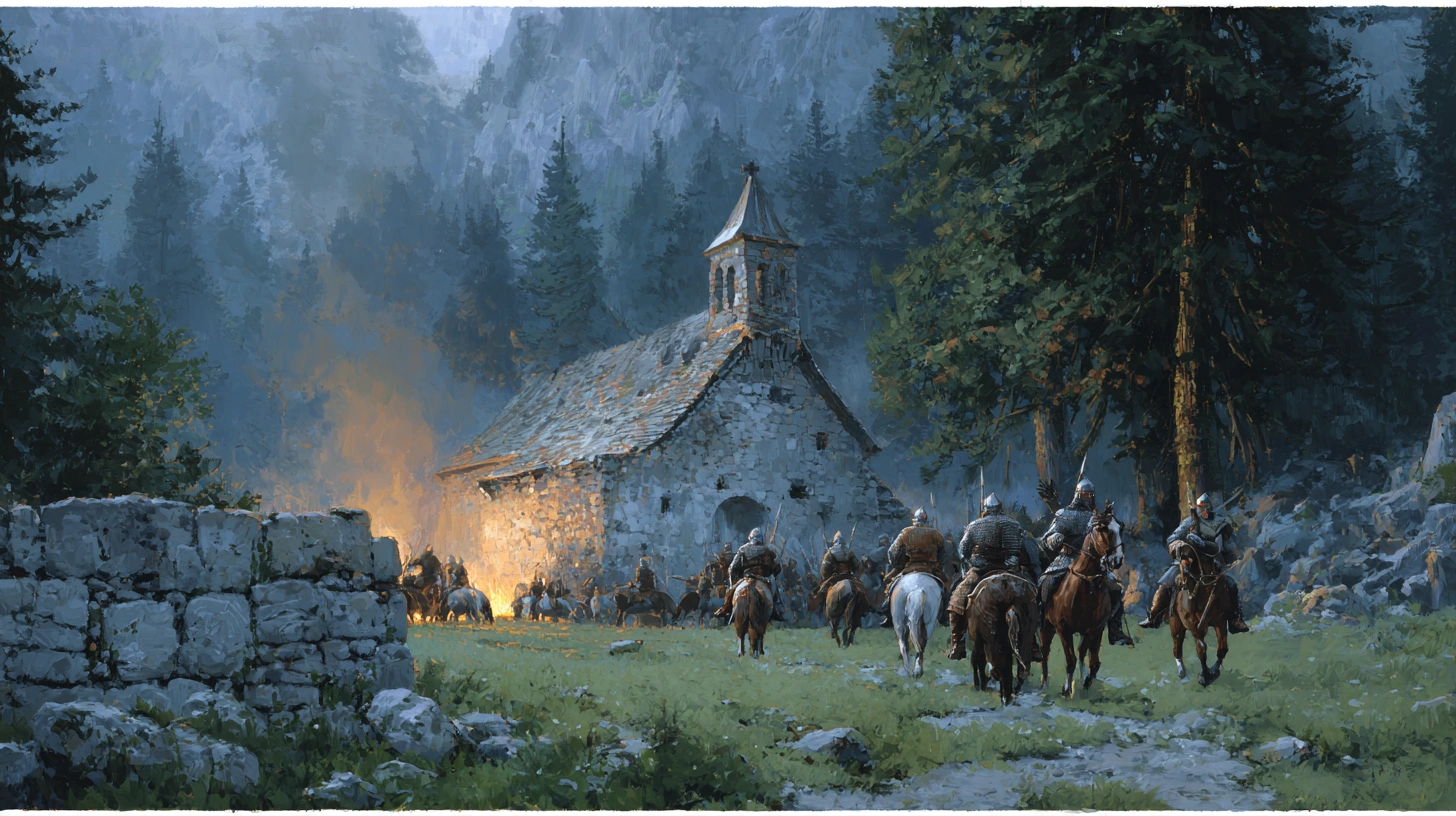
AI reconstruction, not a photograph.
On May 1, 926, raiders broke through the roof of a walled-up stone cell outside the Abbey of Saint Gall and killed the woman living inside it. She had known they were coming for almost a year, and had used that year to save a library instead of herself, a decision that would outlast her by more than a thousand years.
A Library Built Over Generations
By the early 10th century, the Abbey of Saint Gall, in what is now northeastern Switzerland, had become one of the great intellectual centers of early medieval Europe, its scriptorium famous well beyond the immediate region. Generations of monks had spent decades hand copying religious texts, classical works, poetry, grammatical treatises, and music manuscripts, building a collection that represented an almost unimaginable investment of labor and expense. Centuries before printing, every book on those shelves had been produced letter by letter on prepared animal skin, using pigments and inks that themselves had to be sourced and prepared by hand, a process that could take a single scribe months to complete for a single volume, and years for a heavily illustrated one. Losing that collection to fire or looting would not simply mean losing property. It would mean losing knowledge with no guarantee it could ever be recovered or recopied again, since in many cases the abbey’s own copies were among the only ones known to exist anywhere in Europe.
A Recluse Walled Into Her Cell
The woman who would end up saving that library was not, technically, a member of the monastery at all. Wiborada was born into a noble Swabian family, in what is now the canton of Aargau, and followed her brother Hatto to Saint Gall after a pilgrimage to Rome convinced him to become a monk there. Following her parents’ deaths, she joined the community herself as a Benedictine, but eventually chose a stricter form of religious life, becoming an anchoress, a recluse formally enclosed within a small cell attached to a church, in her case beside the church of Saint Magnus near the abbey. She lived there walled in, in near-total isolation, communicating with the outside world mainly through a small window cut into the cell’s stone wall, and developed a local reputation for healing and for prophecy that drew visitors seeking her advice, including, according to her later biographers, a young student named Ulrich whose eventual rise to become bishop of Augsburg she was said to have foreseen years in advance.

A Warning a Year Before the Attack
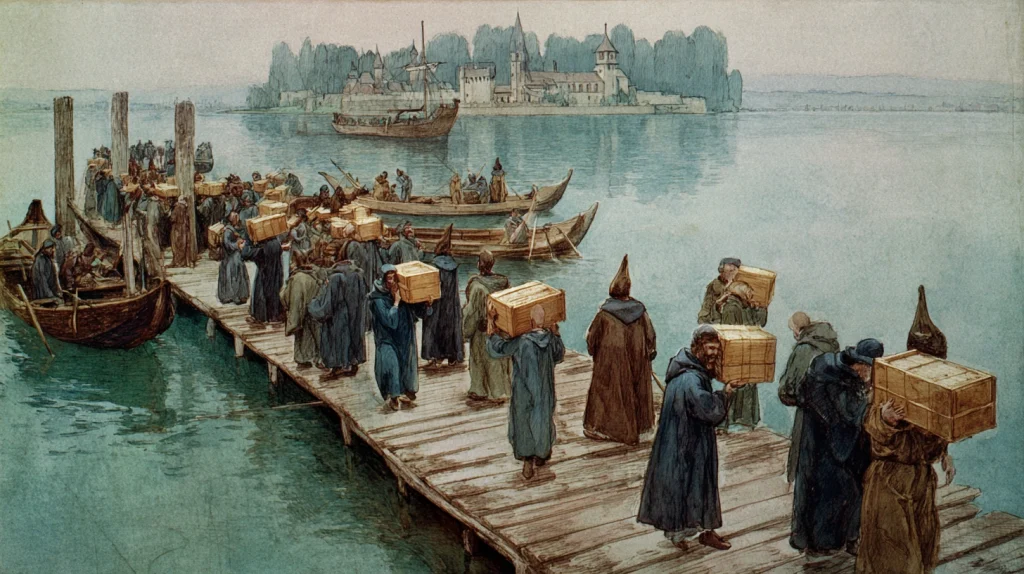
In 925, a year before the Magyar, or Hungarian, raiders who were striking deep into Central and Western Europe during this period reached Saint Gall, Wiborada predicted the coming attack. Abbot Engilbert, who led the monastery at the time, took the warning seriously and organized a staged evacuation rather than attempting to defend everything where it stood, a decision that split the community across three separate destinations depending on age, strength, and what each group was best suited to carry or protect. The elderly and the youngest members of the community were sent across Lake Constance to safety at Wasserburg. The stronger monks took refuge in a fortress built in the woods along the river Sitter, prepared to hold out if the raiders pushed further. And the abbey’s most valuable possessions, above all its manuscripts, were transported to the island monastery of Reichenau, well beyond the raiders’ likely reach and protected by the surrounding water of Lake Constance itself.
The Choice to Stay
Engilbert urged Wiborada to flee along with everyone else, aware of exactly what the approaching raiders had done to religious communities elsewhere in the region. She refused. Her life as an anchoress was built around a vow of stability and enclosure, a formal commitment to remain in her cell rather than move freely through the world even in the face of danger, and she chose to honor that commitment even with a raiding army approaching her own doorstep. According to the medieval biographies written about her in the following century, one by the monk Hartmann and a second, more detailed account by the monk Herimannus, she remained at prayer in her cell as the community around her emptied out, apparently untroubled by the choice she had made.
May 1, 926
When the Magyars reached Saint Gall, they burned the church and monastery of Saint Magnus, immediately adjacent to Wiborada’s cell, and broke through the roof of her enclosure to reach her directly. According to her biographers, she was killed while kneeling in prayer, struck down with an axe rather than given any chance to flee at the last moment. A companion who had joined her in religious life some years earlier, a woman named Rachildis whom Wiborada had reportedly cured of an illness, survived the attack and lived for another two decades afterward, though her own health problems eventually returned. The main abbey itself, emptied out on Engilbert’s orders and defended by the fortifications he had ordered built in advance, came through the raid largely intact, and its library, safely on Reichenau across open water, was untouched entirely.
A First Among Women
Wiborada’s death became part of Saint Gall’s institutional memory almost immediately, preserved in writing by monks who had every reason to remember exactly what her warning had made possible for the community they belonged to. More than a century later, in 1047, Pope Clement II formally canonized her, making Wiborada the first woman in history to be canonized through the Catholic Church’s official process, rather than simply venerated by local tradition, as many earlier saints, male and female alike, had been. She remains the patron saint of libraries and librarians in Switzerland and Germany today, a fitting title for a woman whose most consequential act was making sure a library survived a war she herself chose not to survive.
The collection she helped save is still there. The Abbey Library of Saint Gall holds one of the oldest and most significant assemblies of medieval manuscripts anywhere in the world, recognized today as a UNESCO World Heritage Site and still housed in a purpose-built Baroque hall that draws scholars and visitors from around the globe. It represents a direct, unbroken line running from a warning given in 925 to a reading room still standing, and still in use, nearly eleven centuries later, a survival owed in no small part to a woman who chose to stay behind rather than leave with everyone else.

