An Intact Wari Tomb in Lima Held the Lady of the Mask
Archaeology & Sites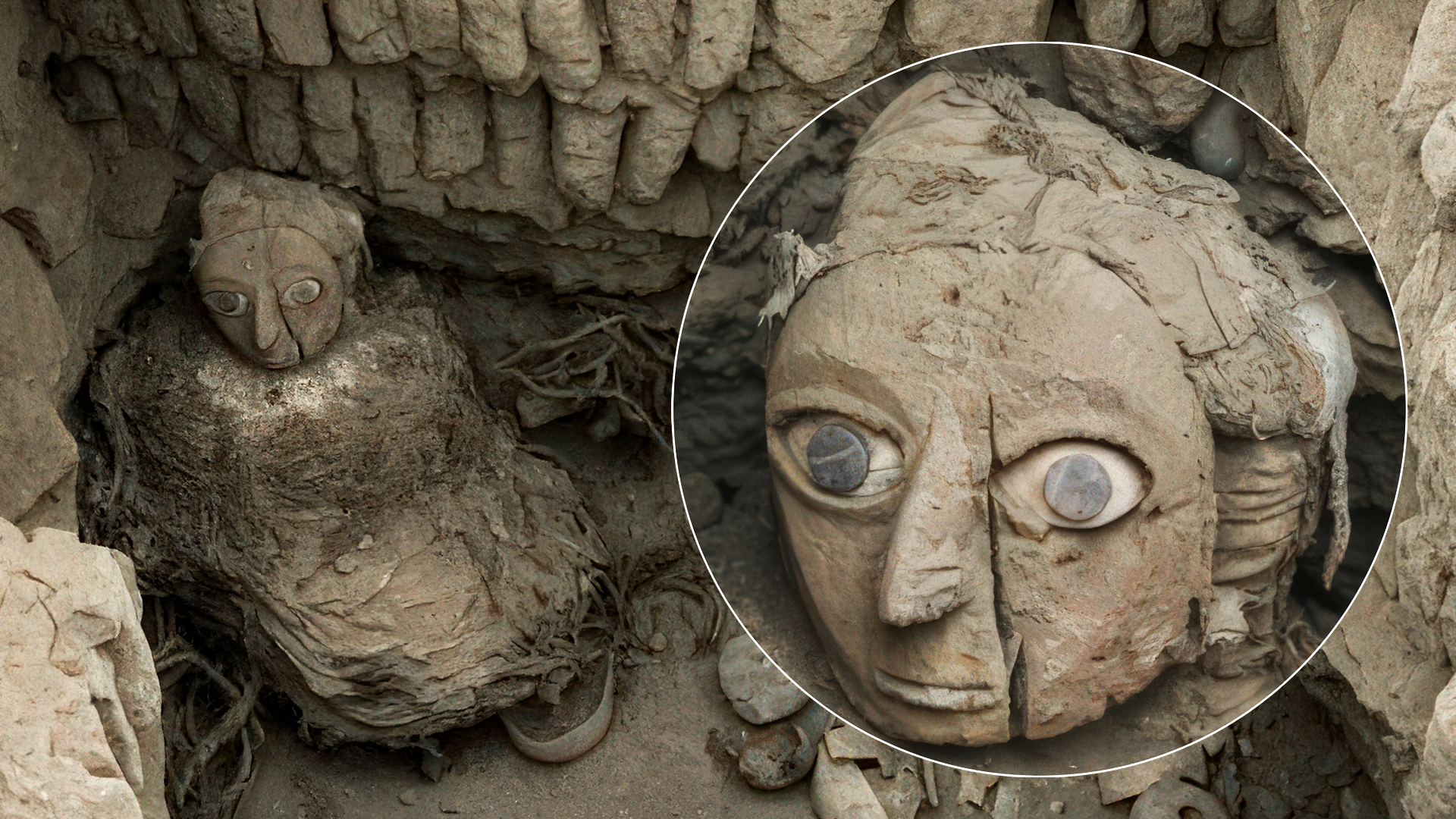
The funerary mask of a Wari woman who died and was buried some 1300 years ago in the area of Lima, Peru.
In August 2008, archaeologists at Huaca Pucllana, an adobe pyramid in Lima’s Miraflores district, announced an intact Wari tomb whose best-known bundle wore a woman’s funerary mask with huge, blue-toned eyes. The team nicknamed her La Dama de la Máscara, the Lady of the Mask. The eyes belong to the mask, not to the woman. Reports of the tomb disagree on its date, on the mask’s material and on how many bundles had faces, and this article sets out where they part.
A Pyramid Built by the Lima Culture
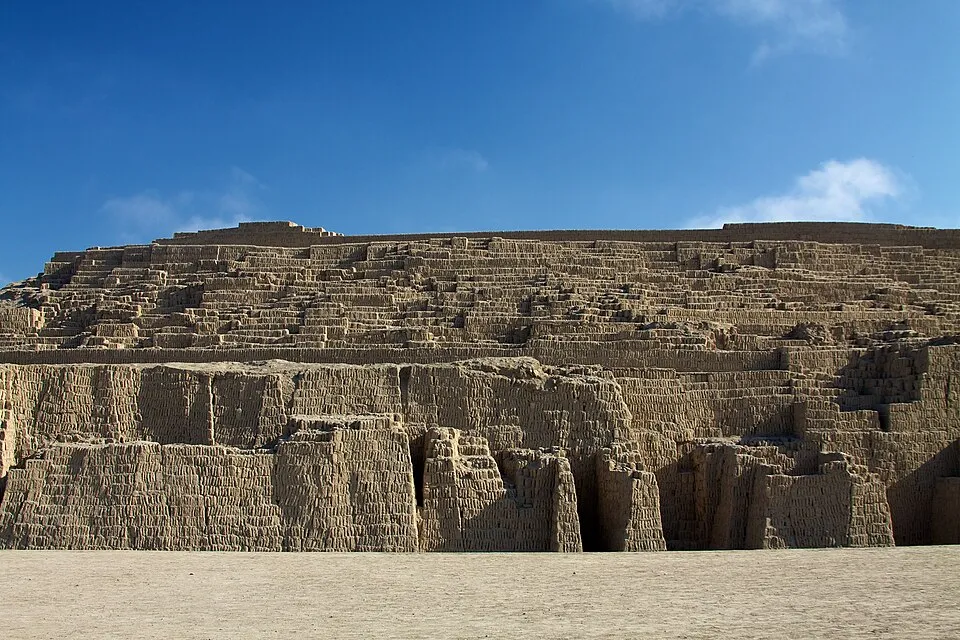
Huaca Pucllana is a ceremonial and administrative centre in the middle of modern Lima. Wikipedia’s article on the site credits the Lima culture with building the Great Pyramid and dates that culture from 200 to 700 AD. Other sources give other spans: Archaeology magazine has 450 to 700 AD, a team publishing in PLOS ONE labels the Lima period 500 to 700 AD, and the Colombian daily El Colombiano reported 200 to 500 AD in 2008. All of them place the pyramid before the tomb in question.
Wari Graves in an Older Sacred Place
The pyramid outlived its builders as a place of burial. Archaeology says the Wari conquered the area in the early eighth century, held it until about 1000 AD and used the site as a cemetery until the ninth century. The Wari were an Andean state centred on Ayacucho in the highlands, and AFP reported that its influence reached Lima and Ica. Gladys Paz Flores, writing in 2021, counts 82 Wari-period tombs in a cemetery between the fourth and sixth platforms of the Great Pyramid. A report on the 2013 find, carried by NBC News, gave about 70, so the count grows with excavation.
What the 2008 Tomb Held
What set the 2008 tomb apart was its condition. Isabel Flores, who directs the project at the site, told AFP that the team had found looted tombs there for years but never an intact one. AFP placed the find in the first week of August, and the announcement came on 26 August. Flores said of it, “This enriches Lima’s story.”
The reports disagree on the count. AFP, through La Nación, describes a multiple tomb with three funerary bundles, among them a woman and a sacrificed child. El Colombiano says each of three bundles held an adult buried in a fetal position, with the bones of a sacrificed child alongside. The History Blog lists a woman, two other adults and a child. Andina added that four more bundles had been noticed at the same spot. Archaeologists thought the child had been placed there as an offering.
Flores read the woman as a weaver from the textile tools around her, and a Peruvian Times report lists Wari garments called unkus and ceramic offerings.
The Mask and Its Eyes
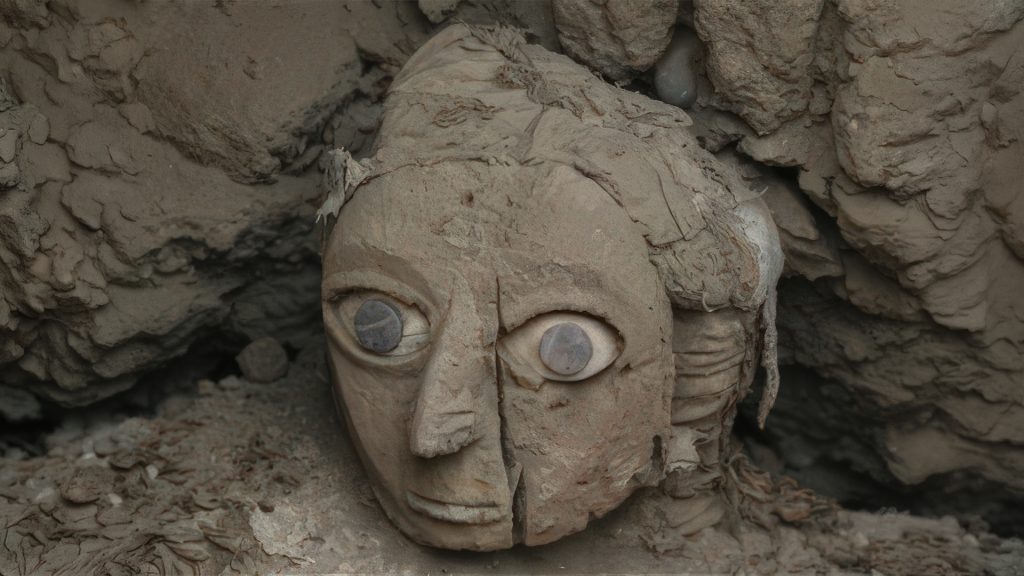
One bundle still had its mask. AFP described a funerary mask with a woman’s features, set at the front of the skull. Archaeology calls it a wooden mask with a feminine face and large blue eyes made of seashells. El Colombiano also reports blue-toned eyes and says Wari tradition made them from sea shells. Andina says the face was painted with strikingly large blue eyes, and a Peruvian Times report describes large eyes with white irises and black pupils. The descriptions do not match on colour or method, and the sources used here do not reconcile them.
A study of false heads hosted by Peru’s Ministry of Culture for Pachacamac describes carved and painted wooden false heads on the bundles of important people from the Middle Horizon, roughly the sixth to eleventh centuries AD, some with shell or valve eyes fixed with organic resin. It lists Ancón, Chimucapac, Pachacamac and Huaca Pucllana among central-coast sites where they occur. It does not describe the 2008 mask, so it shows only that shell eyes were an available choice.
A mask is an object made for a burial. Its eyes record how the mourners chose to show the dead, and they say nothing about the colour of the woman’s own eyes.
How the Bundles Were Made
Reports describe crouched bundles, with knees drawn up under the chin, wrapped in many layers of cloth. Archaeology says the woman’s bundle had six layers of cotton and llama-wool textiles.
Before any unwrapping, the team turned to X-rays. Andina reported on 4 September 2008 that the scans had been taken the day before, to show how the remains lay without cutting the bundles open.
Unwrapping came later. The abstract of an article by Gladys Paz Flores, published in Scientia in 2021, says the infant’s burial was excavated in 2008 and its bundle unwrapped in 2011 by a team of archaeologists, bioanthropologists and curators. The part of the abstract seen here does not give the findings.
Wari, Not Ychsma
The burial belongs to the Wari period. The Ychsma, spelled Ichma in some texts, came afterwards. The PLOS ONE authors date the Ychsma period at the site to 1000 to 1450 AD, and El Colombiano put the Ichma about three centuries after the Wari arrival around 700 AD.
The bundle is sometimes said to be an Ichma tomb from Ancón. The sources used here do not trace that claim, but they place the 2008 burial in a Wari-period tomb at Pucllana, in Lima, which rules it out. Ancón is a separate coastal site north of Lima, listed in the false-head study only as another place where such faces occur.
What DNA Says About the People
The wider question is what the Wari presence meant for the people of the coast. Guido Valverde of the University of Adelaide and colleagues, with Isabel Flores Espinoza among the authors, published an answer in PLOS ONE in 2016. They sequenced 34 complete mitochondrial genomes from people buried at Huaca Pucllana in three periods: Lima (500 to 700 AD), Wari (800 to 1000 AD) and Ychsma (1000 to 1450 AD).
Genetic diversity shifted only slightly through time. The authors read that as arguing against a complete break or replacement of the population under Wari rule, at least around present-day Lima, and a Popular Archaeology summary says they favour cultural diffusion as the way Wari influence spread.
They add cautions. The Wari genetic contribution at this site was very subtle and may not represent the whole Wari territory on the central coast, and mitochondrial DNA traces only maternal lines. Valverde said the site “provides the exceptional opportunity to study 1000 years of pre-Inca history.” The sources used here do not say whether the 2008 bundles were among the 34 individuals.
What the Record Does and Does Not Say
The record supports an intact Wari-period tomb found at Huaca Pucllana in 2008, the first of its kind at the site, with a masked woman, a child offering and other bundles that were X-rayed, one of them, the infant’s, unwrapped in 2011. It leaves three points open.
The first is the date. The 2008 reports called the remains about 1,300 years old, which points to around 700 AD, while the scientific literature labels the Wari period at the site 800 to 1000 AD. A 2009 Archaeology summary gave 1,700 years, which would predate the Wari and conflicts with every other report. No radiocarbon date for the 2008 bundles appears in the sources used here.
The second is the faces. Every 2008 report examined here describes one mask. Wikipedia’s article on the site describes a tomb it calls the Señor de los Unkus, with three shrouds holding three adults, two of them masked, and a sacrificed child. It gives no source for the passage and does not link the tomb to the 2008 find, so two bundles with faces remains unconfirmed for the tomb of the Lady of the Mask.
The third is which tomb is which. A 2011 Archaeology report describes an undisturbed Wari tomb with four bundles, which does not match the three of 2008, and a 2013 find on the sixth platform held an adult and an infant.
Taken together, the sources describe a different chapter of pre-Inca Peru: an older sacred pyramid turned into a cemetery for people tied to the Wari world. The Lady of the Mask records that chapter in a face made for the dead.

