Why the Gods Chose Enkidu, Not Gilgamesh, to Die
Texts & Traditions
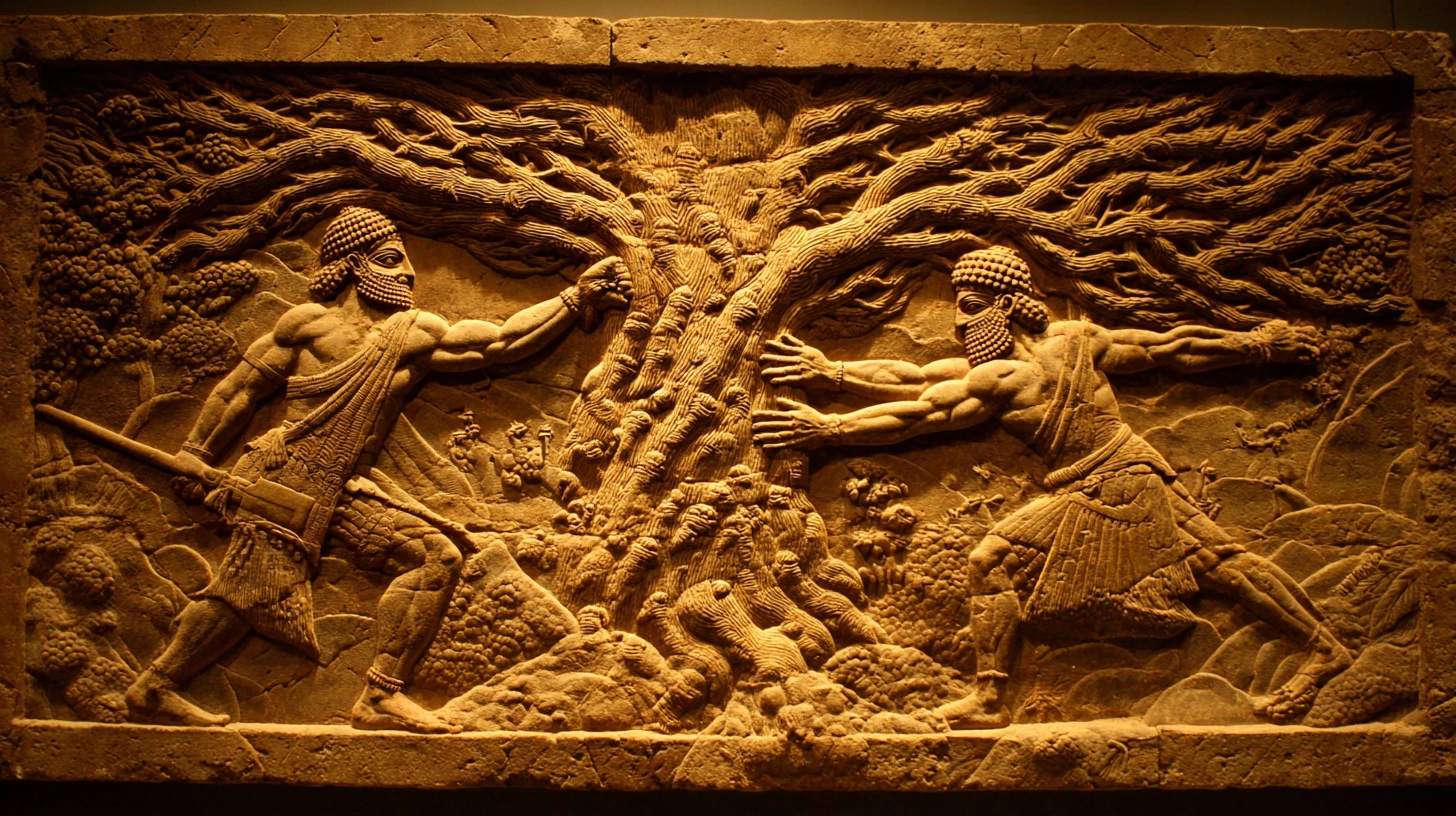
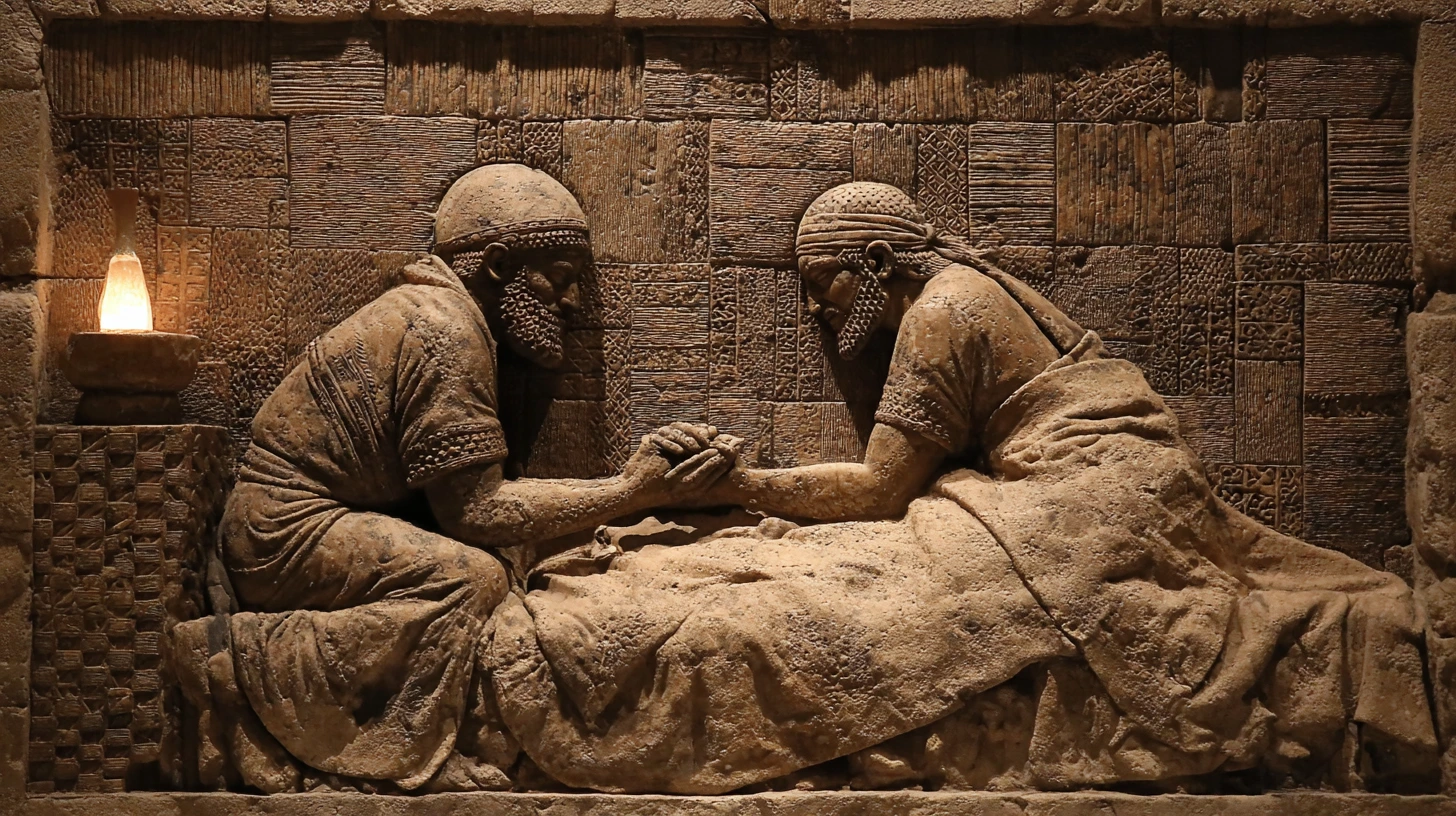
AI reconstruction, not a photograph.
Gilgamesh and Enkidu killed Humbaba together. They killed the Bull of Heaven together. Both acts were joint decisions, carried out by two men acting as one. Yet when the gods met to decide a punishment, only Enkidu was sentenced to die.
By the time that verdict comes down, the two men have fought side by side through two of the epic’s biggest set pieces. They traveled to the Cedar Forest and killed its guardian, Humbaba, together, ignoring his pleas for mercy. Back in Uruk, when the goddess Ishtar proposed marriage to Gilgamesh and he refused her with a string of insults, she sent the Bull of Heaven down to punish the city, and the two friends killed that as well, again as a pair, again by mutual decision. Neither killing was committed by one man alone or against the other’s advice. That is precisely what makes the gods’ verdict, when it comes, so jarring.
A Verdict Delivered in a Dream
The scene arrives in Tablet VII of the standard Babylonian epic, as a dream Enkidu describes to Gilgamesh the morning after he has it. In the dream, the gods Anu, Enlil, Ea, and Shamash sit in council. Anu opens the case plainly: because the two men killed the Bull of Heaven, and because they killed Humbaba, guardian of the cedar forest, one of them must die.
It is Enlil, lord of the earth and Humbaba’s own patron, who answers the question of which one. He does not weigh their individual actions or ask who struck the final blow. He simply rules: Enkidu must die, and Gilgamesh shall not.
Shamash Speaks for the Defense
Shamash, the sun god, objects immediately. He had helped the two men defeat Humbaba himself, sending thirteen winds against the monster, pinning him in place so that Gilgamesh and Enkidu could close in and finish the fight. Shamash’s argument to Enlil is direct: it was by his own command that Humbaba and the Bull of Heaven were killed, so how can Enkidu now be called guilty and die for it?
Enlil’s reply is not an argument on the merits. He turns on Shamash in anger, accusing him of behaving less like a god and more like a third companion who marched alongside the two men every day of their journey. The rebuke ends the debate. Shamash does not answer again, and the verdict stands. A price will be paid, Enlil makes clear, regardless of who helped, or how.
Two Kinds of Creation
The epic itself never states, in so many words, why the sentence lands on Enkidu rather than Gilgamesh. Readers and scholars have puzzled over that silence for as long as the tablet has been read. But the poem gives its audience everything they need to answer the question themselves, because it has already told them, in its opening lines, exactly what each man is made of.
Gilgamesh is introduced as two-thirds god and one-third human, the son of the goddess Ninsun. That divine share of his blood is not incidental description; the epic returns to it whenever Gilgamesh’s survival or status is in question. Enkidu has no such share. He was formed by the goddess Aruru out of a pinch of clay, thrown into the wilderness, and raised running with gazelles, drinking at the watering hole with wild herds, before the temple woman Shamhat found him and brought him into the world of cities. He is fully a creature of the earth, with no divine parent to weigh in on his behalf.
Before the two men ever set out for the cedar forest, Ninsun tried to close that gap. In a ceremony at her temple, she formally adopted Enkidu as her own son, hanging a pendant around his neck and asking Shamash to watch over him as he already watched over Gilgamesh. For the length of the journey, Enkidu is treated, ritually, as if he belonged to the same family as the king he serves. But an adoption performed by a goddess in a temple is not the same thing as birth from a goddess’s body, and when the assembly convenes in Tablet VII, it is blood, not ceremony, that the gods honor. When Enlil chooses between the two friends, the poem has already made clear that only one of them was ever entirely killable.
A Monster’s Curse
The dream is not the only place the epic points its audience toward this outcome. Dying at Gilgamesh’s hand, Humbaba curses the two men as his last act, and the curse is specific: he prays that Enkidu will die in agony, and that Gilgamesh will be left alive to grieve him, inconsolable. It is a monster’s dying wish, not a divine ruling, but it lands on the same division the gods later confirm. Even the epic’s villain, in his final breath, seems to understand which of the two friends the world will actually let die.
A Verdict Without an Argument for Fairness
What the epic never does, at any point, is claim that the outcome is just. Enlil offers no defense of the distinction he draws between the two men beyond the fact that he has drawn it. Shamash’s objection, that both men acted under divine sanction and so neither should be singled out, is not refuted, only shouted down. The poem lets that imbalance sit in plain view rather than resolving it, which is part of what makes the scene so unsettling nearly four thousand years later.
Enkidu, for his part, does not argue that the verdict is fair either. When he wakes and tells Gilgamesh the dream, his reaction is grief, not protest. He weeps, calling Gilgamesh his brother, and mourns that he will never see him again, rather than insisting the gods reconsider. He then falls ill and spends his final days cursing, one by one, the events that led him to this point: the cedar door he built with his own hands, the trapper who first found him at the watering hole, and the woman Shamhat, who brought him out of the wild and into a life where friendship with a king, and a king’s fate, were even possible.
Read against the fight in the cedar forest and the assembly that follows it, the shape of the story becomes hard to miss. Two men do the same thing, for the same reasons, with the same god’s help. One of them walks away because of what runs in his blood, inherited from a mother who was a goddess. The other dies because his mother was clay, and no one in the assembly was obligated to speak for him. The epic does not ask its audience to accept that this was fair. It only asks them to watch Gilgamesh accept that it was final, and to understand that a friendship between an unequal pair can end with only one side of it paying the price.

