A Sumerian Poem About One Human Language Predates Genesis
Biblical History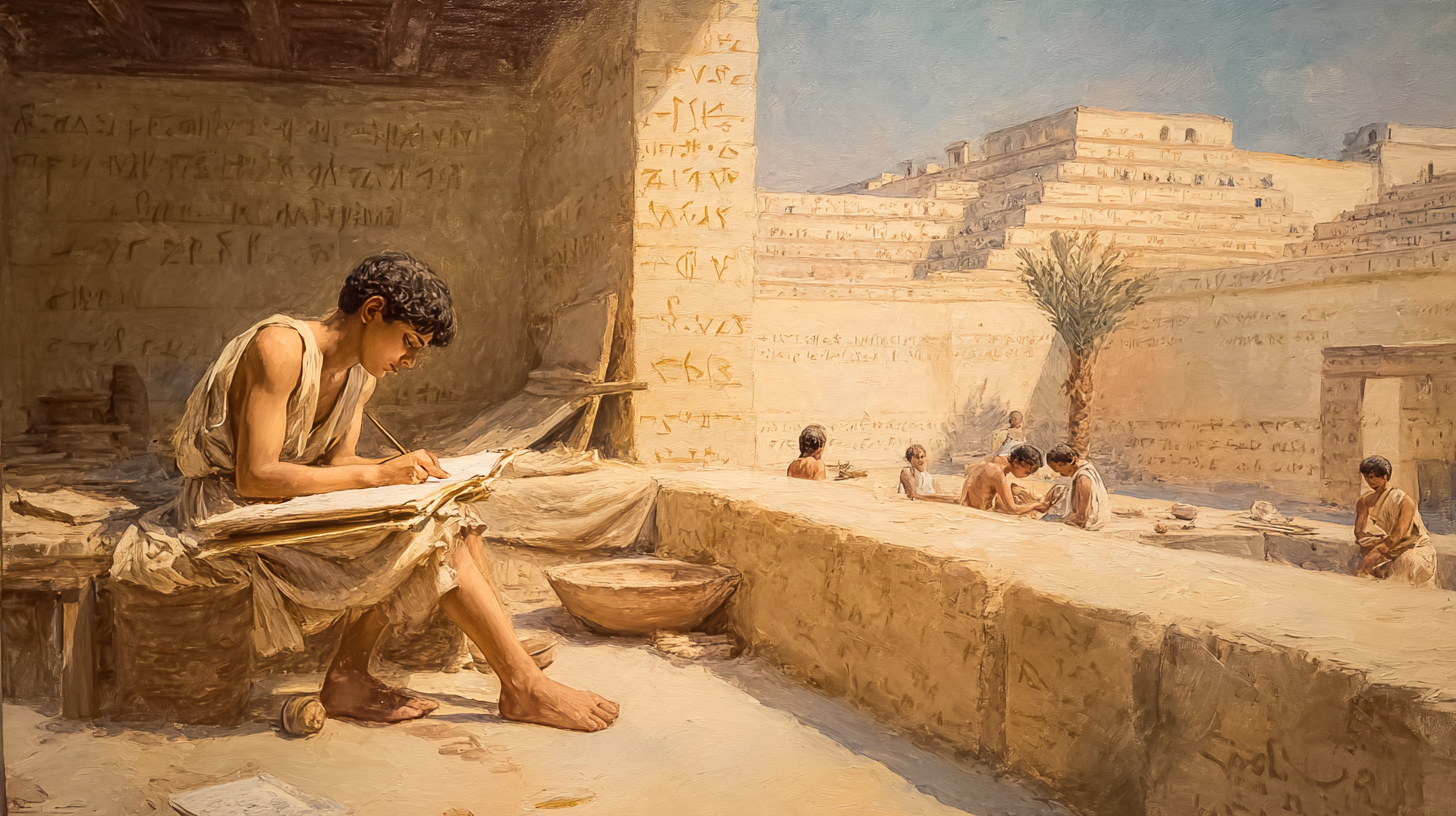
AI reconstruction, not a photograph.
Some 3,800 years ago, scribes in southern Mesopotamia were pressing into clay a poem in which a king tells his messenger to chant a spell about one human language. The poem is Enmerkar and the Lord of Aratta. Scholars think it was composed more than 4,000 years ago, and the tablets that carry it were written over a thousand years before Genesis took its present form. What the spell means is still disputed.
A Contest Between Two Kings
The poem is a contest between rulers. Enmerkar, lord of Unug (Uruk), wants gold, silver, lapis lazuli and stone from the distant land of Aratta to build up the shrines of Eridug and Unug. His patron, the goddess Inana, advises him to send an eloquent messenger with terms: submit and pay tribute, or be destroyed. The messenger travels by night and day, delivers the message, and is answered with defiance, and the contest runs on from there. The Oxford edition of the text, the Electronic Text Corpus of Sumerian Literature, runs to about 640 lines, with a few lost. Later tradition remembered Enmerkar as an early king of Uruk, and reference works place his reign around 2750 BC, though that figure belongs to tradition and not to documented history.
The poem is one of four in a cycle called the Matter of Aratta. Scholars think the cycle took shape in the Ur III period, roughly 2112 to 2004 BC, possibly in the reign of King Shulgi of Ur. The copies come later, from the scribal schools of Nippur and Ur in the early second millennium BC, where the Aratta poems were among the texts pupils copied late in their training. One clay fragment from Nippur, now in the Penn Museum in Philadelphia, preserves parts of two columns of the poem and is catalogued as Old Babylonian, about 1900 to 1600 BC.
Nudimmud’s Spell
Enmerkar does not rely on threats alone. The lines just before the spell threaten Aratta with ruin and compare it to a settlement Enki once cursed, so the god of the spell has already appeared in the message as a god who curses. Then, in the passage numbered 134 to 155 in the Oxford edition, Enmerkar tells the messenger to chant the incantation of Nudimmud, a name of the god Enki, to the lord of Aratta.
The spell opens on a time with no snake, no scorpion and no fear. It names lands from Sumer and Akkad to the Martu country, and calls Shubur and Hamazi “the many-tongued.” It asks that all of them address Enlil “together in a single language.” Enlil came first in the god lists of the period, and his great temple, the Ekur, or “Mountain House,” stood at Nippur, the same city whose school copied the poem. Then Enki, lord of Eridug and god of wisdom, “shall change the speech in their mouths,” and “the speech of mankind is truly one.”
That is how the Oxford translation reads it: a wish, with Enki making speech one. In 1968 the Assyriologist Samuel Noah Kramer read the same lines the other way. He took them as the memory of a golden age in which humanity spoke one tongue until Enki brought contention into its speech, and he called the result a Sumerian “Babel of tongues.” The Sumerian has been translated both ways. On Kramer’s reading Enki divides. On the Oxford reading he reunites. Either way the change is a god’s decision and not an accident.
Genesis 11 and the Tower
Genesis 11 opens with a world where “the whole earth was of one language, and of one speech” (King James Version). People settle on a plain in the land of Shinar, the biblical name for Babylonia, and decide to build “a city and a tower, whose top may reach unto heaven.” The LORD comes down, confuses their language and scatters them (Genesis 11:1–9). The story ends with a name: the place is called Babel, the Hebrew name of Babylon, because the LORD “did there confound the language of all the earth.”
Many scholars link that tower to Etemenanki, the temple-tower of Marduk at Babylon, whose Sumerian name means temple of the foundation of heaven and earth. Its base measured about 91 metres on each side. The version whose remains survive was built by the Neo-Babylonian kings Nabopolassar and Nebuchadnezzar II in the late seventh and early sixth centuries BC, and Nebuchadnezzar’s own inscription for the tower says he raised the summit so that it would “rival the heavens.” The link is the leading view and not a settled one. Takayoshi Oshima argues instead that the tower alludes to Esagila, the temple whose building is told in the Babylonian creation epic Enuma Elish, and reads the Babel story as a polemic against Babylon’s Marduk-centred worldview.
What the Parallel Shows, and What It Does Not
The two texts share a motif. Each imagines humanity with a single language and a god who acts on its speech, and each belongs to Mesopotamia. That is what the sources used here establish.
They do not say that Genesis drew on the poem. The poem names two gods, Enlil and Enki, where Genesis names one. In the lines that carry the spell no tower is raised to heaven, and the spell is one piece of a message between rival kings. On one reading Enki ends unity, on the other he restores it, while in Genesis God divides a people who are building a city. Scholars place the final shaping of the Babel story in the first millennium BC, some as late as the fifth century, so the poem is older by well over a thousand years. Chronology does not show how an idea could travel from a Sumerian school to a Hebrew author, or whether it travelled at all.
The Poem That Invents Writing
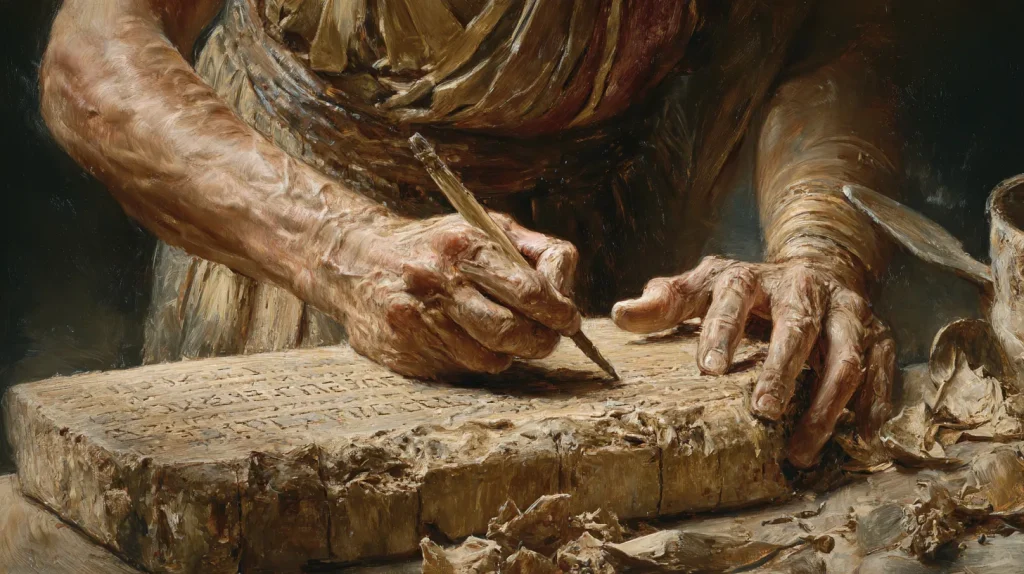
The poem has a second idea that fits oddly well with the tablets that preserve it. When the long message proves too much for the messenger to repeat, Enmerkar sets it down on clay, and the poem presents this as new (lines 500 to 514 in the Oxford edition). That is a story the Sumerians told about their own craft. Archaeology puts the first accounts on clay at Uruk from about 3300 BC, long before any poem. Still, a poem about a king pressing words into wet clay survives on pressed clay, copied by pupils who were learning to do exactly that.
What the Clay Settles
The date of the copies is a fact about the clay. They were written in the early second millennium BC, long before Genesis took its final shape. What the poem meant to the people who wrote it down is a question the tablets leave partly open. The Oxford translation hears a hope, and Kramer heard a memory. Either way, a tablet from southern Mesopotamia holds the idea of a single human language, divided or waiting to be reunited, and neither reading proves a link to Babel.

