Alexander Braced for a Siege, Then Obeyed Babylon’s Priests
Biblical History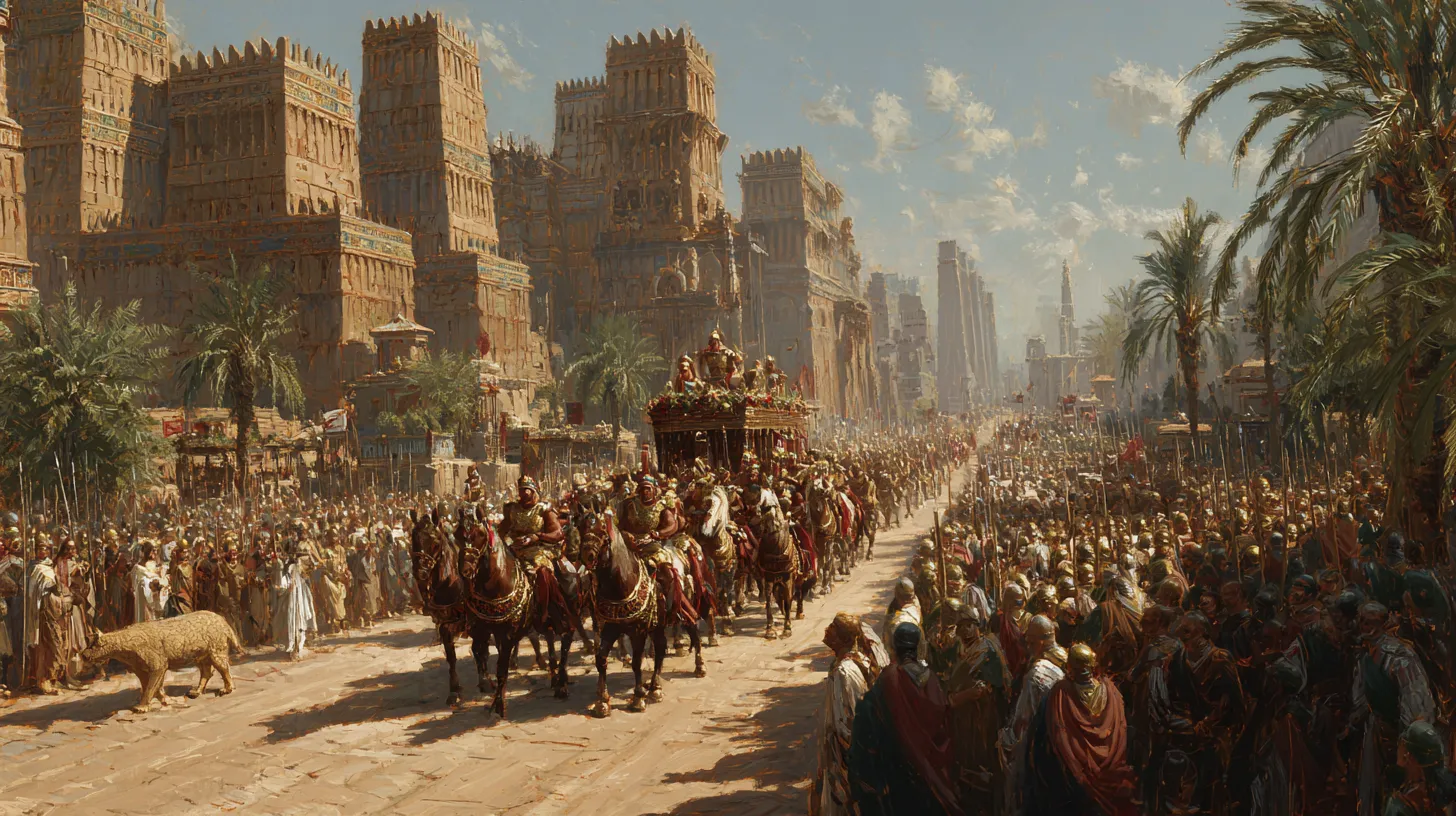
AI reconstruction, not a photograph.
Alexander the Great entered Babylon in October 331 BC with his column drawn up for battle, found the city already surrendered, and then did what its priests told him. He sacrificed to the city’s god, ordered its ruined temples rebuilt, and left behind a plan for the great tower that ended only with his death in 323 BC.
A City That Had Already Surrendered
Alexander had broken the Persian army at Gaugamela on 1 October 331 BC and marched south to Babylon, one of the great cities of the Persian empire. At Sippar, to the north, he announced that Babylon would not be plundered. The Persian satrap Mazaeus, who had escaped from Gaugamela, hurried to the city to prepare its surrender, and had sent his son Antibelos off with Darius so that the family would survive whatever happened, according to the historian Ernst Badian. The Roman historian Curtius Rufus, writing centuries later, says Mazaeus came out to meet Alexander as a suppliant, with his grown children, and gave up the city. Alexander welcomed him gladly, Curtius says, because a siege of so large and well-fortified a place would have been hard. He still formed his column into a square and ordered his men into the city as if for battle (Curtius 5.1.17–19). Badian, reading a Babylonian astronomical diary, dates his arrival to 20 October.
The Babylonians had prepared a welcome. The commander of the citadel and treasury, Bagophanes, covered the road with flowers and garlands and set up silver altars heaped with incense. Caged lions and leopards came as gifts, and Magi, Chaldaeans, Babylonian priests and musicians walked in procession (Curtius 5.1.20–22). The Chaldaeans were priests of Esagila, the temple of Marduk, and were known as astronomers. Badian described the greeting as a ceremony “developed long ago for greeting its conquerors.” A fragmentary Babylonian astronomical diary from the period calls Alexander “king of the world,” a title Assyrian and Babylonian kings had used for centuries. The same title is used of Cyrus the Great in a Babylonian text, the Verse Account of Nabonidus, and an essay in the Harvard Center for Hellenic Studies research bulletin argues the echo is deliberate, a way of placing Alexander in the line of Cyrus and the older Babylonian kings.
What the Priests Told Him
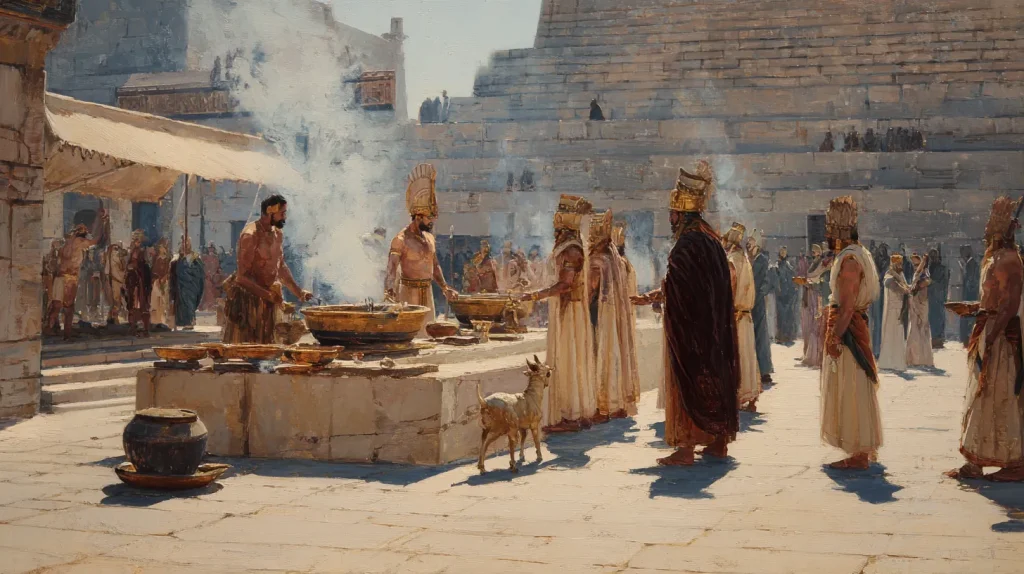
The Greek historian Arrian, writing in the second century AD, reports that Alexander ordered the temples Xerxes had wrecked to be rebuilt, above all the temple of Bel, the god the Babylonians honoured most. Bel, “lord,” was the title by which Marduk, the city’s chief god, was known. He met the Chaldaeans, Arrian says, and did what they told him about the city’s temples, sacrificing to Bel by their instructions (Anabasis 3.16). What those instructions were is not recorded. The sources used here give no content for them beyond the sacrifice itself.
Alexander did not install a Macedonian governor. He made Mazaeus satrap, the first Iranian he appointed to that office, and left the army and the citadel garrison under a Macedonian commander. Badian says that at Babylon Alexander first acted as Great King, and that a promise to restore Esagila would have been welcome to the priests and the people.
A Tower in Ruins
Beside Esagila stood Etemenanki, the ziggurat whose Sumerian name means house of the foundation of heaven and earth. Greek and Roman writers call it the temple or the tomb of Belus. Its base measured about 91 metres on each side, and its latest version came from Nabopolassar and Nebuchadnezzar II in the late seventh and early sixth centuries BC. Arrian describes the temple as a huge structure of brick set in bitumen, and says Xerxes destroyed it after returning from Greece, about a century and a half before Alexander arrived. Strabo repeats the story with the words “as it is said.”
Modern historians doubt how much of that is true. Badian called the story, at the least, “grossly exaggerated,” and noted that the temple was certainly in some disrepair, because the Persians had taken its revenues for the king. Archaeologists and historians still argue about how much of the damage was Xerxes’ work and how much was neglect.
The Size of the Job
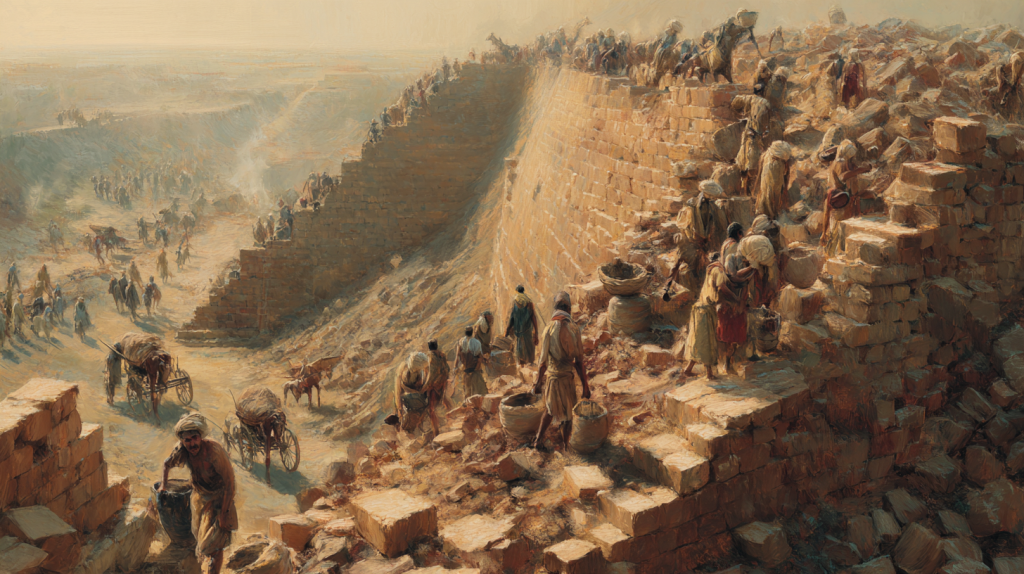
Strabo, writing about three centuries after Alexander’s death, says Alexander meant to repair the tower, a square brick structure a stadium high with sides a stadium long. The mound of fallen brick alone, he says, was “a task for ten thousand men for two months.” That figure was recorded long after the event, and it measures the job. It is not a count of workers who did it.
Arrian says accounts differed on whether Alexander meant to rebuild on the old foundations or to build something larger. He adds a detail about the labour. After Alexander left Babylon in 331, the workmen who had been ordered to clear the site slowed down, and in 323 Alexander proposed to put his own soldiers on the job (Anabasis 7.17).
Relations with the priests were less simple by then. As he approached the city in 323, Chaldaean seers met him and warned, in Bel’s name, that entering Babylon would be fatal. Arrian says Alexander suspected the warning was about money. The god’s old endowments, which had paid for the temple’s upkeep and sacrifices, were in the Chaldaeans’ hands because the ruined temple needed none of it, and a rebuilt temple would claim them back (Anabasis 7.16–17). That is Arrian’s explanation, written centuries later, and not an established motive.
The Work That Ended With Him
Alexander died in Babylon on 11 June 323 BC, aged 32. Strabo says his illness and death ended the work, and that his successors took no interest in it. He blames the Persians, time and Macedonian indifference for the ruin of the city, and notes that when Seleucus fortified Seleuceia on the Tigris, the royal residence moved there and Babylon declined further.
The Babylonian record points the same way. In the Ruin of Esagila Chronicle, a Seleucid prince, most likely Antiochus, the son of Seleucus I, has his elephants help remove the debris of Esagila, and falls on the ruin while making offerings, which the tablet’s editor reads as a bad omen. The tower is not what that tablet concerns. A royal cylinder dates the start of repairs on Esagila and its sister temple Ezida at Borsippa to 27 March 268 BC, and it too leaves the tower out. The sources used here record no later rebuilding of Etemenanki, and no decree or prohibition against it survives. The record simply stops.
What the record shows is a conqueror who treated the tower as a duty owed to the city and its god, and a project that ended with him. No source used here records a ban, a curse or a decision to drop the plan.

