Abram’s Night Attack in Genesis 14: Risks and Rewards
Biblical History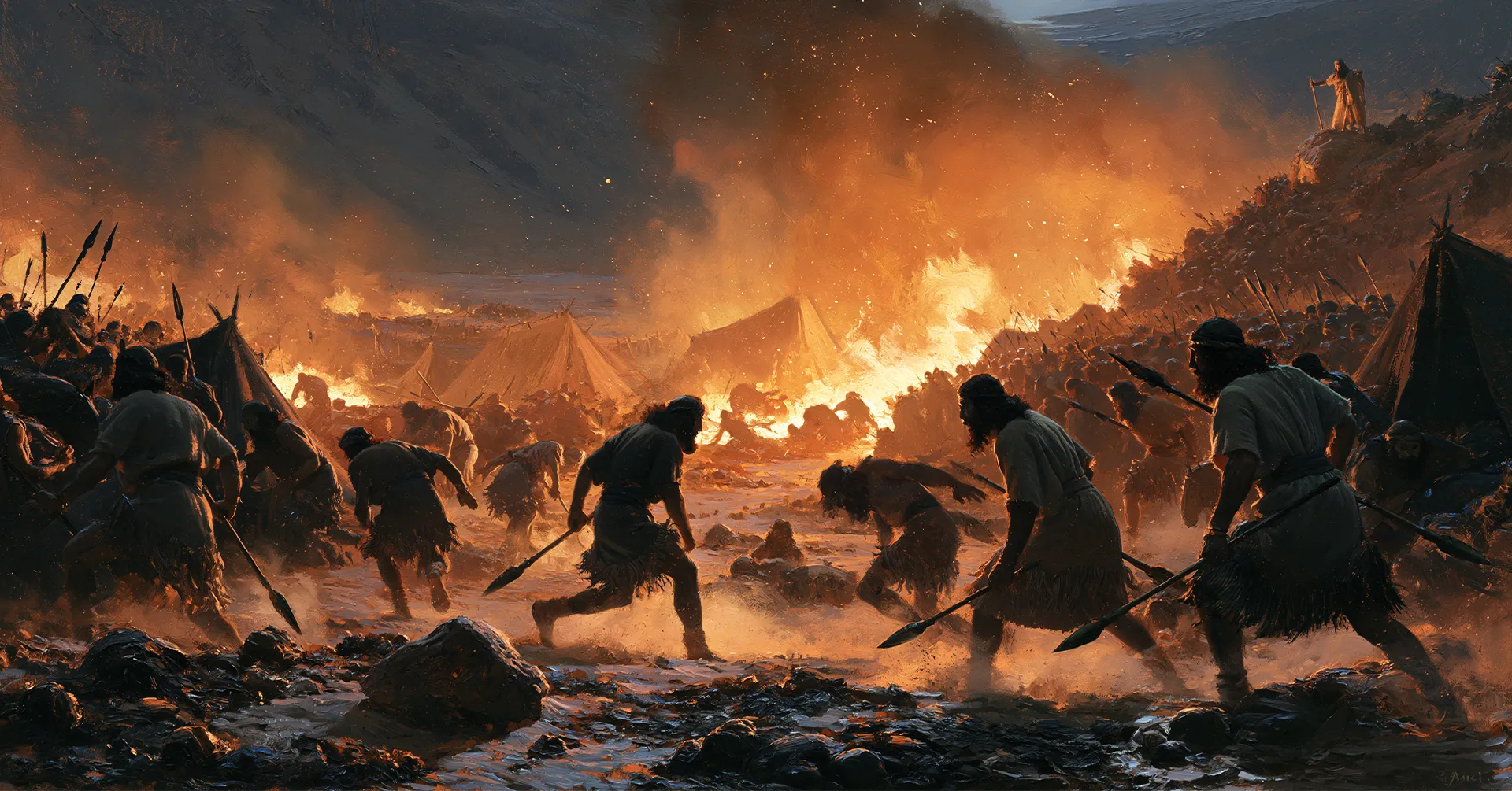
AI reconstruction, not a photograph.
Genesis 14:15 reports Abram’s attack on the invading kings in a single sentence. He “divided himself against them, he and his servants, by night”, struck them and pursued them “unto Hobah, which is on the left hand of Damascus”. The text gives no date, no account of the fighting and no list of losses. This article sets out what the verse says, why Greek writers treated night fighting as dangerous, what darkness could give a small force, what was at stake for Abram and what the text leaves out.
What the Verse Says
The verse turns on one verb. The King James Version has Abram “divided himself”, and English versions read that in different ways. According to the Bible Study Tools website, the NIV has him divide “his men to attack them”, the ESV says he “divided his forces”, the CSB says he and his servants “deployed against them by night” and the NIRV says he “separated his men into groups”. A translators’ handbook by William Reyburn and Euan Fry, published by the United Bible Societies, reads the phrase as Abram splitting his men into smaller units. It does not say how many units there were, and neither does Genesis.
The force was small. Abram “armed his trained servants, born in his own house, three hundred and eighteen” (14:14), and verse 24 names the allies who went with him, Aner, Eshcol and Mamre. Beyond that the verse is silent. It does not say where the attack fell, how long it lasted or whether the invaders had set a watch. It says only that Abram “smote them” and went on to pursue them.
Why Night Fighting Was Feared
Greek writers say plainly what could go wrong. Thucydides describes the Athenian night attack at Epipolae, outside Syracuse, which ended in an Athenian defeat. He describes it as the only night engagement “which occurred between great armies during this war”. In the Henry Dale translation on the Perseids site, he asks of such a fight, “how could any one have a distinct knowledge of any thing?” Even with a bright moon, he says, the soldiers could see only enough to “discern the form of the body before them”, and so “mistrust their knowledge of its being that of a friend”. The Athenians were “in much disorder and perplexity”.
Commanders weighed the choice as well. The World History Encyclopedia, drawing on Arrian, says that before the battle of Gaugamela the general Parmenio urged Alexander to attack the Persians by night, and that Alexander refused because it “would mean to steal a victory”. The same page says the Persian soldiers stayed awake “fearing a night attack that never came”. These are Greek accounts of other wars in other centuries. The sources consulted for this article include no Near Eastern writer who discusses night attacks in the same way, so they show how such an attack looked to Greek observers and not what Abram’s contemporaries thought.
What Darkness Could Give a Small Force
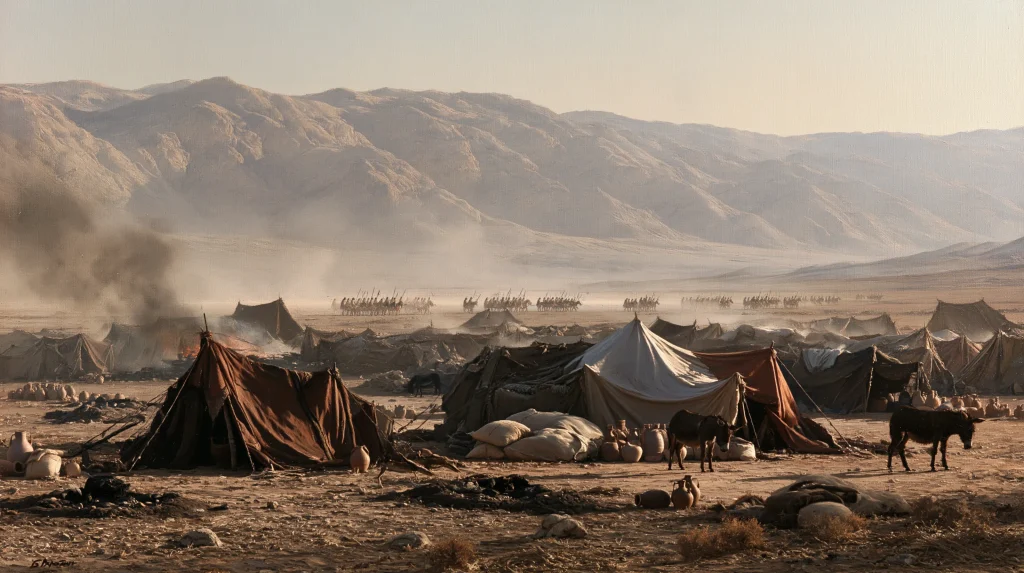
The same darkness could help an attacker who kept control. Xenophon, in Carleton Brownson’s translation, says that “a Persian army at night is a sorry thing”. The horses are tethered and usually hobbled, and a rider roused by an alarm has to ready his horse and his armour before he can fight, which is why the Persians “encamped at a considerable distance from the Greeks”. In Xenophon’s telling, a camp roused in the dark was slow to form up. Genesis does not describe the invaders’ camp, so this shows the kind of weakness an attacker might look for and not what Abram found.
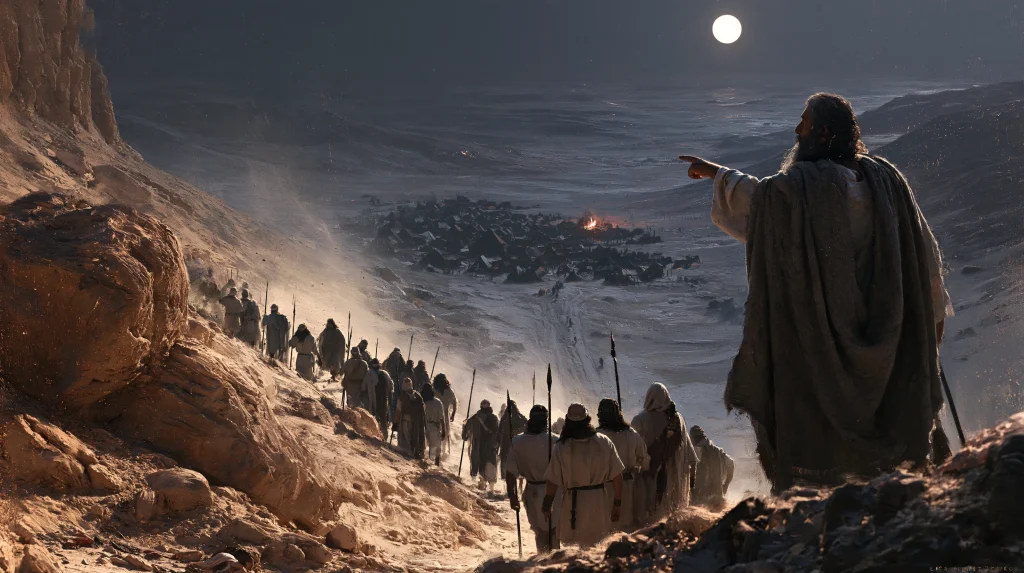
Israel’s own books tell of surprises at night and dawn. Gideon “divided the three hundred men into three companies” (Judges 7:16) and told them to blow the trumpets “on every side of all the camp” (7:18). He and his hundred men reached its edge “in the beginning of the middle watch”, and “all the host ran, and cried, and fled” (7:19-21). Verse 22 adds that “the LORD set every man’s sword against his fellow” throughout the host, so the story makes the enemy’s own confusion part of the defeat. Saul “put the people in three companies” and struck “in the morning watch” (1 Samuel 11:11). Joshua “came unto them suddenly” after going up “all night” from Gilgal (Joshua 10:9). These stories are set later than Abram and say nothing about how common such attacks were. Placing men on several sides may also make a small force look larger, but whether Abram’s division served that purpose, Genesis does not say.
For Genesis 14:15 itself, the translators’ handbook offers a reading: the night attack gave Abram’s men surprise and hid how few they were, and it compares Gideon’s division of his 300 men. The Encyclopedia of the Bible says Abraham and his band “defeated them in a surprise night attack”. Both are readings, since Genesis gives no reason for the timing.
Later tradition filled the silence in other ways. Josephus, in his Antiquities, says Abram “slew some as they were in their beds”, and does not say that he divided his men. The Babylonian Talmud (Sanhedrin 96a), as Wikipedia reports it, has Rabbi Yochanan read the verse to mean that Abraham attacked with the help of an angel called Night. Neither is a statement of the text of Genesis.
A Small Force Far From Home
The risk of failure was real. Genesis gives Abram the household’s trained servants and three allies, and the chase ran from the plain of Mamre “unto Dan” and on to Hobah. Nothing in the verses points to reinforcements, so a beaten force would have had little to fall back on. That is an inference from the text’s silence and not a statement in it.
The stakes were also personal. In Genesis 12:2 the LORD promises Abram “a great nation”, and in 13:16 promises to make his seed “as the dust of the earth”. In the next chapter Abram says “seeing I go childless” and “to me thou hast given no seed”, and that “one born in my house is mine heir” (15:2-3). In the story’s own terms, then, the promised line depended on a man with no child who led his servants into the dark. Genesis 14 does not mention the promise, and the opening of chapter 15, “Fear not, Abram: I am thy shield”, does not say what Abram feared.
What the Text Leaves Out
The verse reports an attack and a pursuit and stops there. It does not say whether any of Abram’s men died, how many invaders fell or what the fighting looked like. It does not say how the attackers found their way in the dark, how the companies kept together or what began the strike. It does not even say where the attack fell. Josephus places it “near Dan”, while the Encyclopedia of the Bible puts it “near Damascus”. Genesis names Dan before the attack and Hobah after it, and says nothing more.
Nor does the verse say that the invaders fled. That is an inference from the pursuit. A result is stated only later, when Abram brings back “the goods”, Lot, “the women” and “the people” (14:16). Everything said about tactics in this article beyond the division itself, including the surprise, is reconstruction from parallels and not a statement of the text.
What Can Be Said
Genesis 14:15 gives Abram’s night attack in a single sentence. Greek writers show how dangerous fighting in the dark could be, a translators’ handbook reads the darkness as cover for a small force, and later tradition adds details the verse never gives. What can be said plainly is narrow: a divided force, a night strike and a long chase north.

