The Chase to Hobah in Genesis 14: How Far Did Abram Go?
Biblical History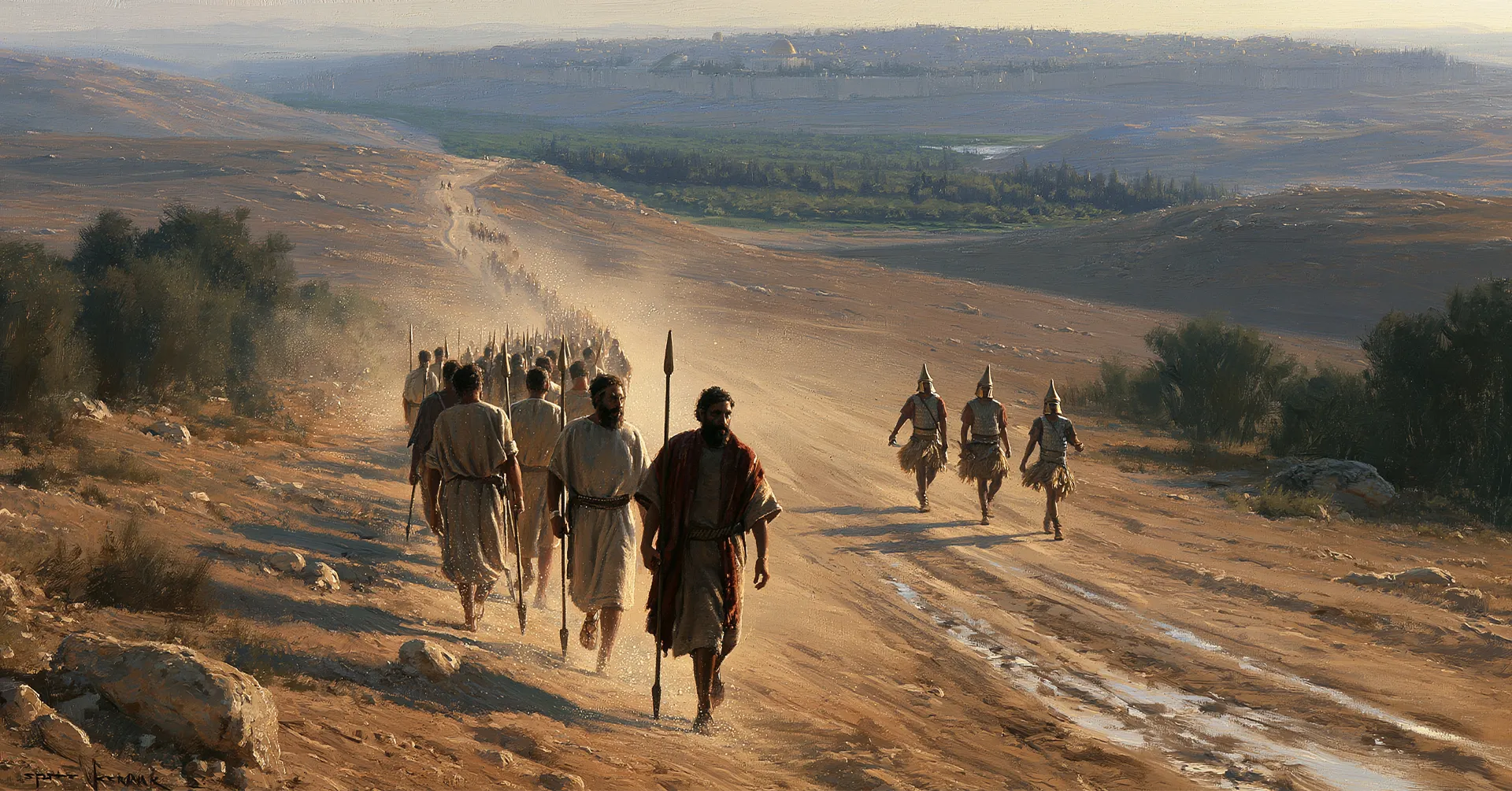
AI reconstruction, not a photograph.
The chase in Genesis 14 runs a long way in two short verses. Verse 14 says Abram “pursued them unto Dan”, and verse 15 says he pursued them “unto Hobah, which is on the left hand of Damascus”. The text gives no date and no timeline. This article sets out the two place names, measures the distance from Mamre, looks at where Hobah might have been and asks what the pursuit means in a story about a promised land.
The Two Place Names
Of the two names, Dan is the better known. Judges 18:27-29 says the tribe of Dan took the city of Laish and “called the name of the city Dan, after the name of Dan their father”, adding that “the name of the city was Laish at the first”. An entry signed W. Ewing on the Bible Hub atlas site gives the older name as “Laish or Leshem” and points to Tell el-Qady, “in the plain West of Banias”. It calls Dan the “northern limit of the land of Israel”, the point in the phrase “from Dan even to Beersheba” (Judges 20:1), and says Abraham pursued Chedorlaomer’s army to this district. Wikipedia says a gate there, estimated to date from about 1750 BCE, is popularly called Abraham’s Gate, a name it links to Genesis 14:14. A popular name is not evidence that Abram passed through it, and the chapter does not mention a gate.
That raises a problem, because a name from a later conquest appears in Genesis 14. A paper hosted on the Dr Barrick website, which does not name its author, lists three explanations. The first, from Earl Kalland’s commentary on Deuteronomy, is that the Dan of Genesis 14:14 “was a place in the north of Gilead”, though Kalland grants that no such Dan is known from other sources. The second, credited to Robert Dick Wilson, is that the same cuneiform signs could be read as Laish or, after the Danite conquest, as Dan. The third, which the paper ties to Eugene Merrill, is that a later hand updated the name, since “some of these place names are latter additions to the text”. The paper treats the first two as viable and rejects the third. The measurements below assume the Dan in the north.
Measuring the Distance
Genesis 13:18 places Abram “in the plain of Mamre, which is in Hebron”, so Hebron is a fair starting point. Wikipedia says the Hebron of the Israelites was centred on Tel Rumeida, with its ritual centre at Elonei Mamre, so the starting point is only approximate. Using the coordinates on the Wikipedia pages for Hebron, Tel Dan and Damascus, the straight-line distances are about 198 km from Hebron to Tel Dan (123 miles), about 248 km from Hebron to Damascus (154 miles) and about 68 km from Tel Dan to Damascus (42 miles). These are crow-flies figures calculated for this article, and any real route would be longer. On the usual reading, which takes “on the left hand” as north, Hobah lies beyond Dan, so the full chase was longer still.
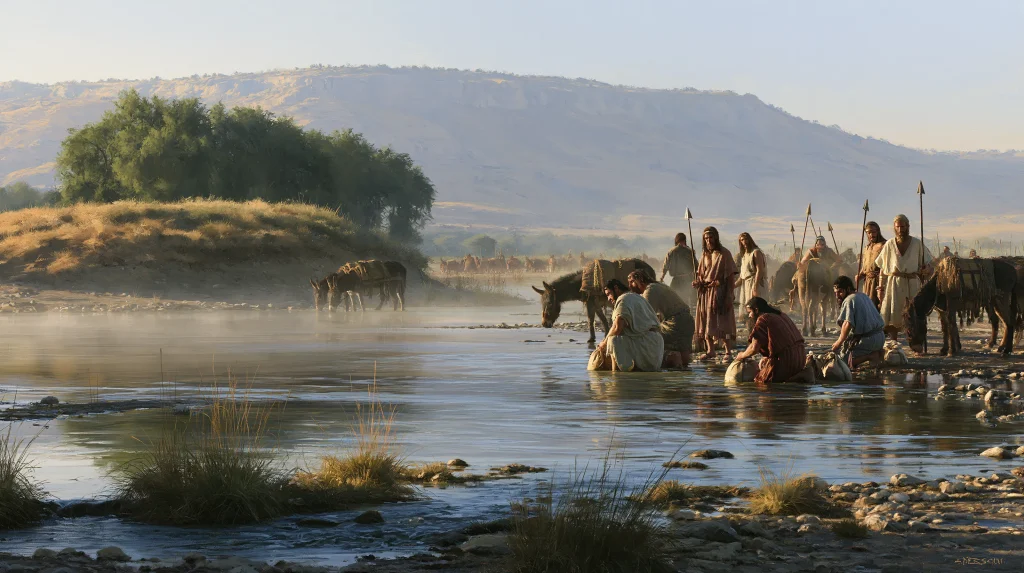
Josephus supplies a timeline that Genesis lacks. In his Antiquities, Abram “marched hastily” and fell on the enemy “the fifth night”, near Dan, “for that is the name of the other spring of Jordan”. Then he pursued them until, “on the second day”, he “drove them in a body unto Hoba, a place belonging to Damascus”. Read literally, 198 km in about five days is nearly 40 km a day in a straight line, and the 68 km from Dan to Damascus in two days is about 34 km a day, if Hoba lay near the city. That is arithmetic on a later retelling and not a measurement from the text. Genesis does not say how many days passed, how the men travelled or how large the invading force was.
Where Was Hobah?
Hobah is harder. Wikipedia says “no identification is certain”, and a United Bible Societies translators’ handbook agrees: “various places have been identified as Hobah, there is no certainty”. The handbook adds that this is the only reference to Hobah in the Bible. Wikipedia says the Hebrew Masoretic Text and the Greek Septuagint both put Hobah “to the left” of Damascus, which is generally translated as north, as in the Aramaic Targum Onkelos.
The commentator Antoine Augustin Calmet, whose commentary Wikipedia dates to 1730, noted that Hobah was “to the left of the road that leads to Damascus”. He argued that if Hobah lay north of the city the text would simply say “beyond Damascus”, as in Amos 5:27, and he identified it with Abila of Celesyria, which Wikipedia places at the village of Souq Wadi Barada, about twelve miles north-west of Damascus. Johann Jakob Wettstein identified Hobah with the modern Ḥoba, which he placed sixty miles north of the city. Richard von Riess’s Bible Atlas of 1895, as Wikipedia quotes it, puts Hobah “west of Karyetain, 111 kilometers northeast of Damascus”. The proposed sites therefore run from north-west of Damascus to north-east of it.
Treating sixty miles north as due north of Damascus, Wettstein’s site would lie about 337 km (209 miles) from Hebron in a straight line, a rough figure. The Genesis Apocryphon, an Aramaic retelling found in Cave 1 at Qumran, renders the name as Helbon, which Wikipedia says identifies it with the city in Ezekiel 27:18. The Book of Judith (15:5) has the enemy cut down “as far as Choba”. Wikipedia says Calmet and George Leo Haydock identified that place with Hobah and that the identification “has some credibility”, since the Septuagint Greek of Genesis 14:15 spells the name almost identically.
Damascus in the Story
Damascus is the landmark in the verse. Wikipedia says Genesis 14:15 mentions it as “existing at the time of the War of the Kings”. Its lead says the city was first settled in the third millennium BC, though its body says there was no large-scale settlement within the walls until the second, and a list of Thutmose III from the fifteenth century BC names it. Genesis gives no date for the war, so none of this dates the chase. Wikipedia also quotes Nicholas of Damascus, in the fourth book of his History, as saying that Abraham “reigned at Damascus”, and that a village was named after him, “The Habitation of Abraham”. Damascus appears again in the next chapter, when Abram calls his steward “this Eliezer of Damascus” (15:2). Genesis does not connect the two mentions and says nothing of Abraham ruling there.
A Chase Beyond the Promised Land?
The pursuit takes the war far to the north. In Genesis 13:14-15 the LORD tells Abram to look “northward, and southward, and eastward, and westward”, and says “all the land which thou seest, to thee will I give it”. Genesis 15:18 later sets the land “from the river of Egypt unto the great river, the river Euphrates”, which is far wider than the Israel later described as “from Dan even to Beersheba” (1 Kings 4:25). Whether Hobah lies inside the promised land therefore depends on which boundary is meant. Placed at or beyond Damascus, it lies outside the later limit at Dan, but it could lie within a frontier drawn at the Euphrates.
Some readers link the chase to the promise in Genesis 12:3, “I will bless them that bless thee, and curse him that curseth thee”. That is an interpretation, since Genesis 14 does not mention a promise during the fighting. The nearest the chapter comes to naming God’s part is Melchizedek’s blessing after the battle: “which hath delivered thine enemies into thy hand” (14:20).
What Can Be Said
Genesis 14:14-15 records a pursuit that ran some 200 km in a straight line to Dan alone and then on to a Hobah that cannot be placed with certainty. The text gives no timeline, and the links to the promised land are readings. What can be said plainly is narrow: a long chase, a vague destination and an enemy driven off the map.

