Spoils of War in Genesis 14: What Abram Brought Back
Biblical History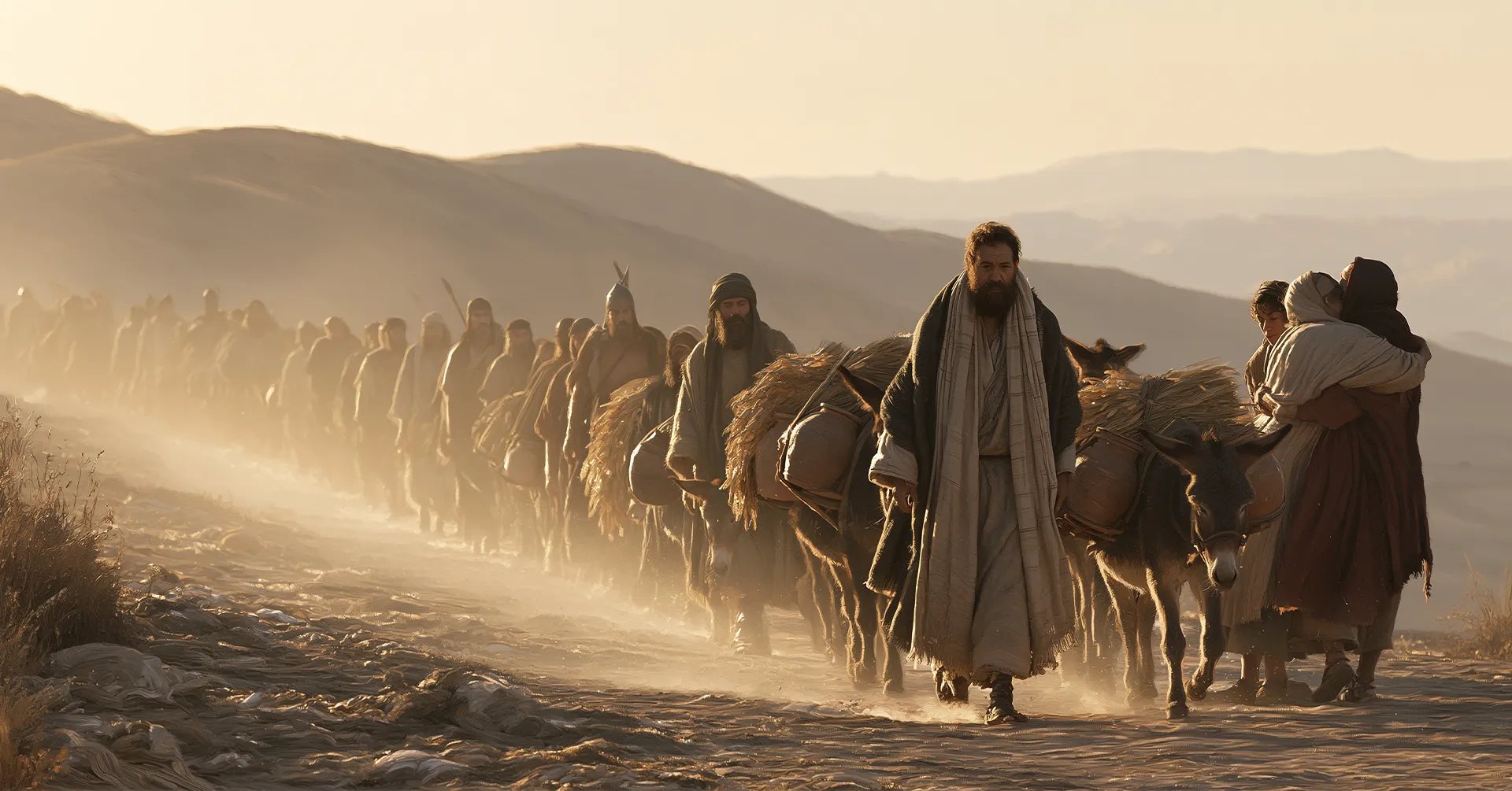
AI reconstruction, not a photograph.
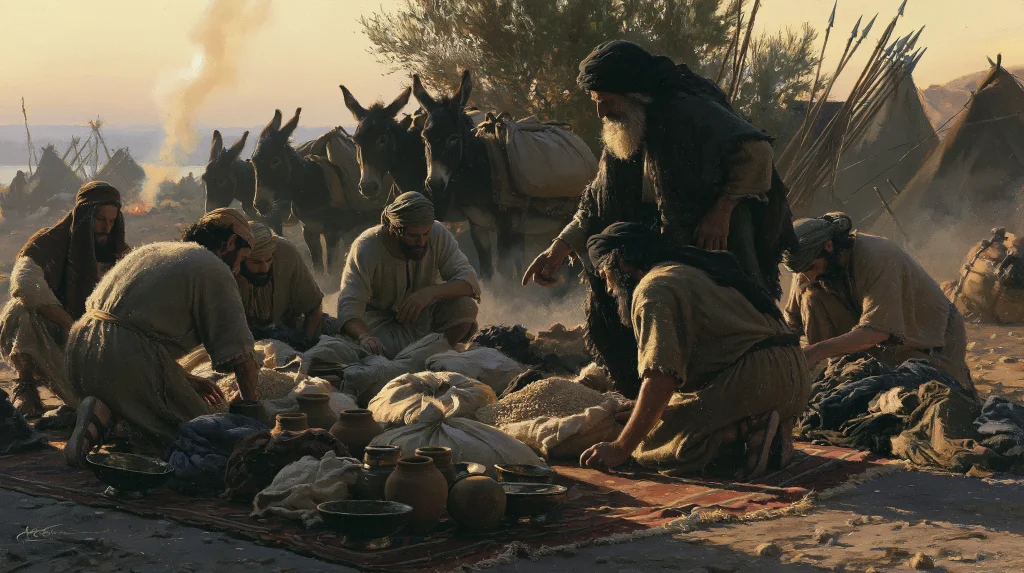
Genesis 14 shows spoil changing hands twice. The invading kings “took all the goods of Sodom and Gomorrah, and all their victuals” (14:11), and Abram, after defeating them, “brought back all the goods” and “brought again his brother Lot, and his goods”, with “the women also, and the people” (14:16). The text gives no date and no count of the goods or the people. This article sets out what the chapter records, how spoil was claimed and divided in the records of Egypt, Anatolia, Assyria and Israel, what Abram refused to keep and what the story leaves unsaid.
What Genesis Records
The sequence is quick. A fugitive brings Abram the news that Lot is a captive (14:13-14). Abram arms his “trained servants, born in his own house, three hundred and eighteen”, pursues the invaders and strikes them by night (14:14-15). His force includes allies, since verse 24 refers to “the men which went with me, Aner, Eshcol, and Mamre”. Then verse 16 describes the recovery.
Two details stand out. The first is the word “all”. The recovery is presented as complete, and the text lists categories without numbers: the goods, Lot and his goods, the women and the people. The second is how the battle is summed up. Verse 17 refers to it as “the slaughter of Chedorlaomer, and of the kings that were with him”, and the king of Sodom goes out to meet Abram at “the valley of Shaveh, which is the king’s dale”. Yet verse 10 had said the kings of Sodom and Gomorrah “fled, and fell there”. The text does not say how a king of Sodom comes to meet Abram afterwards.
Spoil in the Ancient Near East
Records from the region show spoil being assigned and not simply grabbed. Ahmose, son of Ebana, an Egyptian soldier who served under a king of the same name, left an autobiography. In M. Lichtheim’s translation, as reproduced on the Ancient Egypt Online website, he says of the capture of Avaris, “I brought spoil from there: one man, three women”. The next line reads “His majesty gave them to me as slaves”. After the siege of Sharuhen he reports that “the gold of valour” was given to him and that “my captives were given to me as slaves”. The spoil is a personal reward from the king, and in this case a small one.
Hittite practice shows the same concern with who could keep what. A 1963 study of Hittite warfare by V. Korošec, in the journal Iraq, says in a footnote that the army took booty even in earlier times, and that Mursili II later “more often tolerated the appropriation of booty (deportees, cattle and sheep)” by an official called the Bēl madgalti, by the chief of one region and by the army itself. The word “tolerated” suggests that the king’s permission governed who kept booty, but that is a reading of a footnote and not a finding about Genesis.
An Assyrian record shows captives being put to use. Sargon II’s annals, as quoted on the COJS website, say that after he took Samaria he carried off its inhabitants and “formed from among them a contingent of 50 chariots”. People carried off as booty could be turned into soldiers. None of these records comes from the setting of Genesis 14, which the text leaves undated, and they come from different centuries. They show how spoil was handled in other times and places, not what happened to Lot.
Israel’s Rules for Dividing Spoil
Israel’s own books record rules and cases of dividing spoil. Numbers 31:26-27 orders a count of “the prey that was taken, both of man and of beast”, and its division “into two parts”, between “them that took the war upon them” and “all the congregation”. A levy comes out of both halves: “one soul of five hundred” from the warriors’ share, given to the priest Eleazar, and “one portion of fifty” from the people’s share, given to the Levites (31:28-30).
First Samuel 30 describes a recovery much like Abram’s. David pursues Amalekite raiders who had carried off the families of his men, and the text says “David recovered all” (30:18-19). Some of the men who went with him wanted to keep the spoil from the two hundred who had been too faint to follow. David ruled that “they shall part alike”, and the text says this became “a statute and an ordinance for Israel” (30:21-25).
Genesis has a case of its own. In Genesis 34:27-29 the sons of Jacob take “all their little ones, and their wives” captive after the sack of Shechem, and “spoiled even all that was in the house”. These passages are set later in the biblical story than Abram, so they show how Israel’s books treat spoil and not a rule that Genesis 14 itself invokes.
Offer, Oath and Shares
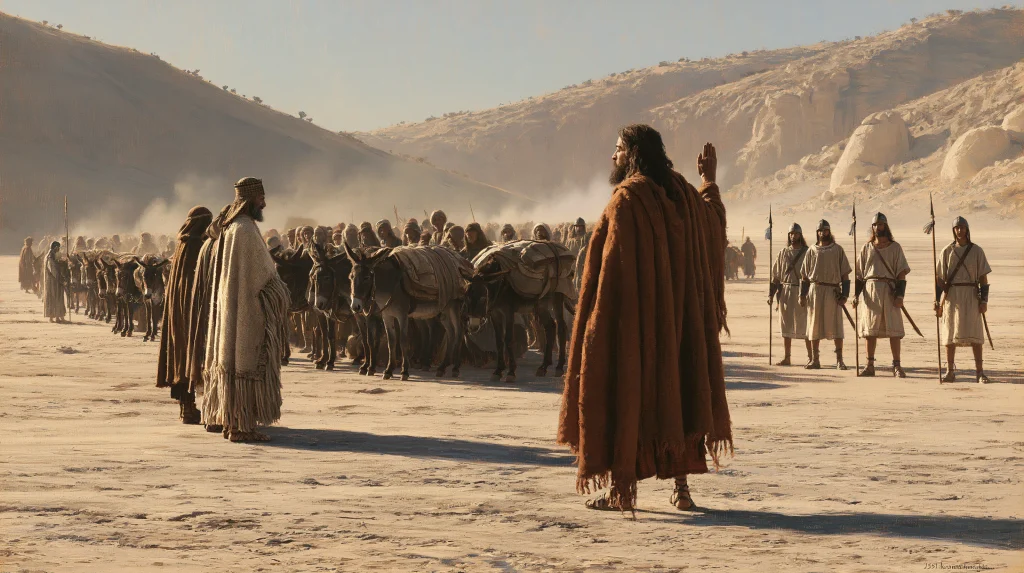
Genesis 14 states no rule about spoil, but the king of Sodom’s words seem to assume one. He tells Abram, “Give me the persons, and take the goods to thyself” (14:21). The offer treats the goods as the victor’s to dispose of and asks only for the people. That is a reading of the verse, and it fits the records above.
Abram answers with an oath: “I have lift up mine hand unto the LORD, the most high God” (14:22). He will not take “from a thread even to a shoelatchet”, “lest thou shouldest say, I have made Abram rich” (14:23). Two things are excepted: “that which the young men have eaten”, and “the portion of the men which went with me, Aner, Eshcol, and Mamre”, who may “take their portion” (14:24). Abram gives up his own claim and leaves his allies free to claim theirs. That matches the idea in Numbers 31 and 1 Samuel 30 that those who took part in a campaign receive a share, although Genesis does not make the connection.
One gap remains. The text never narrates what became of the recovered goods. It says only what Abram will not keep. The natural reading is that the goods went back to their owners, but the verses do not say so.
The scene between the victory and the oath, Melchizedek’s blessing, deserves its own treatment. In it Melchizedek brings bread and wine and receives “tithes of all” (14:18-20), and Hebrews 7:4 calls that gift “the tenth of the spoils”, a larger share than the levies in Numbers 31.
The Cost the Text Does Not Record
The grim side is easy to miss in a story that ends well. The people Abram brought back had been taken in a war between kings, and verse 4 puts the rebellion on the kings, not on the townspeople. The chapter says nothing about what the captives suffered on the road or about their condition when they were found. The invaders’ end is told in a few words: Abram “smote them” (14:15), and verse 17 speaks of “the slaughter”. The text gives no casualty figures.
The records above are far more precise. Ahmose counts the four captives he received at Avaris, and Sargon’s annals count thousands. Apart from the kings, the only people counted in Genesis 14 are Abram’s 318 servants. That leaves the reader with categories of loss and rescue: goods, a nephew, women and “the people”. The text gives no measure of either.
What Can Be Said
Genesis 14:16 records a recovery described as complete, with no figures and no account of what the captives endured. Records from Egypt, Anatolia and Assyria show spoil assigned by kings, Israel’s books show it divided by rule, and Abram refuses a share for himself while leaving his allies theirs. What can be said plainly is narrow: a war’s loot, taken and then retaken, with a family member among it.

