Nebuchadnezzar and Saddam Both Put Names on Babylon’s Bricks
Biblical History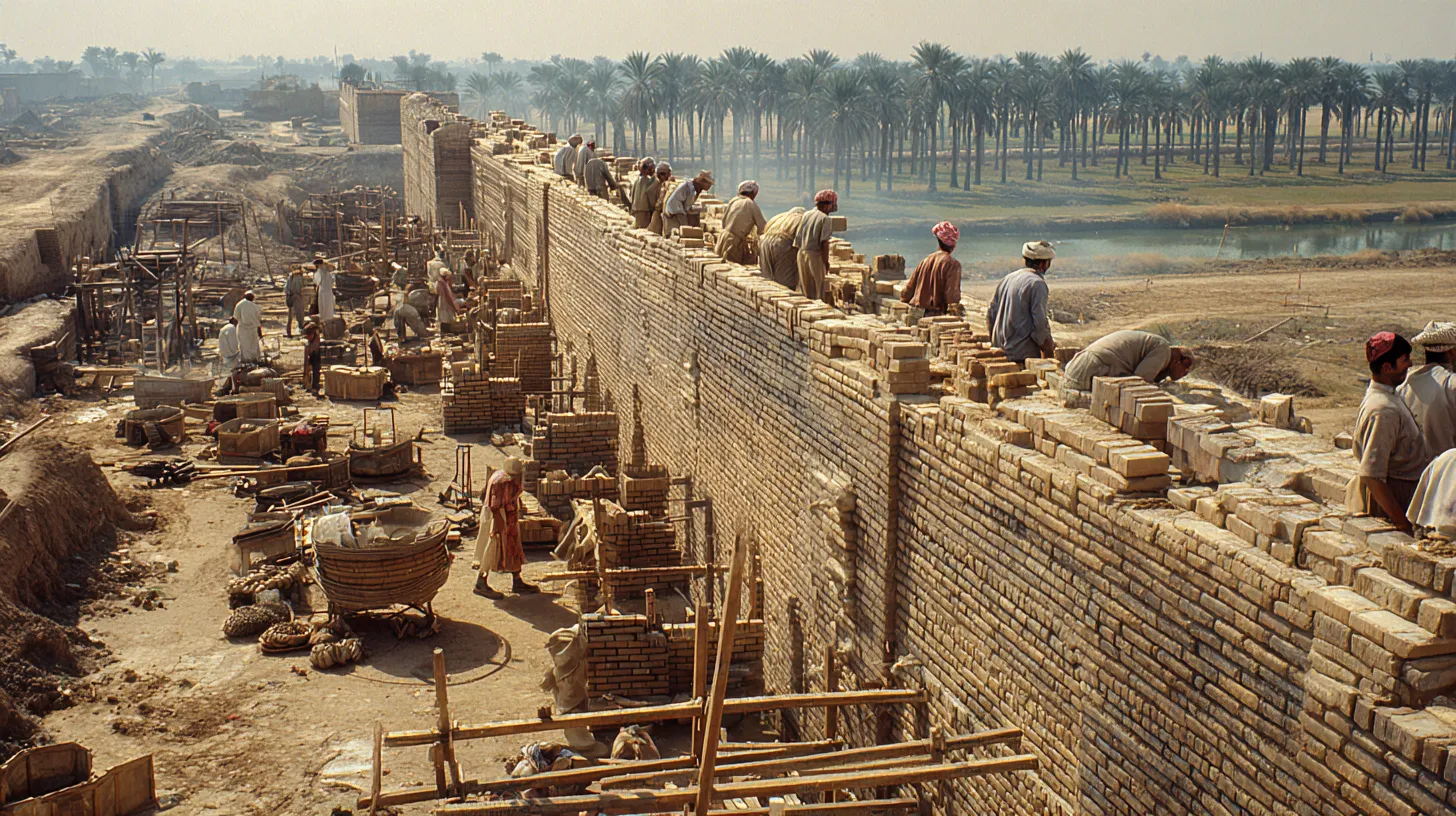
AI reconstruction, not a photograph.
In the 1980s, Saddam Hussein’s builders raised new walls at Babylon from bricks that carry his name, as the bricks of Nebuchadnezzar II had carried his about 2,500 years before. The foundations of Nebuchadnezzar’s great tower, nearby, lay in a shallow pool of water when a reporter visited in 1990. The sources show what was done to the bricks. They do not show why the tower was not rebuilt.
Nebuchadnezzar’s Bricks
Nebuchadnezzar II, who ruled Babylon from 605 to 562 BC, rebuilt much of his capital and put his name on its bricks. A baked brick from Babylon in the Penn Museum, about 33 centimetres square and 8.5 centimetres thick, carries a three-line cuneiform stamp, impressed twice, that reads in part: Nebuchadnezzar, king of Babylon, restorer of Esagila and Ezida, eldest son of Nabopolassar. It also carries an Aramaic stamp bearing a Babylonian personal name, which New York University’s Institute for the Study of the Ancient World described as a worker’s inscription when it exhibited the brick on loan in 2019–20. A workman’s name could therefore share a brick with the king’s.
His longer inscriptions survive on clay cylinders. The one for Etemenanki, the ziggurat of Babylon, exists in thirteen catalogued copies and says he mustered the widespread peoples and set them to carrying baskets, “kings of remote mountains and distant islands” among them, and that he raised the summit so that it would “rival the heavens.” The text repeats the point about the gathered peoples further on. A royal inscription is a king’s own account of his deeds, so it shows how Nebuchadnezzar wished to be remembered. It is not a neutral record of who laid the bricks.
Saddam’s Babylon
Babylon lies about 85 kilometres south of Baghdad. According to the Christian Science Monitor, Iraq launched a project to restore the site in 1979, and ICOMOS, the advisory body to UNESCO, says the reconstructions of the 1980s were carried out as part of the Revival of Babylon Project. The Monitor put the cost of the development programme at $25 million by 1990 and reported plans for hotels and restaurants. It described Southern Palace walls reconstructed with new brick to between 24 and 42 feet, about 7 to 13 metres, and a half-size replica of the Ishtar Gate. Three artificial hills, each about 30 metres high, were created, two of them reportedly meant as stations for a cable car that was never built, and Saddam’s palace stands on the westernmost, overlooking the excavated ruins. Mouayad Said, then director of Iraq’s Department of Antiquities, told the Monitor that before the work the site had been only dust and palm trees, and that visitors left disappointed. He said only reasonable designs had been used, that new materials were kept visibly distinct from old, and that roofs, plaster, trim and windows had been left out. “We are scientists, not builders,” he said.
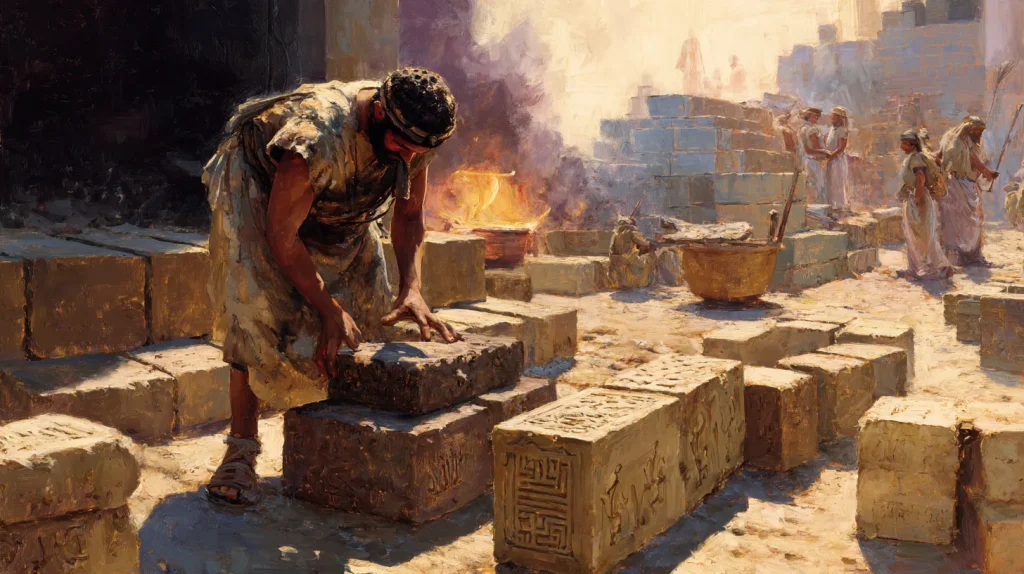
Many of the new bricks name Saddam. The Monitor reported new bricks in the Southern Palace walls, many bearing the inscription “restored in the era of Saddam Hussein,” and Atlas Obscura reports a longer inscription that begins “In the reign of the victorious Saddam Hussein” and dates the rebuilding to 1987. The English wording differs from report to report. Popular accounts add that Saddam insisted on this after archaeologists told him ancient kings had stamped their names on Babylon’s bricks. That is how the story is usually told, but the sources used here include no primary document for it.
The Link Between the Two Rulers
As a public theme, the link between the two rulers is better documented. A slogan used at celebrations in Babylon in 1981 ran, in translation, “yesterday Nebuchadnezzar, today Saddam Hussein.” The Babylon Festival, a four-week event the government staged to show off the rebuilding, had an official seal that showed Saddam beside Nebuchadnezzar, Christianity Today reported in 1988. Charles Dyer, a Dallas Theological Seminary professor invited to the first festival, noted that the portraits were drawn so that Nebuchadnezzar “bears a striking resemblance to Hussein.” He saw its main purpose as improving Iraq’s international image.
Conjecture and Its Critics
Not everyone accepted Said’s account of the rebuilding. The ICOMOS evaluation says the height and design of the reconstructions rest on conjecture rather than archaeological evidence, and that some were almost complete rebuilds on very scanty evidence. It also notes that the Southern Palace suffers from incompatible materials added during the project. A 2012 Monitor report said concrete was poured directly against the original brick in the 1980s, that the old walls are now sandwiched between heavier modern bricks pressing down on the original mud brick, and that a rising water table has sent salt water into the foundations. Jeffrey Allen, a World Monuments Fund consultant who has headed the conservation project since 2009, said the salt attacks the brickwork and turns it to powder, and that the large-scale interventions of the Saddam era compromised the integrity of the original remains. The Monitor’s own words were that the project “has done major damage to the remains of the city.” The Monitor’s 1990 report had also noted a $1.5 million prize offered for matching the technology that raised Euphrates water to the Hanging Gardens, though it said no remains of the gardens have been found.
The Foundations in the Water
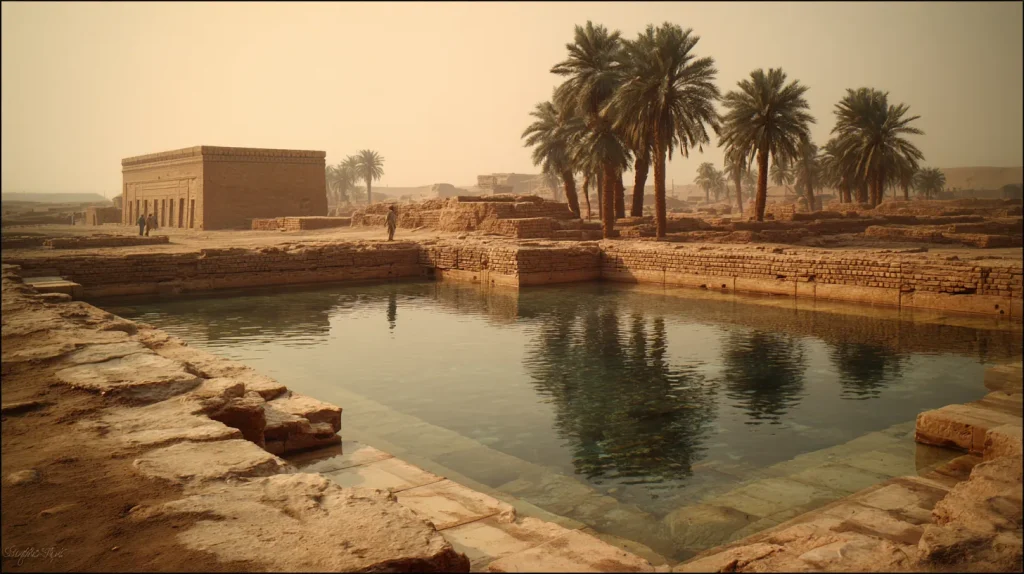
The tower is a different case. German excavators under Robert Koldewey began digging at Babylon in 1899, and the First World War ended their work in 1917. They recovered the plan of Etemenanki, a square base about 91 metres on each side. Nabopolassar’s foundation cylinders already speak of work on a ziggurat that was weak and damaged, and his son Nebuchadnezzar rebuilt and raised it. Alexander the Great meant to rebuild it in 323 BC and died before the work was done. In 1990 the Monitor’s reporter wrote that its foundation stones lay “in a shallow pool of water,” and that archaeologists say it could be the site of the Tower of Babel in Genesis. A model of the tower could be seen in a small museum beside the Southern Palace.
As far as the sources used here show, nobody rebuilt it. ICOMOS lists the Etemenanki remains among the key structures and describes no reconstruction. The Monitor describes a pool, not a tower. Neither says why. One difficulty any rebuild would have met is the tower’s height, which is itself disputed. A cuneiform tablet known as the Esagila tablet gives seven stages and a total height of about 91 metres, while a modern estimate by Fenollós and colleagues gives about 54 metres for the ziggurat and 12 more for the temple on top. That is a difficulty and not a stated reason.
What the Comparison Is
The comparison between the two kings is an observation. It rests on two documented facts: a practice of naming the king on bricks under Nebuchadnezzar, and the same practice under Saddam. It does not show that one copied the other, and it does not show why the tower was not rebuilt. The slogan and the festival seal show that Saddam wished to be seen as Nebuchadnezzar’s successor, which makes a deliberate echo plausible. They do not prove that the brick inscriptions were one.
The result is a site of layered rulers. Bricks naming a modern president sit on walls built by a king whose own bricks bore his name some 2,500 years earlier, while the base of the tower that king boasted of raising to the heavens lay in a pool, as the Monitor found it in 1990.

