Two Leopon Cubs Were Reportedly Born in Kolhapur in 1910
Unexplained & Claims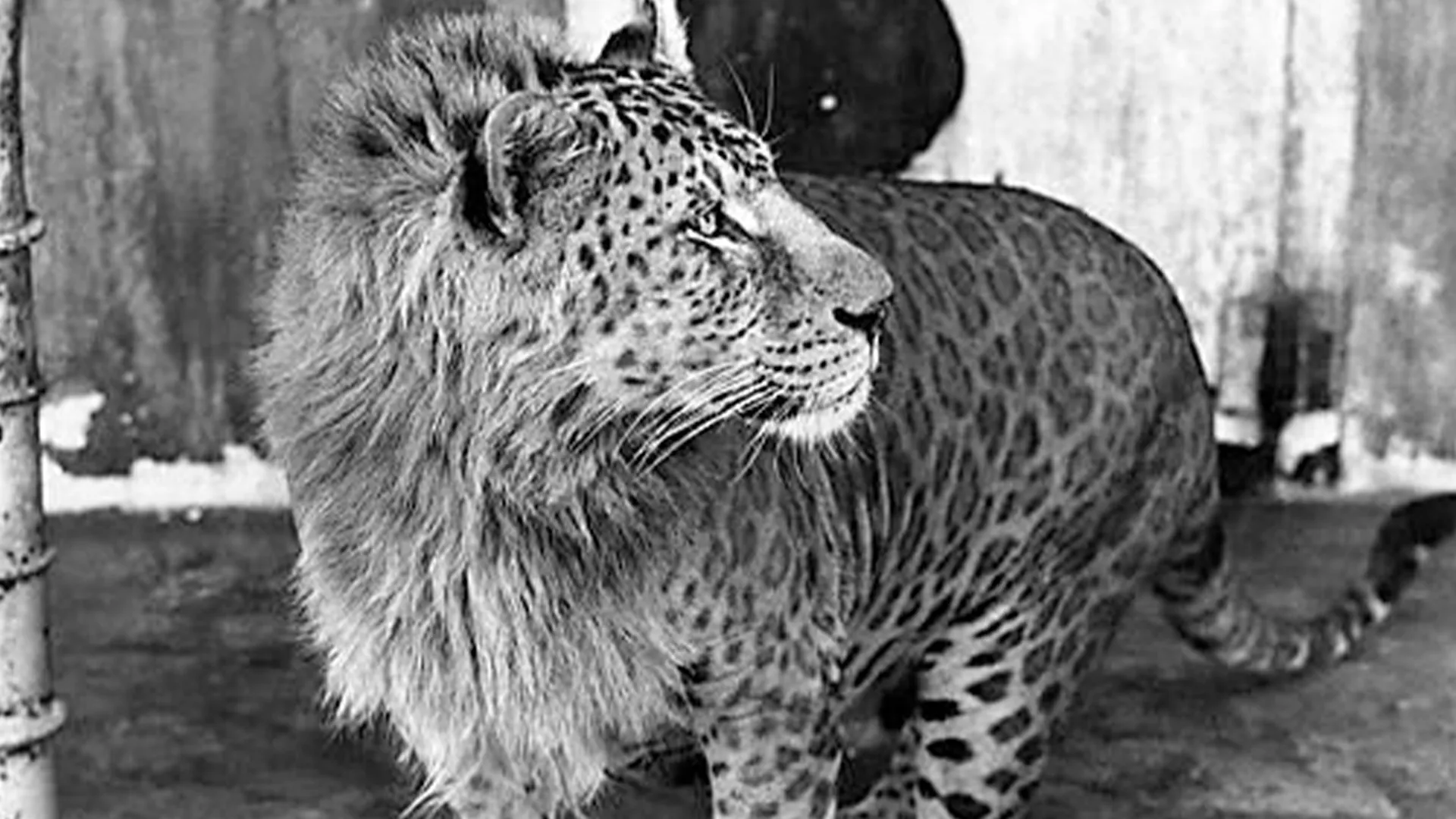
In 1910, a male leopard and a lioness reportedly produced two cubs at Kolhapur, India, and a skin of the hybrid later reached the British zoologist R. I. Pocock, who described it in 1912. The cross is called a leopon. One cub died at about two and a half months, and the other was still living when Pocock wrote. The sources used here do not say who kept the pair or why, so the Kolhapur record is thin, and the leopons later bred in Japan are far better documented.
What a Leopon Is
A leopon is the offspring of a male leopard (Panthera pardus) and a lioness (Panthera leo). The name blends leopard and lion, with the father’s species first, a convention a Kodansha science column spells out. The reverse cross, a male lion and a leopardess, has been called a lipard or lionard, and Wikipedia’s article on Panthera hybrids cites a birth in Florence, Italy, in a 1983 report.
A leopon is not a species of its own. A library record for the 1967 book The Story of Leopons calls it “a newly created species,” but a cross between two existing species is not a species. Both parents belong to Panthera, the genus of the big cats, and National Geographic reported in 2017 that such hybrids come from big cats that crossbreed in captivity.
Kolhapur, 1910
Wikipedia’s article on Panthera hybrids calls the Kolhapur animal the first documented leopon, which describes the record and does not prove that no earlier cross occurred. The parents are given only as a large leopard and a lioness. Two cubs were born. One died aged about two and a half months, and the other was still living when Pocock described the hybrid in 1912.
Kolhapur was then the capital of a princely state in the Deccan division of the Bombay Presidency, in what is now Maharashtra. None of the accounts used here says who owned the pair, whether the two animals were put together on purpose or what became of the survivor after 1912.
A Skin Sent to Pocock
Reginald Innes Pocock (1863 to 1947) had worked at the Natural History Museum in London and was Superintendent of the London Zoo until 1923. Walter Samuel Millard, who had gone out to Bombay in 1884, was the honorary secretary of the Bombay Natural History Society and, from 1906 to 1920, editor of its journal. He also drove the Society’s Mammal Survey from 1911 to 1923, whose collections became the basis for Pocock’s two mammal volumes in The Fauna of British India, published in 1939 and 1941.
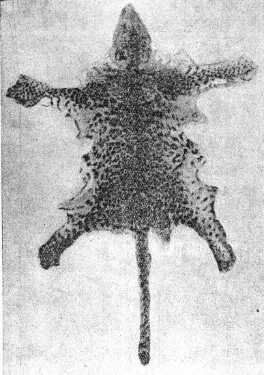
Millard sent a skin of the hybrid to Pocock, and the sources used here do not say which cub it came from. Pocock described the animal in a letter to The Field dated 2 November 1912.
Wikipedia summarises the letter. The animal was spotted like a leopard, but the spots on its sides were smaller and more closely set than an Indian leopard’s, brown and indistinct, like the fading spots of a young lion. Spots on the head, spine, belly and legs were black and distinct. The tail was spotted above and striped below, with a blackish tip. The ears were fawn with a broad black bar and lacked the white spot a leopard has. The letter itself was not among the sources used here, so these details come at second hand.
A Spotted Lion From 1908
Pocock had met a spotted cat of doubtful ancestry before. In spring 1908 an animal billed as a Congolese spotted lion went on show at the London Zoo and was then sold at auction, for 1,030 guineas according to The Times as cited by Wikipedia. Pocock first took it for a hybrid of a lion and a leopard. After hearing of jaguar and leopard hybrids bred in Chicago, he decided in a letter of 9 May that it was a lion crossed with one of them, a cross now called a lijagulep.
In 1912 he set the two animals side by side. The difference, he said, lay in the spots: large and jaguar-like on the 1908 animal, small and more leopard-like on the Kolhapur hybrid.
Why the Cross Stays Rare
The sources used here describe only two breeding episodes, at Kolhapur and at Hanshin Park. Lions and leopards do share ground. Britannica describes the leopard as solitary and mainly nocturnal, found across sub-Saharan Africa, North Africa and Asia, while lions live in prides and an Asiatic population survives under protection in India. A 2020 study in PLOS ONE found both species active at dusk and at night in the Gir protected area of Gujarat and described the leopard as subordinate to the lion, with leopards favouring dense habitat and lions using dense and open ground.
Yet National Geographic reports that feline hybrids are not found in nature, and Discover Wildlife says big cats have crossbred only in captivity. Why lions and leopards that share a range have not produced a documented wild leopon is not settled in the sources used here. Differences in group living and habitat are obvious candidates, but that is an inference. Luke Hunter of the conservation group Panthera told National Geographic that hybrids face a greater chance of infertility and other defects, though the report adds that how common such problems are in big-cat hybrids is not known.
The Leopons of Hanshin Park
Japan produced the best-documented leopons. Hanshin Park in Nishinomiya, Hyogo, also called Koshien Hanshin Park, was run by the Hanshin Electric Railway and closed in March 2003. A Kodansha science column says its second director, Hiroyuki Doi, wanted to give postwar Japan some good news, and names the leopard Kaneo and the lioness Sonoko as the parents. Two leopons were born in 1959 and three more in 1961, according to Hyogo Prefecture and the Kobe Shimbun. English-language summaries that follow an older Wikipedia text give 1962 for the second litter. All the sources agree on five animals in total.
The animals were sterile, the Kobe Shimbun reports, and criticism of the crossbreeding ended the births. A Hyogo Prefecture page says such a hybrid would be unthinkable today on ethical grounds, and a 2017 National Geographic report carried the headline “Cat Experts: Ligers and Other Designer Hybrids Pointless and Unethical.” A book on the animals, credited to Doi and Barbara Reynolds, was published in New York by Putnam in 1967.
Wikipedia, citing data from Japanese leopons at the Nishinomiya City Zoo, says they are larger than leopards, with brown rather than black spots and tufted tails. They climb like leopards and seem to enjoy water, and males may have sparse manes about 20 centimetres long. The head resembles a lion’s and much of the body a leopard’s.
Johnny and the Mounted Leopons
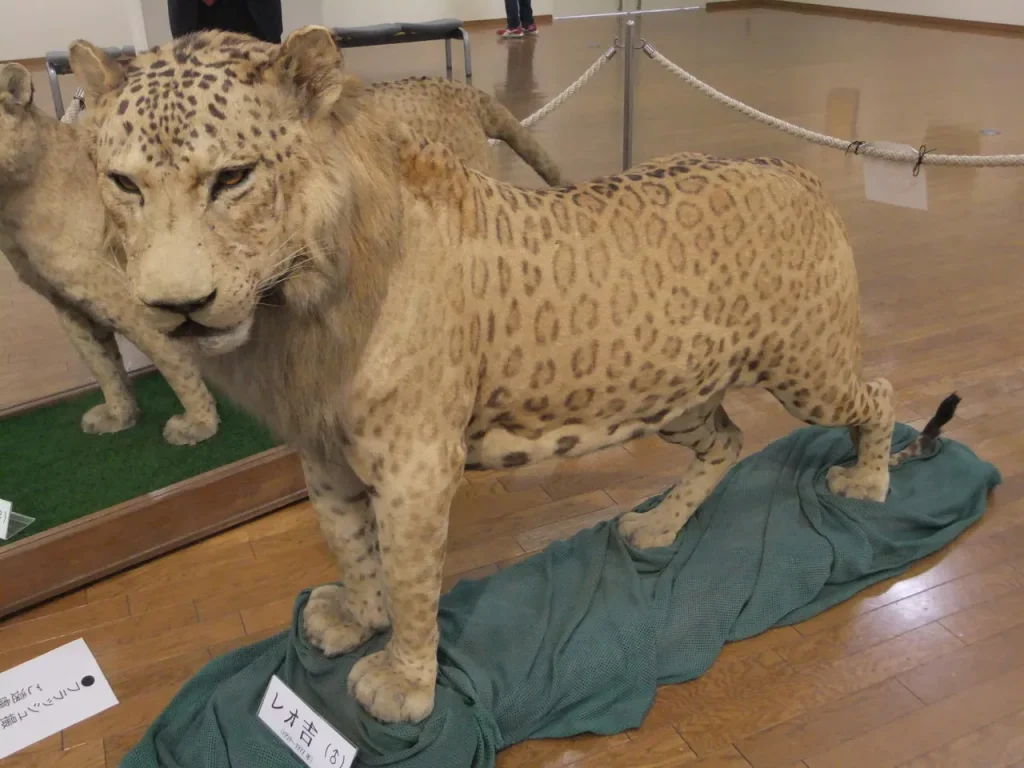
The last leopon, Johnny, was born in 1961 and died on 18 July 1985, aged 24. All five animals were preserved after death. When the park closed, two went to the National Museum of Nature and Science in Tokyo, two to Tennoji Zoo in Osaka and Johnny to the city of Nishinomiya, which displayed him from 2004 at a resort facility. By March 2021 the facility had closed, sunlight had faded his fur, and the city was seeking a new home for him.
What the Record Supports
The record supports less than the legend does. Two cubs were reportedly born at Kolhapur in 1910, and one died at about two and a half months. A skin reached Pocock through Millard, and his 1912 letter described small, closely set, brownish side spots. The breeder, the purpose and the fate of the second cub are not given in the sources used here. Japan’s five leopons stand on firmer ground, with named parents, dated births and mounted specimens that survive.

