Ancient Egypt’s Professional Dream Interpreters: The Scholars Who Read Your Nightmares
Ancient Near East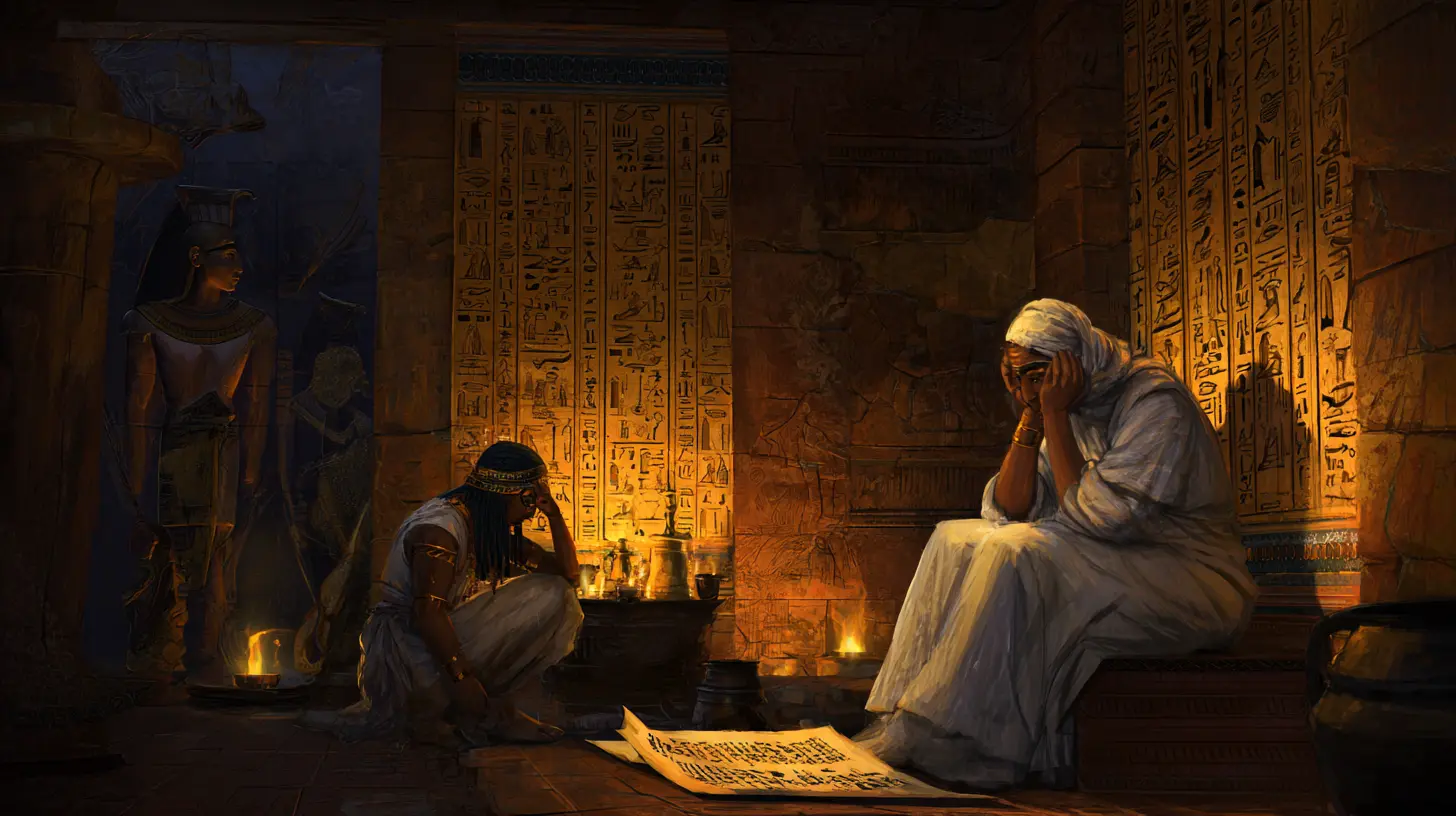
Someone woke up in ancient Egypt having dreamed about eating a donkey. This was now somebody else’s problem.
That somebody was the san-huat — the dream interpreter — a specialist whose entire professional existence was built around decoding the nighttime visions of anxious clients and delivering verdicts that carried genuine religious weight. Not metaphorical weight. Actual, documented, written-down-in-a-manual weight.
Dreams in ancient Egypt were not psychological noise. They were communications — from gods, from the dead, from forces operating just below the surface of waking reality. The line between the living world and the divine one was thinner at night, and what crossed through that line while you slept required a trained professional to decode.
The Chester Beatty Dream Book: Egypt’s Official Nightmare Manual
The most important surviving evidence for this profession is a papyrus now held in the Chester Beatty collection in Dublin, dating to approximately 1275 BCE during the reign of Ramesses II. It is one of the oldest dream interpretation manuals ever discovered, and it is extraordinarily specific.
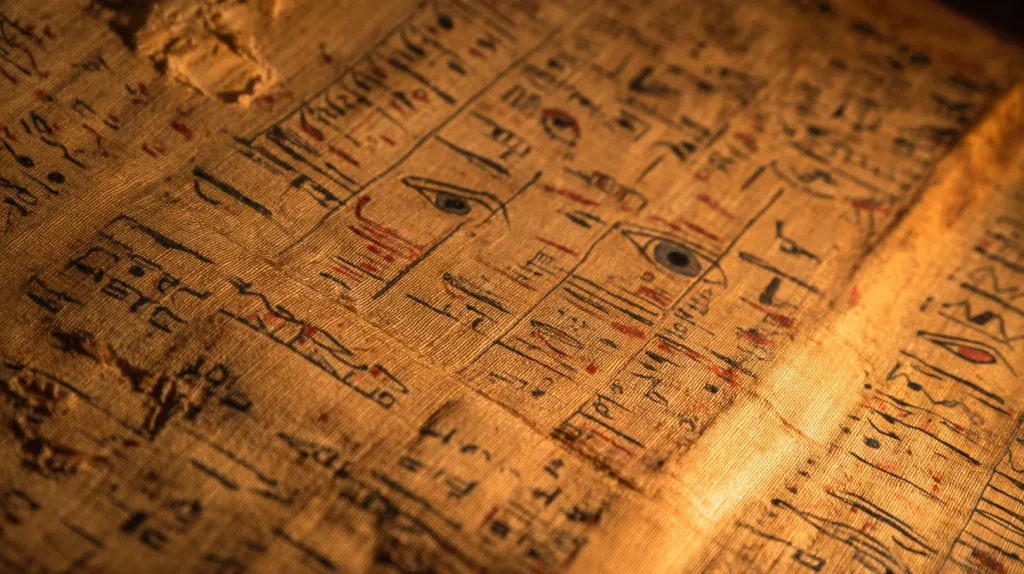
The papyrus is organized as a reference document. Each entry follows a consistent formula: “If a man sees himself in a dream [doing or seeing a specific thing] — good/bad — it means [specific outcome].” The interpretations cover over 200 individual dream scenarios, sorted into favorable and unfavorable columns. The scribe even used red ink to highlight the bad ones — a color Egyptians associated with danger and the god Set — making the manual both a reference tool and a visual warning system.
Some entries from the Chester Beatty papyrus that survive intact:
Seeing yourself drinking wine — good — it means living in righteousness. Seeing yourself with your face in a mirror — bad — it means a new wife is coming but it signals trouble. Seeing yourself with a dwarf — good — it means half your life’s troubles are over. Seeing yourself eating donkey meat — good — it means promotion. Seeing yourself copulating with a cow — good — it means a happy day in the house.
The system is wonderfully, unapologetically literal. There is no “it depends” and no “dreams are subjective.” The manual says what the dream means. The interpreter’s job is to find the right entry and deliver the verdict.
Who Actually Performed This Role
Dream interpreters in ancient Egypt occupied a specific place within the larger priestly and scribal class. The san-huat were not street-corner fortune tellers. They were educated men, typically operating within or adjacent to temple institutions, trained in the written tradition that the dream manuals represented.
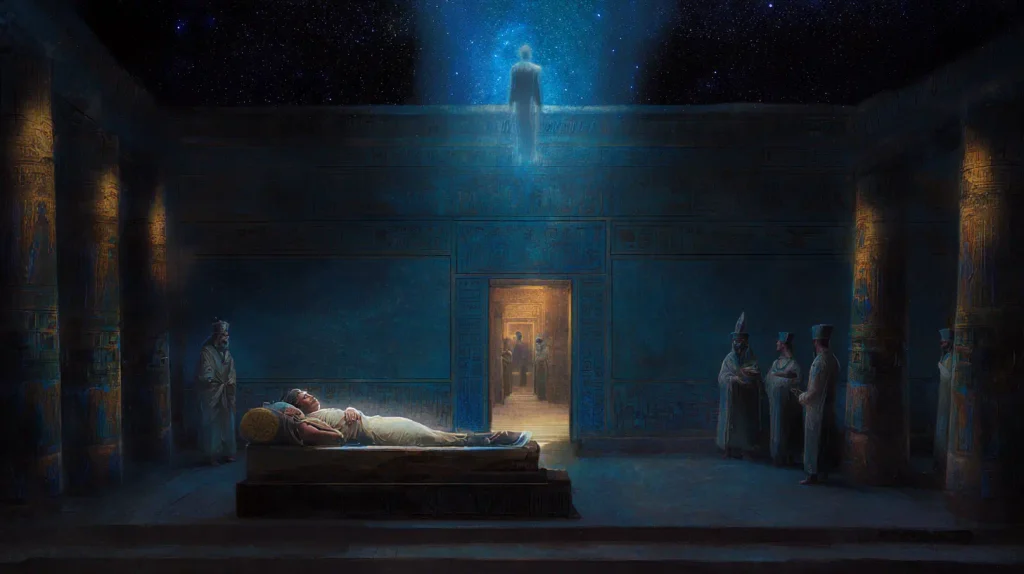
The connection to temples was not incidental. Several Egyptian temples maintained dedicated spaces called sekhmet chambers or dream incubation rooms — places where a person experiencing troubling or significant dreams could sleep overnight under priestly supervision, with the explicit intention of receiving divine guidance through their dreams. The god most associated with this practice was Serapis, whose cult centers at Memphis and Alexandria became famous throughout the Mediterranean world as destinations for dream incubation.
Herodotus, writing in the 5th century BCE, described Egyptian priests as among the most learned men he had encountered in his travels, specifically noting their sophisticated engagement with dream interpretation as a formal discipline. By the time of the Ptolemaic period, when Greek culture merged with Egyptian tradition, the practice had become so established that it attracted clients from across the Mediterranean — including Greeks and Romans who traveled specifically to Egyptian temples seeking prophetic dreams.
One remarkable series of documents survives from the Serapeum at Memphis: a collection of texts written by a man named Ptolemaios, a Macedonian Greek who lived voluntarily inside the temple precinct for years during the 2nd century BCE, acting as an interpreter of dreams for visitors and pilgrims. His archive preserves both his own dream records and the requests of clients — a genuine paper trail of the profession in daily operation.
The Customer Service Problem
The structural difficulty of this profession was one that no manual could fully solve. Some clients arrived hoping for reassurance. Others arrived already frightened. But the dream manual did not negotiate.
If the Chester Beatty papyrus said the dream was bad, the interpretation was bad. There was no ancient Egyptian equivalent of a therapist softening unwelcome news with careful language. The interpreter delivered a verdict the way a physician delivers a diagnosis — as a fact about reality, not an opinion about possibility.
This created a genuine professional tension. A nervous client who dreamed of seeing his face in a mirror needed to be told that marital trouble was coming. A merchant who dreamed of a specific unfavorable symbol needed to hear that his trading venture carried risk. The interpreter’s credibility depended entirely on his willingness to deliver unwelcome verdicts accurately — because if he softened them and the predicted trouble arrived anyway, his reputation was finished.
The profession rewarded honesty over comfort, which is perhaps why it was anchored in written manuals rather than improvised intuition. The manual was the authority. The interpreter was its voice.
Dreams That Changed History
Egyptian dream interpretation was not confined to private anxieties. Royal dreams carried political and military weight.
The Sphinx Stele — carved between the paws of the Great Sphinx at Giza and still standing there today — records a dream received by the prince who would become Thutmose IV around 1400 BCE. According to the stele, the Sphinx appeared to the prince while he rested in its shadow and promised him the throne of Egypt if he cleared the sand that had buried its body. Thutmose cleared the sand. He became pharaoh. The dream was commemorated in stone and placed at the most visible religious monument in the country.
The message was institutional: dreams were real events with real consequences, documented in royal records alongside military victories and building projects.
Ramesses II, who ruled during the period the Chester Beatty papyrus was compiled, reportedly received divine guidance through dreams before the Battle of Kadesh — one of the largest chariot battles in ancient history. The king who commissioned or oversaw the most famous dream manual in history also claimed his own military decisions were shaped by dream communications.
The profession that decoded ordinary Egyptians’ nighttime anxieties operated at every level of society — from the nervous man wondering what eating a donkey meant for his week, to the pharaoh asking what the gods wanted him to do with his army.
In ancient Egypt, dreams were not something that happened to you. They were something that required a professional response.
And somewhere in Memphis or Thebes, the san-huat was already consulting his manual, red-ink entries and all, ready to tell you exactly what your night had meant.

