Babylon Burned Jerusalem in 586 BCE, and Psalm 137 Remembers
Biblical History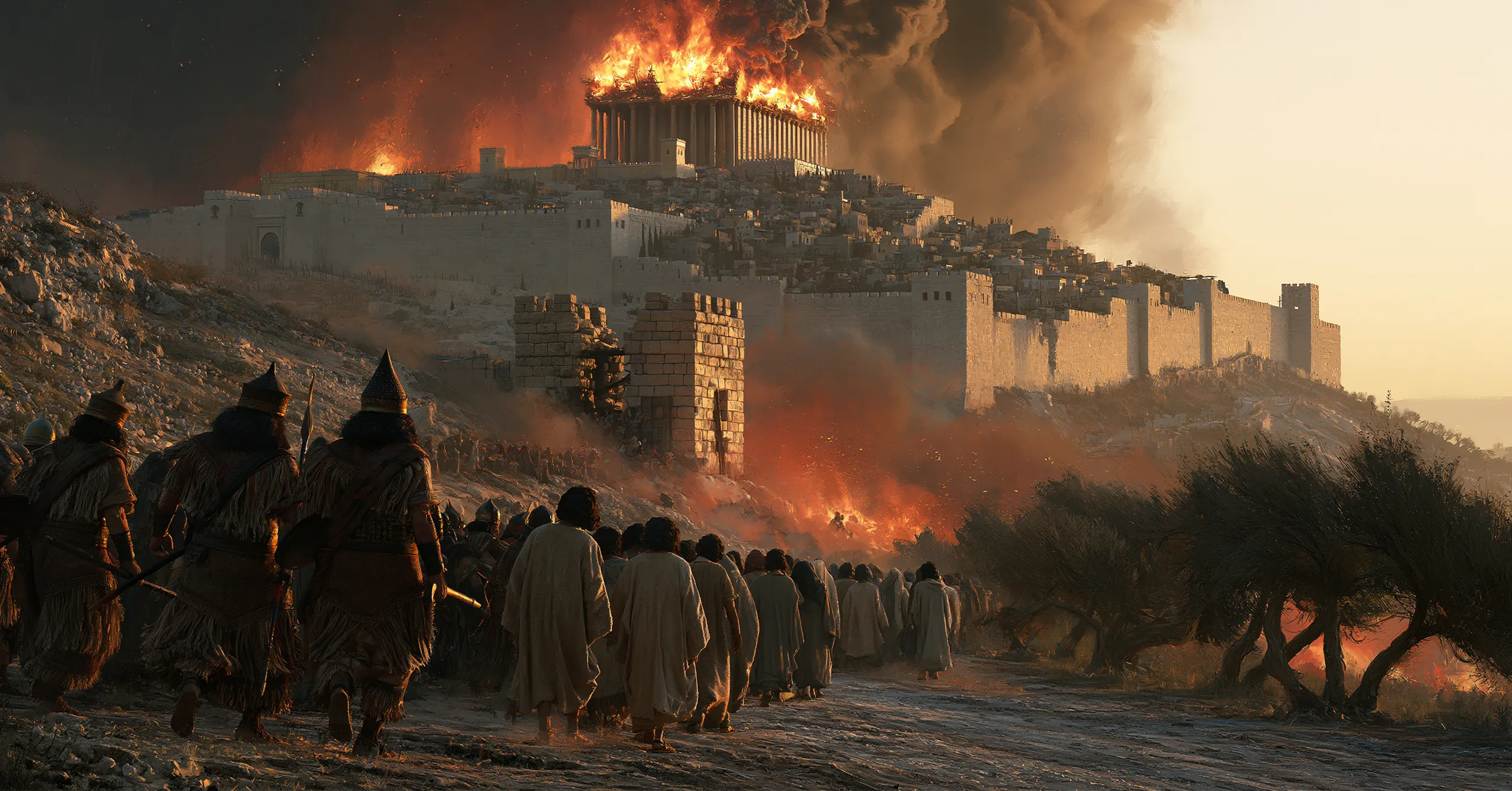
AI reconstruction, not a photograph.
Babylon burned Jerusalem and its temple in 586 BCE, and the event left several kinds of record. The Bible tells it as history in 2 Kings 25 and as grief in Psalm 137, where the exiles weep by the rivers of Babylon. A Babylonian chronicle covers an earlier capture of the city, and excavations in Jerusalem have found burned buildings and arrowheads. Popular retellings add a claim that none of these sources makes, that Babylon belonged to a cursed line descended from Nimrod. This article sets out what each record says and then checks Genesis 10.
What 2 Kings 25 Says
Chapter 25 follows an earlier defeat, told in chapter 24. Nebuchadnezzar II besieged Jerusalem, took King Jehoiachin, carried off the temple treasures and thousands of captives, and made Mattaniah king as Zedekiah (24:10-17). Then “Zedekiah rebelled against the king of Babylon” (24:20). Wikipedia adds that he stopped paying tribute and entered an alliance with Pharaoh Hophra.
The siege began in Zedekiah’s ninth year, and the besiegers “built forts against it round about” (25:1). Famine followed, and “there was no bread for the people of the land” (25:3). When the city “was broken up”, Zedekiah fled toward the plain, was overtaken near Jericho and was brought to the king of Babylon at Riblah. The Babylonians “slew the sons of Zedekiah before his eyes”, blinded him and took him to Babylon (25:4-7).
In the fifth month Nebuzaradan, captain of the guard, came to Jerusalem. He “burnt the house of the LORD”, then the king’s house, all the houses of the city and the house of every great man, and the army “brake down the walls of Jerusalem round about” (25:8-10). The rest of the people were carried away, though “the poor of the land” were left “to be vinedressers and husbandmen” (25:11-12). The chief priest and other officials were taken to Riblah and put to death (25:18-21).
Jeremiah 52 parallels this account but differs in detail. Jeremiah 52:12 gives the tenth day of the fifth month for Nebuzaradan’s arrival, where 2 Kings 25:8 gives the seventh. The totals of exiles vary too: 2 Kings 24:14 says “ten thousand captives”, while Jeremiah 52:28-30 reaches “four thousand and six hundred” over three deportations. Even the year is debated. Wikipedia says scholars disagree on whether the fall belongs to 587 or 586 BCE, and this article uses 586.
What the Chronicle and the Archaeology Add
A Babylonian chronicle covers the earlier capture, not the burning. The Center for Online Judaic Studies publishes the relevant lines from Babylonian Chronicle 5, on British Museum tablet BM 21946. They record Nebuchadnezzar’s campaign against Judah in 597 BCE: “he seized the city and seized the king”, and he appointed “a king of his own pleasure”. The page says the section covering 594-557 BCE is not extant, so the tablet has no entry for 586.
Archaeology adds the burned buildings. Wikipedia lists burned wooden beams from three structures in the City of David and attributes the fire to the Babylonians in the early sixth century BCE. It says trilobate arrowheads first appear in the southern Levant in burnt layers tied to the destruction, and that burnt beams and ash from the Givati Parking Lot have been linked to the traditional 586 date. In 2023 N. Shalom and colleagues, writing in the Journal of Archaeological Science, combined FTIR spectrometry and archaeomagnetic analysis to reconstruct the fire in Building 100, “an extraordinarily large and rich elite building, thoroughly destroyed during the Babylonian campaign”.
The finds come with cautions. In 2017 the Times of Israel reported that Israel Antiquities Authority excavators had uncovered a row of rooms on the City of David’s eastern slope, covered in charcoal ash. The report says the burnt layers had preserved flooring and utensils in place, which suggests a sudden blaze. One co-director, Joe Uziel, said, “It seems like not all of the buildings were destroyed in a single event.” The report also recalls the Babylonian-era arrowheads that Nachman Avigad found in the Old City in 1975.
Lamentations and Psalm 137
Two poems from the aftermath survive in the Bible. Lamentations is a book of five poems about the ruined city. Wikipedia says most scholars agree it was composed shortly after 586 BCE, that its first four poems are acrostics, and that the modern consensus is that Jeremiah did not write it, although tradition credited him. The first poem pictures Jerusalem as a widow: “How doth the city sit solitary, that was full of people!” (1:1). The last asks the LORD to remember what has come upon the people, and says, “Our inheritance is turned to strangers, our houses to aliens” (5:2).
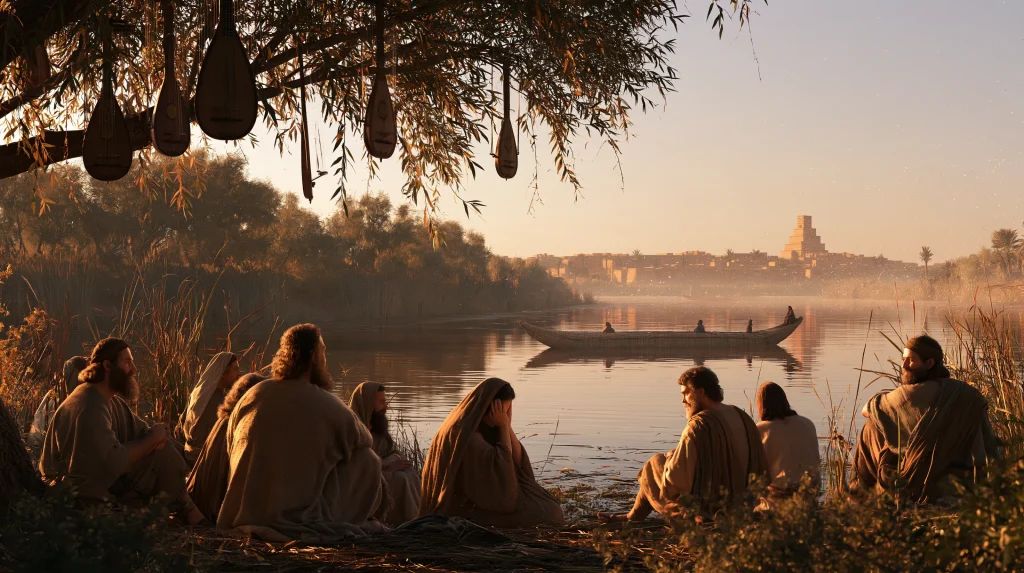
Psalm 137 opens in exile: “By the rivers of Babylon, there we sat down, yea, we wept”. The exiles hang their harps on the willows, their captors ask for songs of Zion, and the singers ask how they can sing the LORD’s song “in a strange land”. They vow to remember Jerusalem (verses 5-6). Verse 7 asks the LORD to remember the children of Edom, who said, “Rase it, rase it, even to the foundation thereof”. Verse 8 addresses Babylon as one “who art to be destroyed”, and verse 9 blesses whoever seizes Babylon’s little ones and dashes them “against the stones”.
Many readers find that ending among the hardest verses to read, and take it as a cry of rage from people who had lost everything, not as a model of conduct. Wikipedia notes that hymn settings often omit the violent final verses and that after the Second Vatican Council the last three verses were deleted from Catholic liturgical books. Tradition credited Jeremiah with the psalm: Wikipedia says rabbinical sources attributed it to him, and the Septuagint heading reads “By Jeremias, in the Captivity”.
How the Exile Reshaped the Record
New World Encyclopedia counts three deportations, in 597, 586 and about 582-581 BCE, and places the breach of the walls in July 586 and the burning of the temple, palace and city in August. Second Kings does not describe an empty land. Babylon left some people behind and made Gedaliah their ruler, he was killed at Mizpah, and the people who remained went to Egypt, “for they were afraid of the Chaldees” (25:22-26).
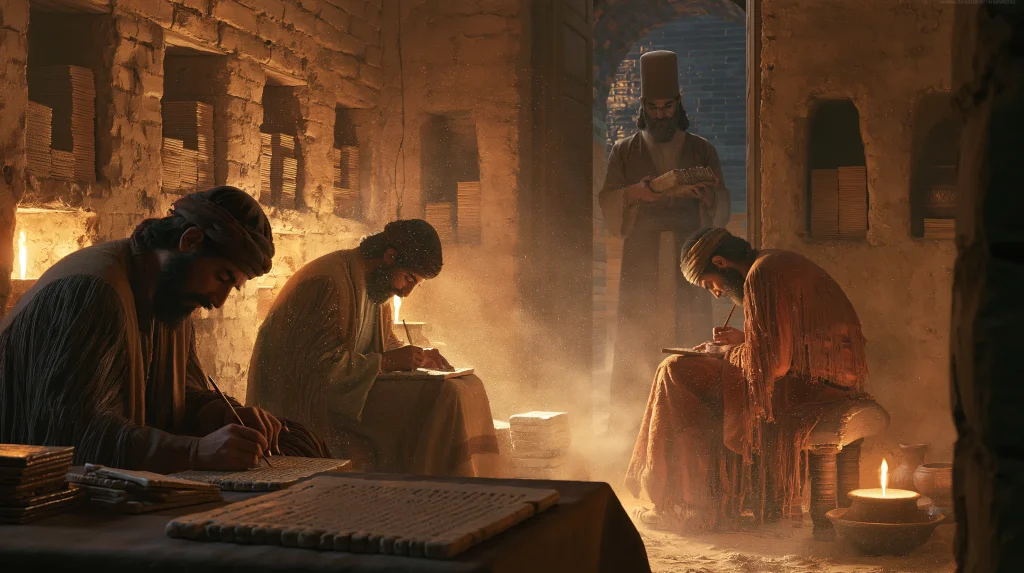
Second Chronicles 36:20-21 says the survivors served Babylon “until the reign of the kingdom of Persia”, and reads the desolation as the land keeping its sabbaths for “threescore and ten years”. New World Encyclopedia adds that scribes gained importance in exile and that historical writings were compiled and revised. Many scholars likewise think the exile pushed Israelite writers and scribes to gather and edit their traditions.
Babel, Nimrod and Genesis 10:10
Popular retellings link Babylon to Nimrod and cast the Babylonians as heirs to a cursed line. Genesis offers one hook. Nimrod is a son of Cush, so a grandson of Ham (10:6, 8), and “the beginning of his kingdom was Babel” in the land of Shinar (10:10). That is all the chapter says about Babel. It never mentions the Babylonians of Nebuchadnezzar’s day, and it mentions no curse. The only curse in that part of Genesis falls on Canaan (9:25), and Genesis 10:6 lists Canaan as a brother of Cush, so Nimrod does not descend from the cursed son.
Where 2 Kings gives a reason for the disaster, it looks at Judah: 24:19-20 says Zedekiah “did that which was evil in the sight of the LORD” and that Jerusalem’s fate came “through the anger of the LORD”. Those verses say nothing of Babylon’s ancestry.
What Can Be Said
The Bible says Babylon burned Jerusalem and its temple and carried many of its people into exile. A Babylonian chronicle records an earlier capture in 597 BCE, and excavations have found burned buildings and arrowheads in the city. The exact year, the number of exiles and the reach of the fires are still debated. Genesis 10:10 names Babel as the beginning of Nimrod’s kingdom and says nothing about what a later empire would do. What can be said plainly is narrow: a city and its temple burned in 586 BCE, and the survivors left a lament in verse.

