Sodom and Gomorrah: A Border Verse, a Ruin and a Lost Site
Biblical History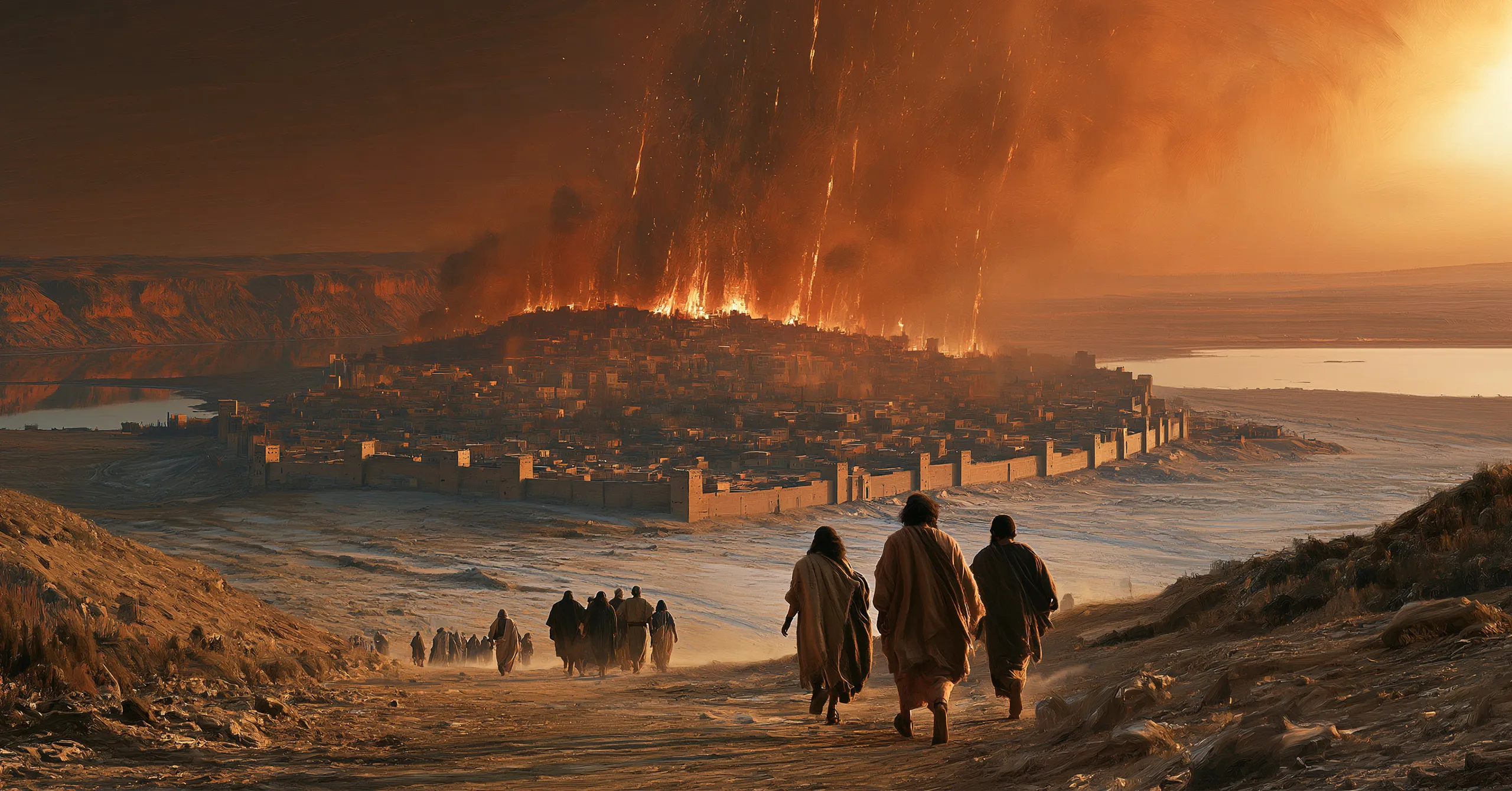
AI reconstruction, not a photograph.
The cities of the plain appear twice in Genesis, first on a map and then in a ruin. Genesis 10:19 includes Sodom, Gomorrah, Admah and Zeboim in its description of the Canaanite border, and Genesis 19:24 says the LORD rained brimstone and fire on Sodom and Gomorrah. Where the cities stood is not known, and a 2021 paper linking an airburst to a city near the Dead Sea was retracted in 2025. Popular retellings add a link the text never makes, that the fire was the Canaanites’ punishment under Ham’s curse. This article sets out what Genesis says, what other biblical writers made of Sodom and where the search for the site stands.
What Genesis 10:19 Says
The border verse closes the list of Canaan’s sons in the Table of Nations (10:15-18). It runs from Sidon toward Gerar and Gaza, and then “as thou goest, unto Sodom, and Gomorrah, and Admah, and Zeboim, even unto Lasha”. Genesis gives no date for the verse. Lasha is its vaguest point: the Encyclopedia of the Bible says “Its location is unknown” and offers Callirrhoe, a ravine east of the Dead Sea, as one of several suggestions.
Genesis 14 adds a fifth city. The kings of Sodom, Gomorrah, Admah, Zeboiim and Bela, “which is Zoar”, fight four invading kings in “the vale of Siddim, which is the salt sea”, a valley “full of slimepits” (14:2-3, 10). The invaders carry off Lot, Abraham’s nephew, who “dwelt in Sodom” (14:12).
What Genesis 19 Says
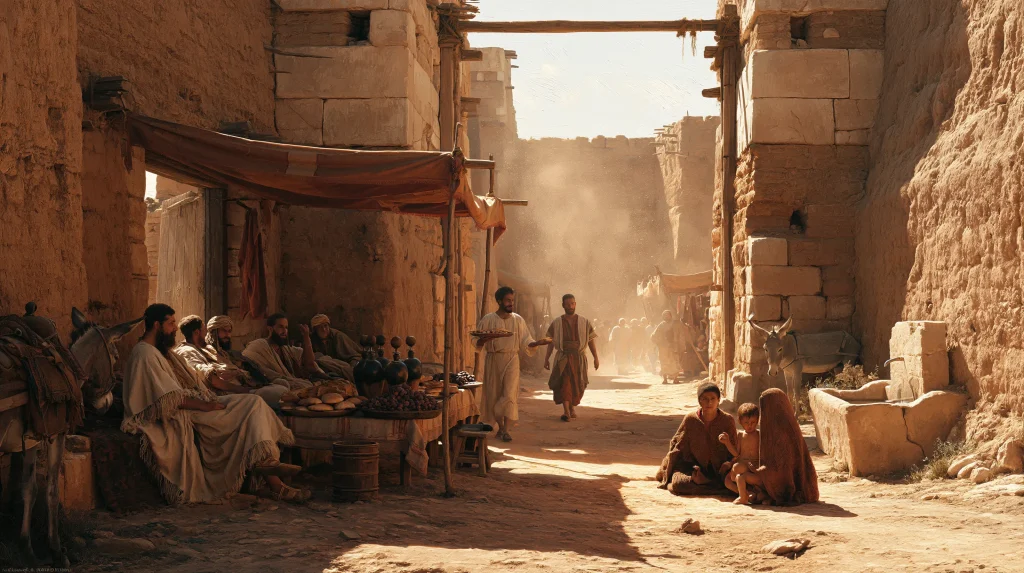
Lot chose “all the plain of Jordan”, which the narrator calls “well watered every where, before the LORD destroyed Sodom and Gomorrah”, and he “pitched his tent toward Sodom” (13:10-12). The narrator adds that “the men of Sodom were wicked and sinners before the LORD exceedingly” (13:13), and the LORD says that “the cry of Sodom and Gomorrah is great” (18:20). In chapter 19 two angels reach the city at evening and Lot gives them a meal. Before bedtime the men of the city, “both old and young”, surround the house and demand that Lot bring his guests out (19:1-5).
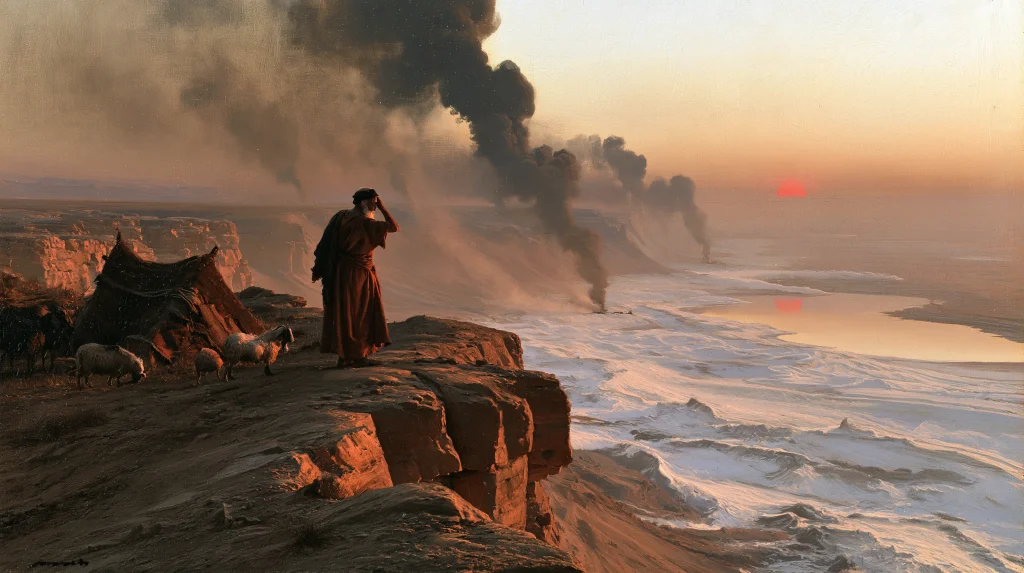
The angels warn Lot to leave. His sons-in-law take it for a joke, and at dawn the angels lead Lot, his wife and his daughters out by the hand (19:12-16). Lot begs to flee to a small city, Zoar, and it is spared (19:20-22). Then comes “brimstone and fire from the LORD out of heaven” (19:24), and “all the plain” is overthrown (19:25). Lot’s wife looks back and becomes “a pillar of salt” (19:26). Abraham rises early, looks toward the plain and sees that “the smoke of the country went up as the smoke of a furnace” (19:27-28).
Where Were the Cities?
The Bible places the plain near the Dead Sea, and no more exactly than that. New World Encyclopedia says “The exact location of the cities is uncertain” and adds that some theorists put them under the water or doubt that they existed.
Two groups of sites have been proposed. In the south, Bab edh-Dhra and Numeira lie at the southern end of the Dead Sea. BiblePlaces says both were Early Bronze Age towns, destroyed and never resettled, with most scholars dating the destructions to about 2300 BCE. That is more than two centuries before the date the page gives for Sodom, and it calls the identification difficult, mainly because of that gap. In the north, a sidebar in the Biblical Archaeology Society’s library argues that Lot’s view in Genesis 13 points to the area north of the sea, opposite Bethel and Ai. Its author favours Tall el-Hammam and notes that the site has a large gate complex and covers about 100 acres, against about 12 for Bab edh-Dhra.
Then came the airburst. In 2021 a paper in Scientific Reports argued that a cosmic airburst destroyed Tall el-Hammam around 1650 BCE, and Retraction Watch covered it as a claim that an asteroid destroyed biblical Sodom and Gomorrah. Critics questioned its images and its dating, and in April 2025 the journal retracted it. Retraction Watch quotes the chief editor as saying that final concerns “undermining the conclusions of the paper” required retraction, while the corresponding author said he and his co-authors “strongly disagree with the retraction”. An opinion piece in SAPIENS by critics of the excavation says most archaeologists in the region do not equate Tall el-Hammam, Bab edh-Dhra or Numeira with the biblical cities.
More Than One Charge
Retellings often reduce Sodom to a single sin, but the Bible names more. Ezekiel 16:49 says the iniquity of Sodom was “pride, fulness of bread, and abundance of idleness”, and that she did not “strengthen the hand of the poor and needy”. Verse 50 adds that her people “were haughty, and committed abomination before me”. Jeremiah 23:14 likens the prophets of Jerusalem to Sodom because they “commit adultery, and walk in lies”. The Enter the Bible website says such texts mention a wide range of behaviour, including “neglect of the poor and needy, lies, greed, and luxury”. In Matthew 10:14-15 Jesus says it will be “more tolerable for the land of Sodom and Gomorrha” than for a town that refuses his disciples, which the website reads as a reference to inhospitality. Jude 7 speaks of “fornication” and “strange flesh”, and the website says it is the only one of nearly thirty other references to the cities that explicitly mentions sexual behaviour, which it reads as a reference to sex with angels.
Genesis 19 itself shows a crowd demanding Lot’s guests, which New World Encyclopedia and Enter the Bible both treat as a threatened assault. Readers disagree about what the story condemns. New World Encyclopedia reports that traditional Christian theologians read it as homosexuality and rape, that some rabbinical traditions stress cruelty and a lack of compassion, and that liberal theologians emphasise the economic reading. Enter the Bible says many traditional interpretations have focused on same-sex activity, but argues that the text speaks of violence and not of orientation.
Canaan’s Curse and Sodom’s Fire
Popular retellings treat the fire as the Canaanites’ punishment under Ham’s curse. The text does not join the two. The curse in Genesis 9:25 is “Cursed be Canaan; a servant of servants shall he be unto his brethren”, which is servitude, not fire. The border verse puts the cities at the edge of Canaanite territory, but the word Canaanite does not appear in Genesis 14, 18 or 19 in the King James text.
Later writers used Sodom’s fate as a warning aimed at many peoples. Deuteronomy 29:23-25 says Israel’s land would become “like the overthrow of Sodom” if the people forsook the covenant. Isaiah 1:10 calls the rulers of Judah “rulers of Sodom”, and Amos 4:11 compares Israel’s losses to the fall of Sodom. Jeremiah 49:17-18 compares Edom’s coming desolation to it, Zephaniah 2:9 says Moab “shall be as Sodom”, and Isaiah 13:19 says Babylon “shall be as when God overthrew Sodom and Gomorrah”. Hosea 11:8 asks how Israel could be made “as Admah” and set “as Zeboim”.
What Can Be Said
The border verse in Genesis 10:19 puts four cities at the edge of Canaanite territory, and Genesis 19 records the fire that ended Sodom and Gomorrah. The Bible gives more than one reason for their fall and never ties it to Ham’s curse. Several sites near the Dead Sea have been proposed, and the most dramatic claim for one of them has been retracted. What can be said plainly is that a border verse names four cities, a later chapter records their end, and their location is lost.

