Before His Boulder, Sisyphus Once Captured Death Itself
Vikings & Norse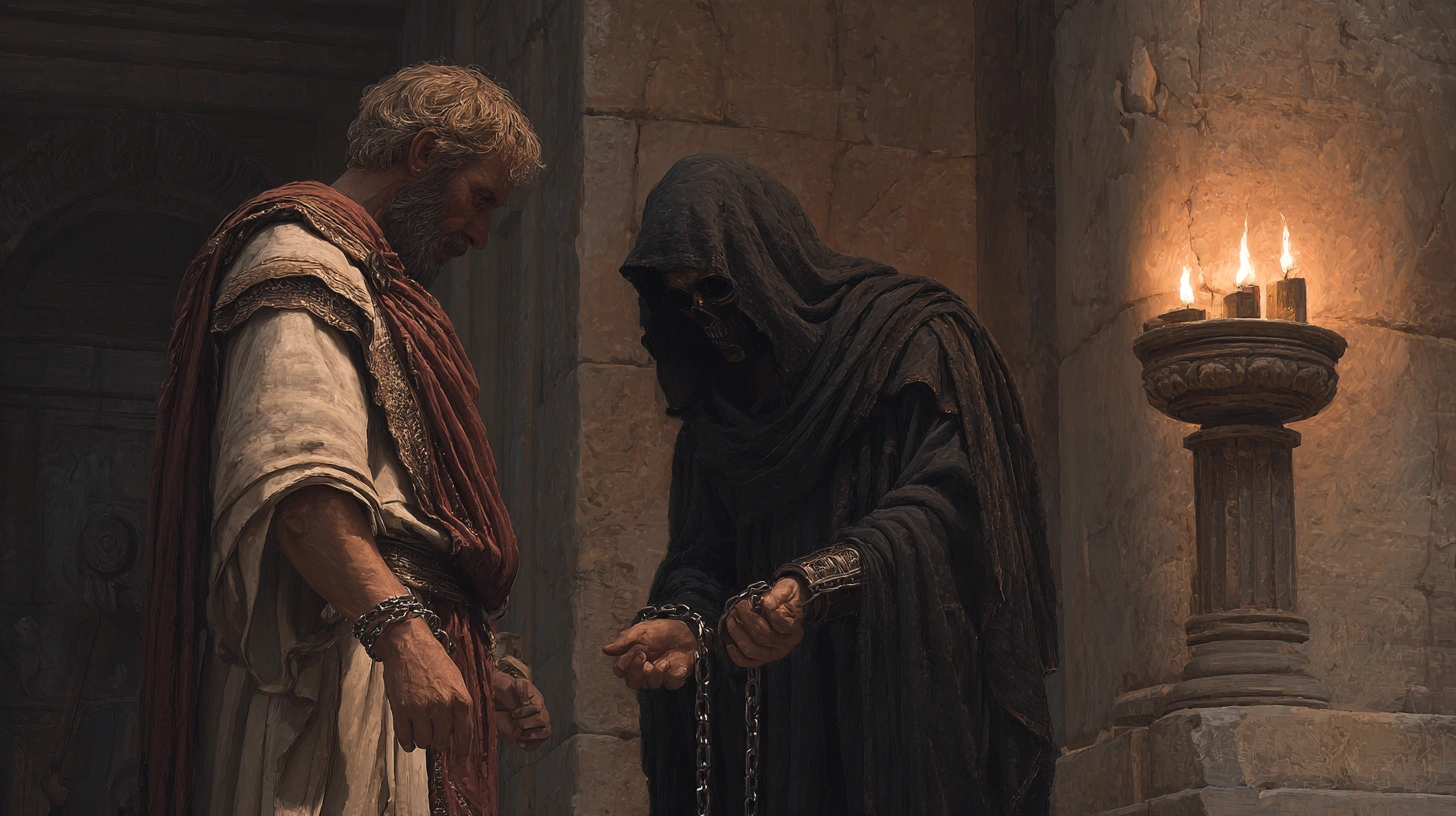
AI reconstruction, not a photograph.
Long before Greek tradition remembered him for an eternity spent pushing a boulder uphill, Sisyphus was remembered for something almost as remarkable: he captured Death itself, and got away with it for long enough that people stopped dying at all, warriors and invalids alike trapped in bodies that could no longer let them go.
A King Known for Cunning Before He Was Known for Punishment
Sisyphus was said to have founded, or at least ruled, the city of Ephyra, later known as Corinth, and Greek tradition consistently painted him as clever to the point of danger, a king willing to deceive gods as readily as rivals. He was remembered as the son of Aeolus, ruler of the winds, and stories about his cunning circulated widely enough that Homer himself called him the most cunning of men in the Iliad, a reputation that followed him through every later retelling of his story. That habit of outsmarting everyone around him, including beings who were technically owed his obedience and respect, set up the two schemes that would eventually define his afterlife more thoroughly than anything he accomplished as a living king.
A Spring in Exchange for a Secret
Sisyphus’s troubles began after he witnessed something he was never meant to see: Zeus carrying off Aegina, daughter of the river god Asopus, to an island that would later be named for her. When Asopus came looking for his missing daughter, distraught and searching the region on his own, Sisyphus recognized an opportunity rather than simply a danger to stay quiet about. He offered to name her abductor, but only in exchange for something practical and lasting rather than any immediate reward, a permanent spring of fresh water on the high citadel of Corinth, a city that badly needed a reliable water supply for its growing population. Asopus agreed to the trade, and the spring, later identified by ancient writers with the famous fountain of Peirene on Corinth’s acropolis, was said to flow from that bargain onward, a genuinely useful gift purchased at a genuinely dangerous price.

Betraying the King of the Gods
With the deal struck, Sisyphus told Asopus exactly what he had seen: Zeus was responsible for taking Aegina. Betraying the king of the gods, even to settle an unrelated grievance that had nothing directly to do with him, was not the kind of offense a mortal could simply walk away from unpunished, no matter how useful the resulting spring turned out to be for Corinth’s residents. Zeus responded by ordering Sisyphus punished directly, and dispatched Thanatos, the personification of Death himself, to bind him in chains and drag him down to the underworld before he could cause any further trouble for the gods or embolden other mortals to test similar limits.
Trapping Death Itself
When Thanatos arrived carrying his chains, prepared to do exactly what Zeus had ordered without expecting any trouble from a mortal, Sisyphus greeted him with what looked like simple curiosity rather than fear. He asked, almost admiringly, how exactly the chains worked, wondering aloud how such a device could possibly hold a being as powerful as Death himself. Thanatos, apparently seeing no harm in satisfying the question and perhaps even a little flattered by the interest, agreed to demonstrate. The moment Death fastened the chains onto his own wrists to show Sisyphus how they closed, Sisyphus snapped them shut and left Thanatos bound and helpless in his own house, a god of death rendered entirely powerless by the very trap he had carried in himself.
A World Where Nothing Could Die
With Death imprisoned, the natural order broke down almost immediately across the entire mortal world. Warriors on distant battlefields survived wounds that should have ended them instantly, left alive but shattered, run through with spears or hacked apart yet somehow still breathing, unable to finish dying no matter how severe the damage. The elderly and the terminally ill, who had been waiting for release from long suffering, found none, trapped in failing bodies that refused to give out entirely. Even animals could not die properly, breaking a boundary that had held since the beginning of the world and disrupting the most basic rhythms of ordinary life, since livestock meant for slaughter simply would not expire. What should have been Sisyphus’s clever personal escape from punishment had, almost as a side effect, thrown the entire mortal world into a kind of suspended agony that no one else had asked for or consented to.

Ares Restores the Natural Order
The god most immediately bothered by the situation was Ares. War without death had become pointless, a spectacle of endless, meaningless violence in which no one could actually be killed no matter how badly they were cut down on the battlefield, robbing combat of the stakes that gave it any meaning at all. Ares eventually intervened directly, freeing Thanatos from Sisyphus’s chains himself and handing Sisyphus back over to Death’s custody, restoring the natural order to a world that had briefly, chaotically, lost the one certainty every living thing had always been able to count on.
One Last Trick, in the Underworld Itself
Even facing Death in person a second time, Sisyphus was not finished scheming. Before he was taken down to the underworld, he instructed his wife, Merope, not to perform the customary funeral rites that would have properly honored and released him, leaving his body without the offerings and burial any dead king was owed. Once he arrived below, he complained to Persephone, queen of the underworld, that he had been brought there improperly, without the burial and offerings any dead man deserved, and persuaded her to let him return briefly to the world of the living to arrange things properly and punish his negligent wife for the oversight. Persephone, apparently convinced by his outrage, granted his request. Once back on the surface, Sisyphus simply refused to return, living out a long stretch of ordinary life among the living before he was finally, forcibly dragged back down, some accounts say by Hermes himself, to face the punishment the gods had been waiting to deliver all along.
That punishment, once Sisyphus finally arrived in the underworld for good, was devised specifically for him: an enormous boulder that he was condemned to push up a steep hill for eternity, only to watch it roll back down again each time he neared the top. It was, in its way, a fitting match for a man who had twice refused to accept the ordinary limits placed on mortal life, forced instead into a labor that could never be completed and a task that offered no ending of any kind, the one form of permanence Sisyphus had never managed to escape.

