This Ancient Girl Had a Neanderthal and a Denisovan Parent
Origins & Prehistory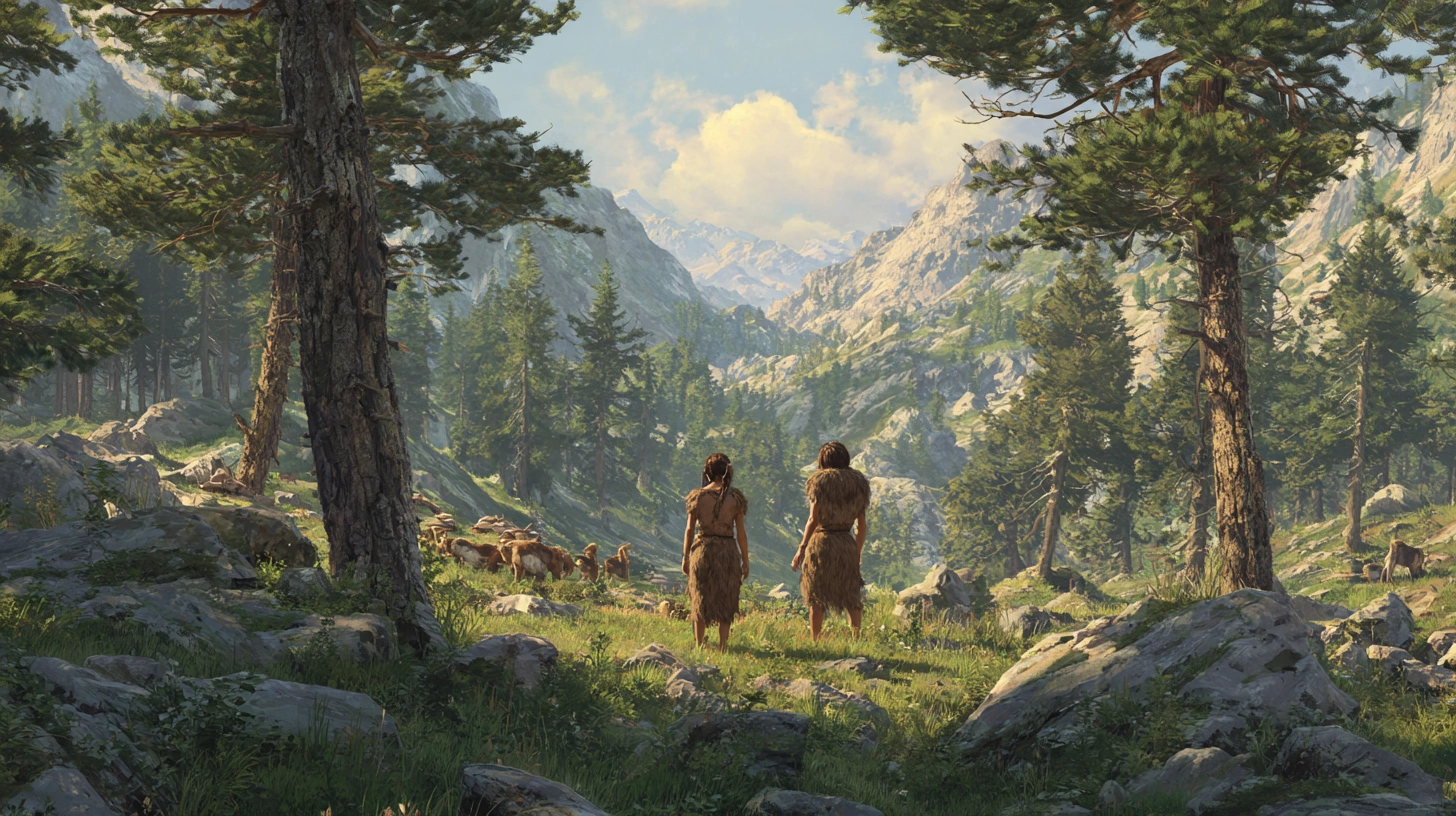
AI reconstruction, not a photograph.
A sliver of bone no larger than a thumb tip, pulled from a Siberian cave and nearly discarded as unidentifiable, turned out to belong to a teenage girl with a Neanderthal mother and a Denisovan father, the only first-generation hybrid between two ancient human lineages ever confirmed. She was not a distant, diluted trace of mixed ancestry passed down across many generations of intermarriage. She was proof of a single meeting, between two individuals from two different, long-separated populations, that produced a child.
A Sliver of Bone Among Thousands
In 2012, researchers sorting through more than two thousand unidentifiable bone fragments excavated from Denisova Cave, in Russia’s Altai Mountains, pulled out one small piece of long bone with no distinctive shape and nothing about its appearance to mark it as unusual among the rest of the collection. It was identified not by how it looked but by what its proteins revealed, since decades of careful excavation at the site had already made clear that visual inspection alone would miss fragments like it entirely. Using a technique called collagen peptide mass fingerprinting, which distinguishes species by subtle differences in bone protein structure rather than visible morphology, a team led by Tom Higham at Oxford was able to determine the fragment belonged to an ancient human, and early mitochondrial testing pointed toward Neanderthal ancestry. The fragment was catalogued as Denisova 11 and eventually nicknamed Denny, joining a small, remarkable collection of archaic human remains this single cave system has produced over decades of excavation.
What the Genome Revealed
Full genomic sequencing, carried out by Viviane Slon and Svante Pääbo’s team at the Max Planck Institute for Evolutionary Anthropology and published in Nature in 2018, showed something far more specific than a general Neanderthal identity. The bone belonged to a girl who died at roughly thirteen years old, based on the thickness of the bone itself, around 90,000 years ago. Her genome showed a pattern researchers had never confirmed directly before in any archaic human specimen: one full set of chromosomes inherited from a Neanderthal parent and a separate full set inherited from a Denisovan parent, rather than a blended mix accumulated gradually across many generations of intermarriage between two mixed populations. That pattern showed up as unusually high heterozygosity across her genome, roughly four times higher than typical Neanderthal or Denisovan individuals sequenced previously, exactly what geneticists would expect in a child with two parents from genetically distinct populations rather than two parents already carrying similar mixed ancestry. Mitochondrial DNA, passed down only through the maternal line, confirmed that her mother was the Neanderthal parent, and comparison of the paternal genetic contribution identified her father as Denisovan.
A Mother From Far Away
Denny’s mother’s genetic signature held an additional surprise. Rather than matching the Neanderthals whose remains had already been found in the same cave, part of a distinct local population sometimes called the Altai Neanderthals, her mitochondrial DNA was more closely related to Neanderthal populations known from farther west, closer to the kind of Neanderthals later found across Europe. That detail suggests her mother’s ancestors, or she herself, had migrated a considerable distance across Eurasia before meeting Denny’s father in the Altai Mountains, evidence that Neanderthal populations were moving and mixing across the continent more extensively than researchers had firmly established before this single genome came along.
A Father Already Carrying Neanderthal Blood
Denny’s father held a surprise of his own. Analysis of his genetic contribution showed traces of Neanderthal ancestry reaching back somewhere between roughly three hundred and six hundred generations before his own lifetime, evidence of a separate, much older interbreeding event somewhere further back in his own Denisovan lineage, long before he himself was born. In other words, Denny was not simply the product of one unusual meeting between two otherwise cleanly separate populations. She was the product of at least two distinct rounds of mixing between Neanderthals and Denisovans, one recent enough to produce her directly, and one considerably older buried deep in her father’s own ancestry, hundreds of generations before he ever encountered her mother.

Who Were the Denisovans, Really?
Denisovans remain one of the strangest chapters in human evolutionary history precisely because so little of them survives physically. Almost everything known about them comes from a small number of bone fragments and teeth, nearly all recovered from this single cave system in the Altai Mountains, since no substantially complete Denisovan skeleton has ever been identified anywhere, an absence that makes Denisovans unusual even among extinct human relatives, most of which are known from at least some recognizable skull or skeletal material. Genetic comparison between Denisovans, Neanderthals, and modern humans shows all three populations descended from a shared common ancestor, before splitting apart and evolving in relative isolation from one another for hundreds of thousands of years, spreading across different parts of Eurasia, only to end up occupying overlapping territory again deep in the Late Pleistocene, long after that initial split.
Not a Rare Accident
Denny’s genome makes it difficult to treat that later overlap as a single, unrepeated coincidence. Other Denisovan genetic material recovered from the same cave shows roughly seventeen percent Neanderthal-derived ancestry on its own, a separate strand of evidence pointing toward repeated contact between the two populations across many thousands of years rather than one isolated encounter that happened to produce a single surviving child. That pattern is still visible today, carried in the DNA of living people all over the world: most Europeans and Asians carry roughly two percent Neanderthal ancestry, while some Melanesian populations carry as much as four to six percent Denisovan ancestry, a genetic footprint that only makes sense if interbreeding happened often enough, across a long enough span of time and in enough different places, to leave a lasting mark on population after population rather than fading out after one brief encounter.
Some questions about Denny’s own existence remain unanswered, and likely always will. Researchers cannot say whether the meeting between her parents was consensual by any modern standard, or whether hybrids like her were even capable of having children of their own, a common complication when otherwise distinct lineages interbreed after long periods of separate evolution. What her genome does answer is the larger question her discovery raised about ancient humans generally: distinct lineages that had been evolving apart for hundreds of thousands of years, in different corners of an enormous continent, were, evidently, never quite as separate as the sheer length of that separation alone would suggest.

