Tyr Paid for the Gods’ Broken Promise With His Hand
Vikings & Norse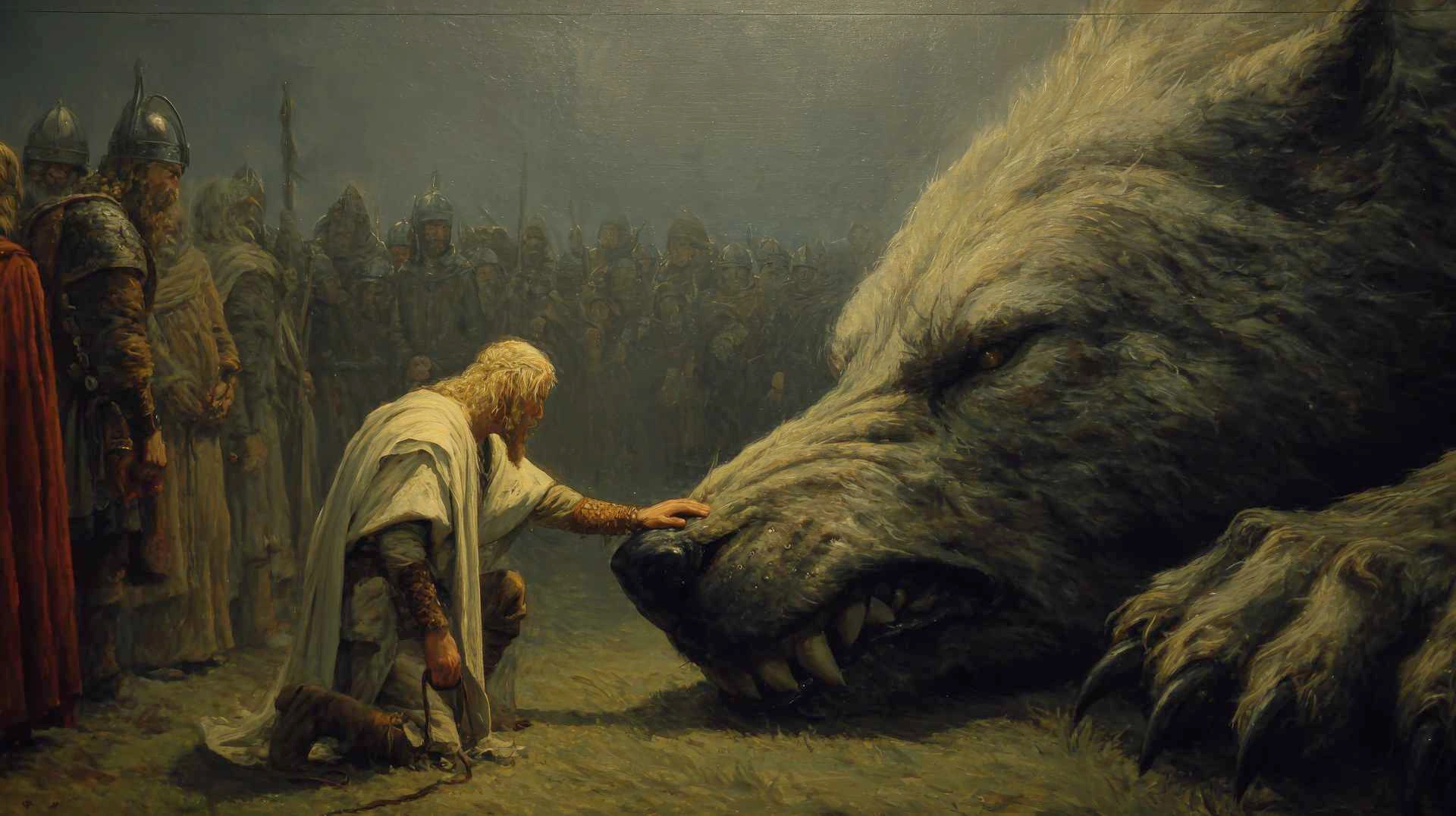
AI reconstruction, not a photograph.
Týr appears only a handful of times in the medieval Icelandic sources that preserve most of what survives of Norse mythology, far less often than Odin or Thor. His name, though, points toward something older than either of theirs, and the one story where he plays a central role costs him more, in permanent physical terms, than any surviving myth costs any other god in the Norse pantheon.
A Name Older Than the Stories About Him
Týr’s name descends from the Proto-Germanic *Tiwaz, which in turn traces back to the Proto-Indo-European root *deywos, a word meaning roughly “god” or “shining, celestial one.” That same root produced the names of major deities across a wide swath of ancient Indo-European religion, including the Greek Zeus and the Roman Jupiter, whose own name derives from a compound meaning “sky father,” and related words for divinity in Sanskrit and other ancient languages descended from the same distant linguistic family. The connection suggests that Týr’s name preserves something close to the oldest layer of Germanic religious vocabulary, a general word for divinity that eventually narrowed to refer to one specific god, even as later mythology pushed him to the margins of the pantheon in favor of Odin and Thor. Some scholars have taken this as a sign that Týr, or a god like him, may once have held a more central position in earlier Germanic religion than the surviving medieval sources, written down centuries after Christianization began, would suggest.
A Roman’s Best Guess
The earliest written reference that may describe Týr comes from a Roman source rather than a Germanic one. Writing around AD 98, the historian Tacitus described the religious practices of Germanic peoples in his short ethnographic work Germania, identifying one of the deities they worshipped with the Roman god Mars. Many scholars have connected this figure with Týr, since both were associated with war, and the identification fits the broader Roman habit of mapping foreign gods onto their own pantheon based on perceived shared function, a practice known as interpretatio romana. That habit makes Tacitus’s account useful but imprecise. He was describing Germanic religion through a Roman lens, matching gods by role rather than by name, so treating his “Mars” as a confirmed, precise reference to Týr specifically calls for real caution rather than certainty.
A Wolf Raised Among Gods
Týr’s clearest surviving story concerns Fenrir, a monstrous wolf born to the trickster god Loki and the giantess Angrboða, one of three fearsome offspring from that union alongside the World Serpent Jörmungandr and the ruler of the dead, Hel. Prophecy held that Fenrir was destined to play a central, destructive role at Ragnarök, the foretold end of the world, and the gods raised him among themselves partly to keep watch over him as he grew. Only Týr was willing to actually feed the growing wolf, a detail medieval sources treat as an early sign of his particular courage, since none of the other gods dared approach an animal already rumored to be dangerous. As Fenrir grew larger and more dangerous, the gods tried to restrain him with two iron chains, one named Leyding and a second, stronger chain named Dromi, each time framing the attempt as a simple test of the wolf’s strength rather than a genuine effort at permanent confinement. Fenrir broke free of both without much apparent difficulty, convincing the gods that no ordinary binding would hold him.
A Ribbon Made From Impossible Things
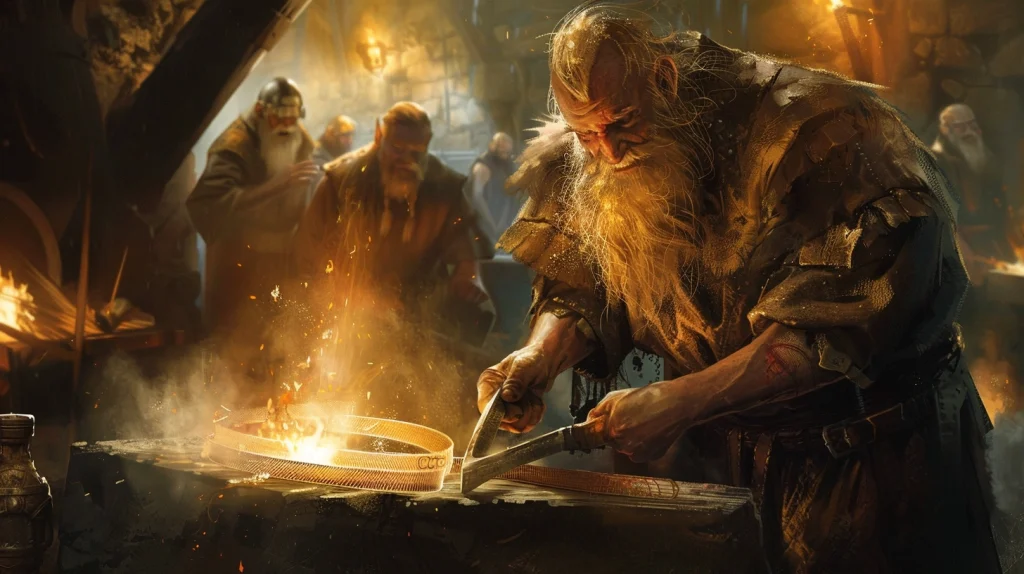
With ordinary chains proven useless, the gods turned to the dwarves of Svartálfaheimr, master craftsmen capable of working with materials no blacksmith could touch. What they produced was Gleipnir, a fetter that looked like a thin, smooth ribbon rather than a chain, forged from six things that do not exist in the ordinary world: the sound of a cat’s footfall, the beard of a woman, the roots of a mountain, the sinews of a bear, the breath of a fish, and the spittle of a bird. The Prose Edda explains that this is precisely why none of those six things can be found in the world today, since all of them were used up in the making of Gleipnir. Despite its harmless appearance, Fenrir grew suspicious the moment he saw it. A binding that thin, he reasoned, should be easy to break, unless it had been made with exactly that trick in mind, and he refused to be bound a third time without some assurance that the gods were not simply setting up another humiliating failure at his expense.
The Pledge in the Wolf’s Mouth
Fenrir agreed to be bound with Gleipnir only on one condition: that a god place a hand inside his mouth as a pledge of good faith, a guarantee that the gods intended to release him if the fetter turned out to hold. None of the gods stepped forward, unwilling to make a promise they suspected they had no intention of keeping. Týr alone volunteered, walking forward and placing his right hand between Fenrir’s jaws before the binding began.
The Price of the Gods’ Deception
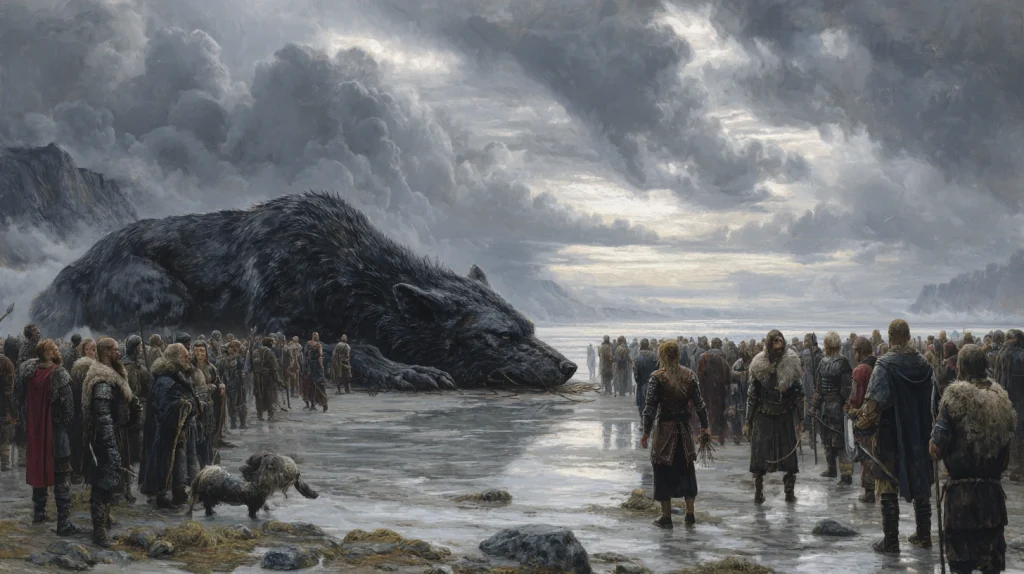
Once Gleipnir was fastened around him, Fenrir strained against it with everything he had and found, for the first time in his life, that he could not break free. Realizing he had been tricked, he closed his jaws, biting off Týr’s hand at what the sources call the wolf’s joint, the wrist. The other gods, watching Fenrir finally and permanently restrained, laughed at their success. Týr did not. The Prose Edda, compiled in the thirteenth century by the Icelandic writer Snorri Sturluson, records the episode with characteristic bluntness, noting afterward that Týr had lost his hand and was no longer considered a fit mediator of settlements between people, a wry aside that quietly links his personal loss to his broader role as a god associated with law, oaths, and justice among the Norse gods.
Fenrir remained bound after that, a sword wedged between his jaws to hold them open and his own saliva said to form a running river called Ván, waiting out the ages until the day the sources predict he will finally break free at Ragnarök and kill Odin himself before being killed in turn by one of Odin’s sons. Týr, meanwhile, is left in the myths as the one god whose reputation rests less on victory than on what victory cost him, a single, deliberate sacrifice that the other gods, laughing at the wolf’s capture, were never asked to make themselves.

