Daniel Names Michael, but the Euphrates Angels Stay Nameless
Biblical History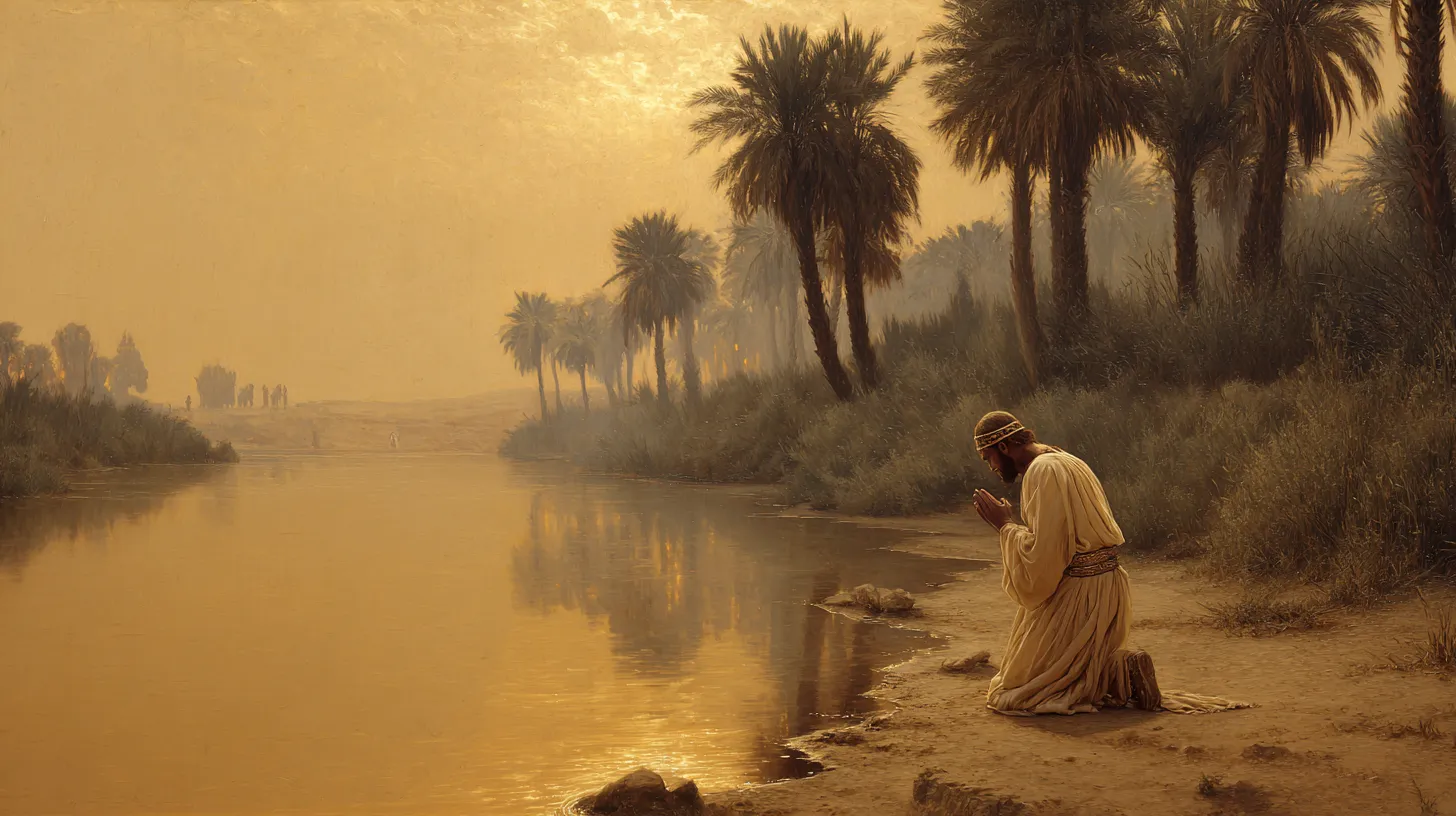
AI reconstruction, not a photograph.
Daniel 10:13 gives one angel a name and leaves his opponent without one, and Revelation 9:14 goes further: four angels are bound at the Euphrates, and the text names none of them. Readers keep asking who the four are. The Bible never says, and the two best-known answers, one drawn from the Book of Enoch and one from Daniel’s talk of princes, are proposals the text itself does not make.
A Named Angel, an Unnamed Rival
Daniel 10 opens in the third year of Cyrus, king of Persia (10:1). Daniel has been mourning for three full weeks (10:2-3). On the twenty-fourth day of the first month he is beside the great river Hiddekel, usually identified with the Tigris, when a man clothed in linen appears (10:4-5). Only Daniel sees the vision, and the men with him flee (10:7). The man tells him that “the prince of the kingdom of Persia withstood me one and twenty days.” Then comes the line at the centre of the question: “Michael, one of the chief princes, came to help me” (10:13).
The messenger is not named in this chapter. Michael is, and he is named twice more, as “Michael your prince” (10:21) and as “the great prince which standeth for the children of thy people” (12:1). The rival gets only a title, “the prince of Persia,” and a second power, “the prince of Grecia,” is said to be coming next (10:20).
Named angels are a late feature of the Hebrew Bible. David L. Everson, writing in Bible and Interpretation in 2009, says named angels “do not appear within pre-exilic biblical literature,” and that in Daniel they receive names. Encyclopaedia Britannica notes that numerous scholars date Daniel to the first half of the second century BC, although the book sets this vision in the sixth century BC.
Princes of Kingdoms
What is “the prince of Persia”? The nineteenth-century commentators Keil and Delitzsch took him to be a “guardian spirit of the kingdom.” The idea is sometimes tied to Deuteronomy 32:8, where the King James Version has God setting the bounds of the peoples “according to the number of the children of Israel,” while the Septuagint and a Dead Sea Scrolls text have “sons of God.” F. F. Bruce, quoted by C. Peter Wagner, said the Septuagint reading implies that the administration of the nations “has been parceled out among a corresponding number of angelic powers.” David E. Stevens, on the other hand, notes that many scholars read the prince of Persia as an earthly ruler such as Cambyses II, though he himself accepts the angelic reading.
Daniel 10 does not settle the matter. It says the prince “withstood” the messenger, that Michael came to help, and that the messenger will return to fight the prince of Persia. How either power acted is not described.
Four Angels and No Names
Revelation 9 reaches its sixth trumpet with a voice “from the four horns of the golden altar which is before God.” The voice orders the trumpeter, “Loose the four angels which are bound in the great river Euphrates” (9:13-14). When they are loosed, they are “prepared for an hour, and a day, and a month, and a year,” and their task is to kill a third of mankind (9:15). John writes that he was on the island of Patmos (1:9), and the book is usually dated to the 90s AD, in the reign of Domitian.
Nothing more is said about the four. The passage does not say who bound them, when, or for what. The United Bible Societies handbook on Revelation, by Bratcher and Hatton, compares their binding to the holding back of the four winds in chapter 7 and notes that the passive wording shows God is in charge: they are released only when he chooses. Phillip J. Long adds that Revelation does not identify them and that they seem to be a different set from the four angels of 7:1. Whether they are good or evil is left open, though the IVP New Testament Commentary reads them as evil angels in charge of the demonic cavalry that follows.
The book does name some angels. Michael leads his angels against the dragon in 12:7, and the king of the locusts is “the angel of the bottomless pit,” called Abaddon in Hebrew and Apollyon in Greek (9:11). Another angel, with a great chain, binds the dragon for a thousand years (20:1-2), and he goes unnamed. Jude 9 calls Michael “the archangel.” The silence about the four is therefore not a rule of the book.
A Prison in Enoch
The Book of Enoch, a Second Temple Jewish work outside most biblical canons, does name its angels and its prisons. In R. H. Charles’s translation, Michael, Uriel, Raphael and Gabriel look down from heaven on the bloodshed on the earth (9:1). The Lord then tells Raphael to bind Azazel hand and foot in the desert of Dudael (10:4-5), and tells Michael to “bind Semjaza and his associates” (10:11). They are to be held “for seventy generations in the valleys of the earth” until the day of judgement (10:12).
The comparison with Revelation is partial. Enoch’s Watchers number two hundred (6:6), not four, and nothing in the passages quoted puts them at the Euphrates. What the two books share is the idea of angels held in custody until a set time. Jude 6 and 2 Peter 2:4 also speak of chained angels, and Jude quotes Enoch directly (Jude 14-15), but Revelation never cites Enoch, and no source used here shows that John meant the Watchers.
Why the Euphrates?
The river itself may explain more than the names do. The Old Testament calls it “the great river, the river Euphrates” and makes it the far boundary of the land promised to Abram’s descendants (Genesis 15:18). It is also the river of Babylon and Assyria, the powers that invaded Judah. Isaiah 8:7-8 pictures the king of Assyria as a flood, “the waters of the river, strong and many,” and Jeremiah 46:10 sets a day of vengeance “in the north country by the river Euphrates.”
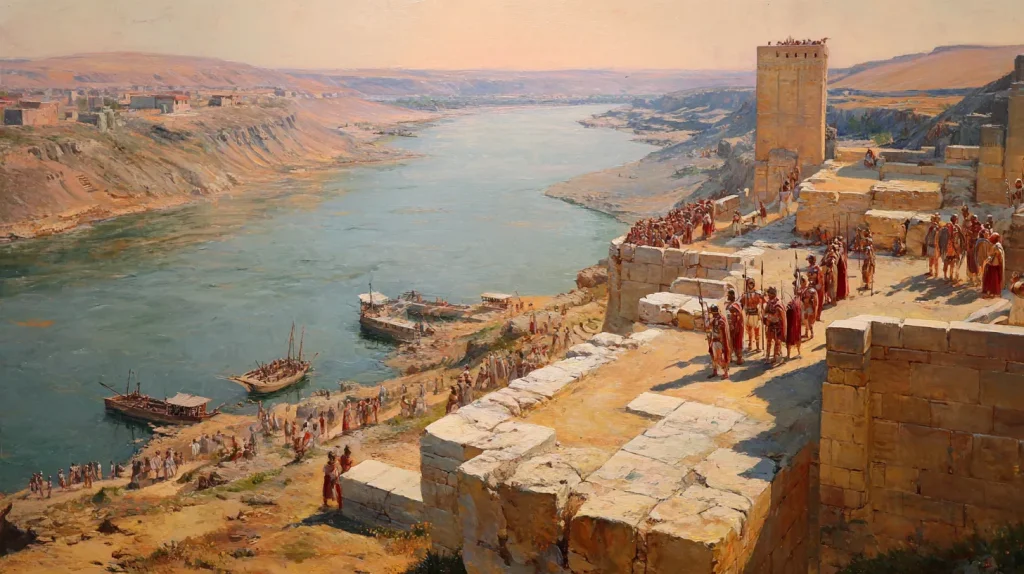
By John’s day the river marked the eastern boundary of the Roman Empire, according to Bratcher and Hatton, with the Parthian kingdom beyond it. Long notes that many commentators read the cavalry of Revelation 9 as an echo of Parthian horsemen, though he himself reads the horde as demonic. The IVP commentary adds that Romans feared the Parthians beyond the Euphrates. At Zeugma, whose name means “bridge,” the Romans stationed Legio IV Scythica in AD 66 to guard against Parthian invasions and Armenian raids, according to Livius.org. None of this says why John set the four angels there. It shows only what the river meant to people who knew the frontier.
Two Proposals, No Verdict
Two proposals fill the gap. The first draws on Enoch: the four are Watchers, or powers like them, held until a day of judgment. The second draws on Daniel: if nations have princes, as Daniel 10 suggests, the four might be powers once tied to the kingdoms of the Euphrates, such as Babylon, Assyria or Persia.
The sources used here treat both as proposals and do not choose between them. The second is an inference, since no commentator in the sources checked makes it, and Daniel names princes only for Persia and Greece (10:20).
Whether the river is literal or symbolic is also open. Naming and not naming may carry no meaning at all, since the text never says a name was withheld on purpose. The Bible names the archangel in one book and gives no name for the four in the other, and it never explains the difference.

