The Bible Gives Weight to Sinai, the Jordan and Hinnom
Biblical History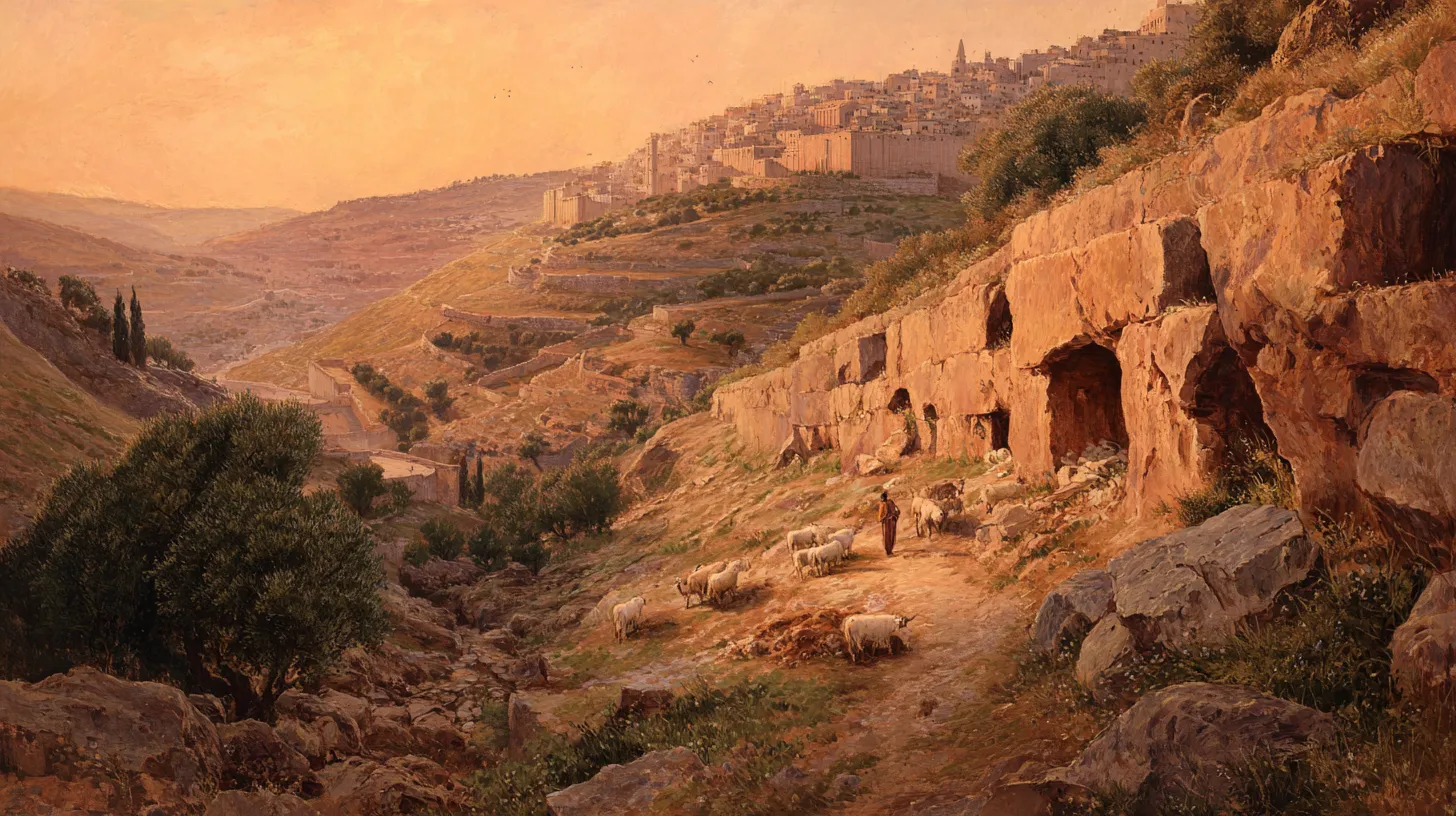
AI reconstruction, not a photograph.
Sinai, the Jordan and the valley of Hinnom are real places that the Bible loads with meaning, and readers sometimes ask whether the Euphrates of Revelation 9:14 belongs with them. The pattern is real. The Bible never groups these places itself, though, and no verse calls the Euphrates a gateway.
Sinai, a Mountain Nobody Can Locate
Exodus describes Sinai in the language of storm and fire. Thunder, lightning and a thick cloud cover the mountain (19:16), and “the LORD descended upon it in fire” (19:18). Later “the glory of the LORD abode upon mount Sinai,” and to the Israelites its sight was “like devouring fire” (24:16-17). Moses stays there forty days and forty nights (24:18). “Heaven and earth met” is a reader’s summary of such scenes. The text says the LORD “came down upon mount Sinai” (19:20).
The mountain’s location is a separate problem. A sidebar in Biblical Archaeology Review, signed R.N., says of the traditional Jebel Musa in the southern Sinai peninsula that no objective reason can be given for choosing it, and that “there are neither archaeological nor historical reasons for the identification.” The tradition was a major contender by the fourth century, when the pilgrim Egeria, probably in 381-384, was shown the “Mountain of God” and a cave associated with Moses. After Justinian built a fortress-monastery at the foot of the mountain in the late sixth century, its identity was “sealed in Christian belief.” Jebel Serbal, also in the south, has its own old tradition, and critics of the tradition have proposed other mountains, such as Jabal al-Lawz.
So Sinai carries its weight without a map reference. The text gives the mountain a name and a manner of divine arrival, and later tradition supplied the place.
The Jordan, a River That Has Stopped
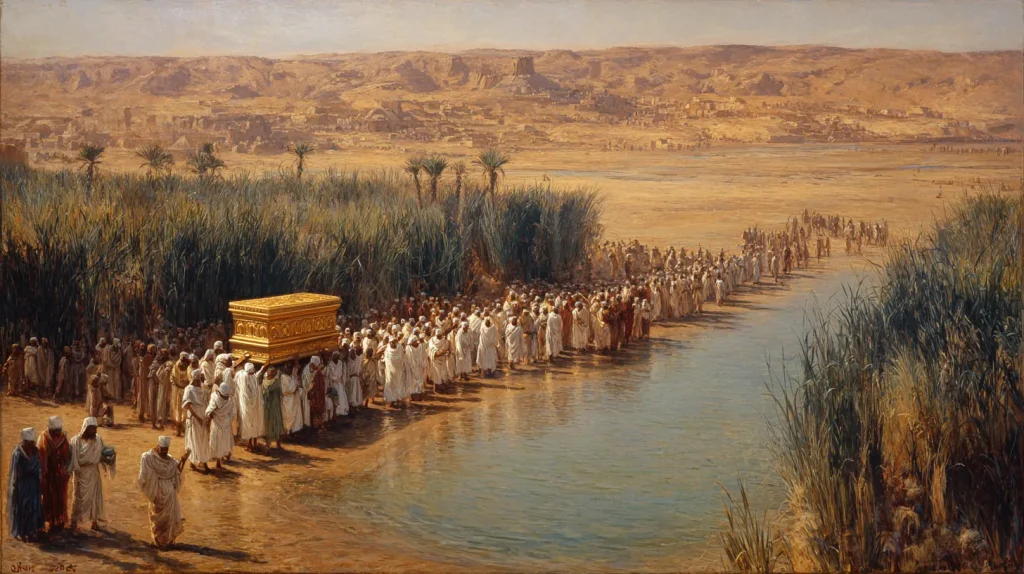
The Jordan marks turning points. In Joshua 3 the priests carry the ark to the river while it “overfloweth all his banks all the time of harvest” (3:15). When their feet touch the water, the water from upstream “stood and rose up upon an heap,” the water below “failed,” and the people cross “right against Jericho” (3:16). The text dates the crossing only to a day and month, the tenth day of the first month (4:19), and gives no year.
Other Jordan scenes follow. Elijah divides the water with his mantle (2 Kings 2:8), Naaman dips himself seven times (2 Kings 5:14), and in Mark 1:9-11 Jesus is baptized “in Jordan” as the heavens open. John 1:28 places John’s baptizing “beyond Jordan.” At Al-Maghtas on the east bank, a site inscribed by UNESCO in 2015, excavations found Byzantine churches and plastered baptism pools dated roughly to the fifth to early seventh centuries AD. Madain Project notes that the site’s identification as the place of the baptism rests mainly on John’s Gospel.
The river has also stopped in recorded history. The United Bible Societies Handbook on Joshua, by Bratcher and Newman (1983), reports that a landslide in the soft walls of the Jordan blocked the flow for 16 hours in 1267, and that an earthquake on 11 July 1927 stopped it for 21½ hours. W. F. Albright proposed that the Joshua stoppage was a similar blockage at Adam, about 30 kilometres north of Jericho, with the water backing up as far as Zarethan, some 20 kilometres farther north. Jefferson Williams’s compilation at deadseaquake.info gives other figures, such as 22.5 hours for 1927 and the year 1266 for the medieval event, so the numbers are approximate.
The passage does not mention a landslide, and it ties the stoppage to the moment the priests’ feet touched the water. Whether a natural blockage lies behind Joshua 3 is a suggestion, not something the text says.
Hinnom, the Valley Behind Gehenna
The valley of Hinnom lies by Jerusalem, and Joshua 15:8 uses it as a border marker. Its darker meaning comes from Judah’s own kings. Jeremiah says the people built high places at Tophet, in the valley of the son of Hinnom, “to burn their sons and their daughters in the fire” (7:31), and he warns that the place will be renamed “the valley of slaughter” (7:32, 19:6). Second Kings 23:10 says King Josiah defiled Topheth so that no one could make a son or daughter “pass through the fire to Molech.”
The Gospels carry the name forward in Greek as Gehenna, and the King James Version renders it “hell” (Matthew 5:22, 10:28, Mark 9:43-48). A popular explanation says Hinnom was Jerusalem’s burning garbage dump, and that Jesus chose the image for that reason. The sources used here do not support it. Todd Bolen of BiblePlaces, in a 2011 post, quotes Lloyd R. Bailey, who traced the explanation to Rabbi David Kimhi’s commentary on Psalm 27 around AD 1200 and wrote that “there is no evidence that the valley was, in fact, a garbage dump.” G. R. Beasley-Murray calls the notion “not attested in any ancient source,” and W. D. Davies and D. C. Allison call it “without ancient support, although it could be correct.” Bolen offers the child sacrifice named by Jeremiah as a simpler explanation of why the valley became a symbol. Wikipedia’s article on Tophet adds that no archaeological evidence for a Tophet at Jerusalem has been found.
What archaeology has found at Hinnom is a cemetery. At Ketef Hinnom, a burial site southwest of ancient Jerusalem, Gabriel Barkay’s team found two small silver scrolls in a rock-cut burial cave in 1979, dated to about 650-587 BC. One carries the priestly blessing of Numbers 6:24-26 and the divine name. Barkay called them “the only biblical verses we have from the time of the First Temple.” The scrolls are now in the Israel Museum.
The Euphrates, Where the Question Starts
The Euphrates is the longest river in Western Asia, about 2,700 to 2,800 kilometres depending on the source, and the Encyclopaedia Judaica lists Carchemish, Mari, Babylon, Erech and Ur among the cities on or near its banks. It enters Scripture early. Genesis 2:14 names it as the fourth river of Eden, and in Genesis 15:18 it is “the great river” that marks the border of the land promised to Abram’s descendants.
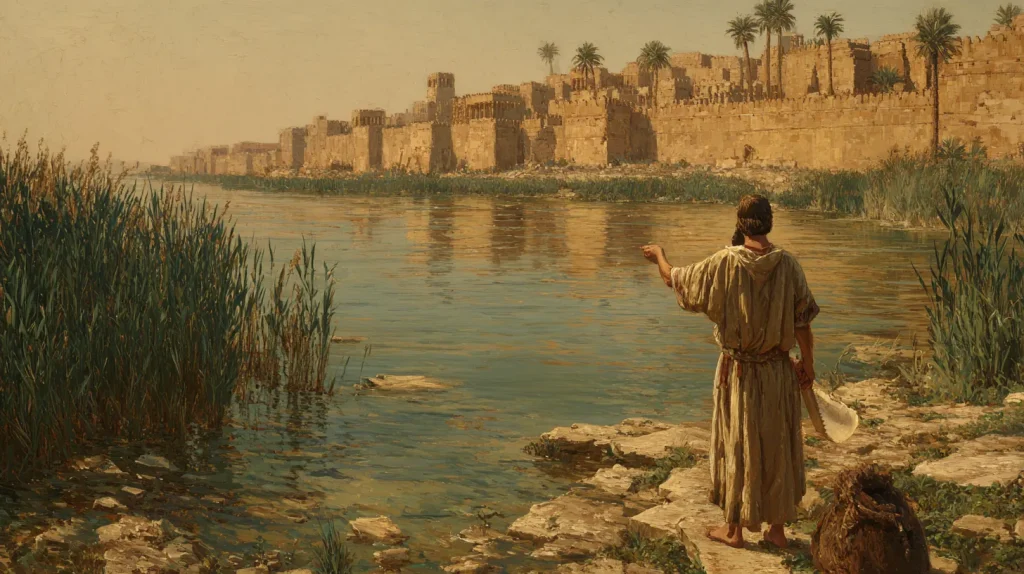
In Jeremiah 51 the river becomes a stage for a sign. In the fourth year of King Zedekiah, about 594 BC, Seraiah goes to Babylon with a book of Jeremiah’s words against the city. He is to read it, bind a stone to it and “cast it into the midst of Euphrates,” saying “Thus shall Babylon sink” (51:59-64). The Encyclopaedia Judaica adds that third-millennium texts from Mari show the river treated as a deity. Revelation brings the river back twice. Four angels are bound in it (9:14), and the sixth bowl dries it up “that the way of the kings of the east might be prepared” (16:12).
What a Pattern Cannot Prove
Each of the three places has its own texts, and each carries more than its geography. Sinai is the mountain where the LORD comes down, though no one can say with confidence where it is. The Jordan is where the people pass into the land and where Jesus is baptized, and it has been blocked in recorded history. Hinnom is a border valley, a place of burning in Jeremiah’s day and the source of the name Gehenna, and the garbage-dump explanation of that name has no ancient support.
The Euphrates carries weight too: Eden, a boundary, a sign against Babylon, a river that is dried up. The comparison readers make is an observation, and a fair one, that Scripture does not keep geography and meaning apart. It is not evidence about Revelation 9:14. A river that carries meaning in one passage need not carry the same meaning in another, the Bible never groups these places together, and no verse calls the Euphrates a gateway, a seal or a veil. Revelation 9:14 says only that four angels are bound there, and readers differ on whether the river is literal, symbolic or both.

