Does Looking at the Ark Mean Fire? Ethiopia’s Deadly Rule
Biblical History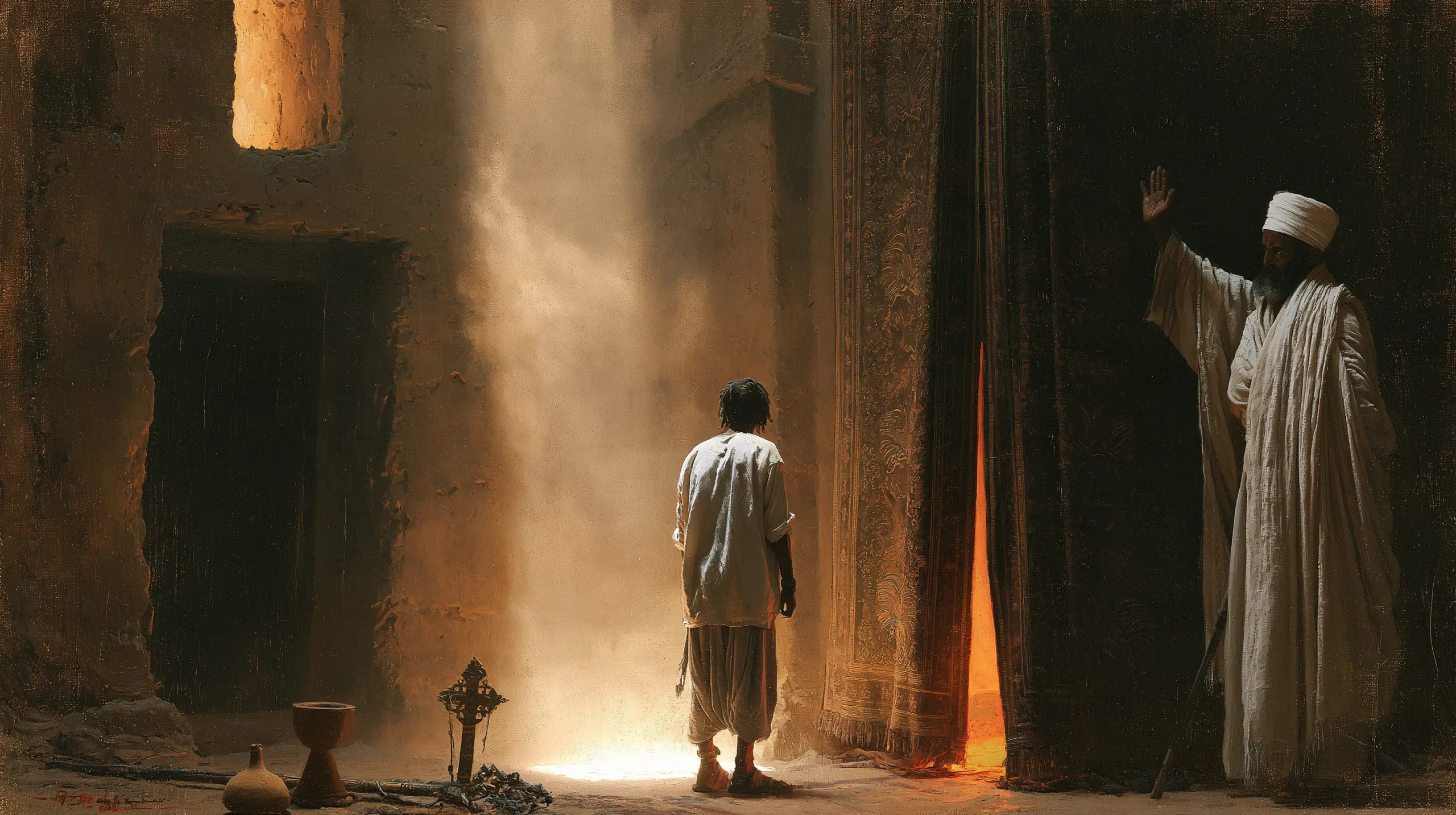
AI reconstruction, not a photograph.
A photojournalist who travelled in northern Ethiopia says believers there told him the power of the Ark of the Covenant can burn a person alive. He says he was told that anyone other than the guardian priest who looked at one of the sacred tablets would be consumed by fire at once, which is why every tablet is wrapped in cloth. The belief echoes older stories in the Bible, where the Ark is a holy and dangerous object. This article sets out what the photojournalist says he was told, what Ethiopian churches do with their tablets, where the caution comes from in the Bible and what the account cannot show.
What the Photojournalist Says He Was Told
At a church in a village called Bethlehem, the photojournalist says, he was warned not to step too close to the curtain. If he touched the object behind it, he was told, flames would shoot up his nostrils. The priest also told him he could not enter the inner part of the church, because he had recently eaten and been with his wife and was therefore temporarily impure. A deacon let him in under watch. He describes himself as a sceptic and says it still seemed wise to obey.
The account is one traveller’s report. The sources consulted for this article contain no second witness to the visit and no record of it made at the time, so it is treated here as what it is: a warning given to a visitor by people who keep a rule.
The Tabot and Its Coverings
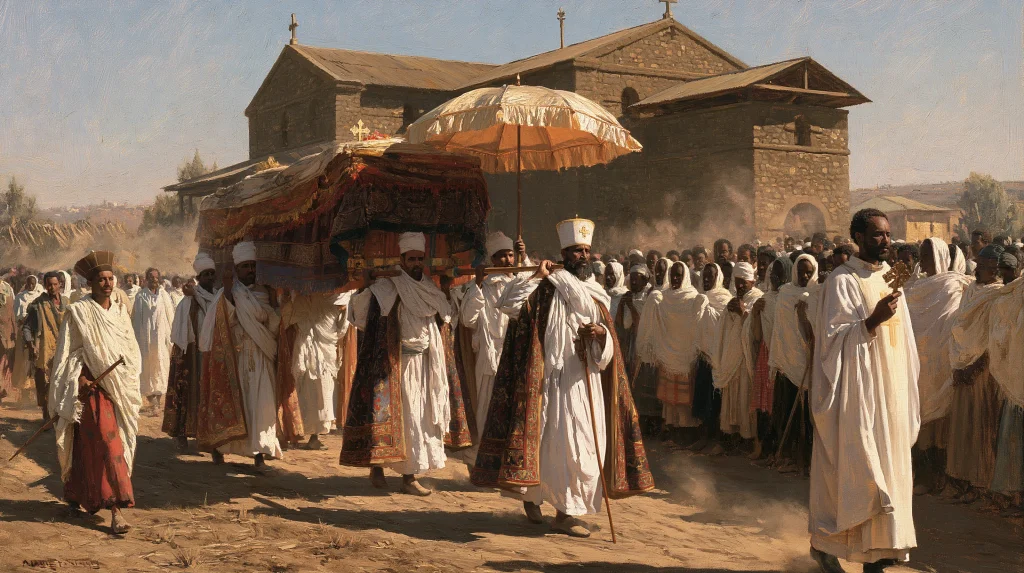
In Ethiopian Orthodox churches the sacred tablet is called a tabot. Wikipedia describes it as “a replica of the Ark of the Covenant, and represents the presence of God”. The same article says that “Only bishops and priests are allowed touch or handle a tabot”, and that they alone may see it without its coverings. The tabot is “wrapped in ornate cloths to conceal it from public view”. It is kept in the church’s innermost sanctuary, “where only the clergy may enter”. In a Smithsonian magazine article, Paul Raffaele describes the sanctuary of one church as an inner room “shielded by brocade curtains and open only to senior priests”, a setting like the one the photojournalist describes.
The penalty that Wikipedia records for breaking the rule is ritual, not fiery. If a layperson touches a tabot, “a bishop must reconsecrate it before a church may use it again”. The article mentions neither fire nor death.
The rule is kept far from Ethiopia too. The Art Newspaper reported in 2019 that the British Museum holds eleven tabots, which it says British troops seized at Maqdala in 1868, and that the Ethiopian Church holds that tabots “should never be viewed by anyone other than its priests”. The newspaper called them “an invisible part of the British Museum’s collection”. Wikipedia says the museum has, since 2004, limited viewing of them to “Ethiopian Orthodox clergy”.
The strictest form of the rule is claimed for the Church of Saint Mary of Zion at Axum, which, in Wikipedia’s words, “claims to contain the original Ark of the Covenant”. Wikipedia’s article on the church says “only the guardian monk may view the Ark”, and that he is “confined to the chapel of the Ark of the Covenant” for the rest of his life. The article ties the restriction to “the Biblical accounts of the dangers of doing so”, without saying what those dangers are. The guardian told Raffaele: “No king or patriarch or bishop or ruler can ever see it, only me.”
The same article reports a tradition that comes close to fire. As part of the church’s account, it says the Ark was moved to the Chapel of the Tablet because “a divine ‘heat’ from the Tablets” had cracked the stones of its previous inner sanctum. It frames the church’s position as a claim, and it adds that questions about the account have led Ethiopian and foreign scholars alike to doubt it.
Where the Caution Comes From
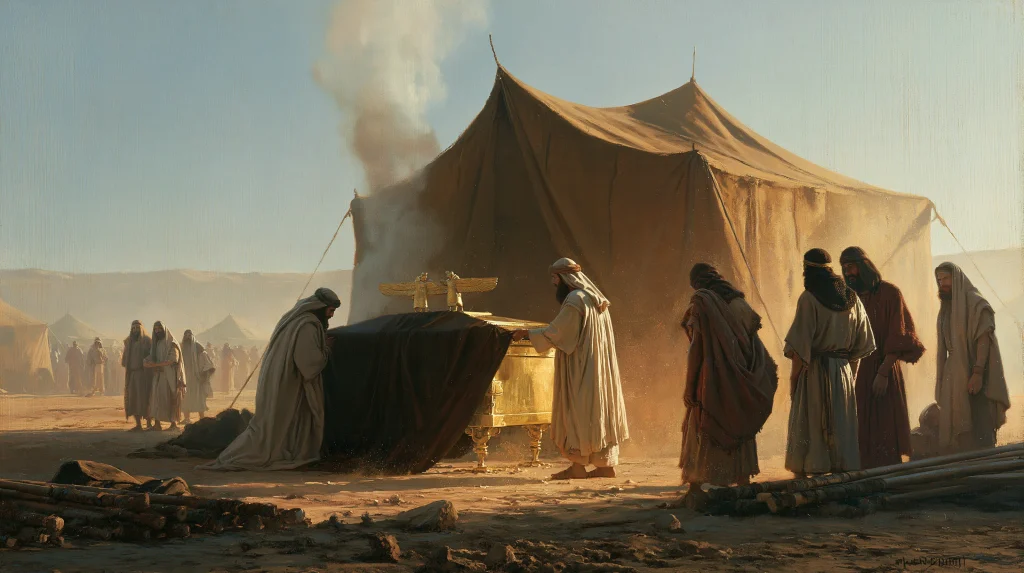
The Bible supplies a precedent for the covering. In Numbers 4:5-6, Aaron and his sons take down “the covering vail” and cover the ark of testimony with it, then add a covering of badgers’ skins and a cloth wholly of blue. Only after that, in 4:15, do the sons of Kohath come to carry it, and they “shall not touch any holy thing, lest they die”. Verse 20 adds that they “shall not go in to see” the holy things being covered, “lest they die”.
In 1 Samuel 6, the Ark comes back from the Philistines on a cart and the men of Beth-shemesh rejoice to see it. Then, as verse 19 has it, the LORD “smote the men of Bethshemesh, because they had looked into the ark of the LORD”. The King James Version gives the toll as fifty thousand and threescore and ten. A translation commentary on the verse calls so large a number “highly improbable” and says most translations, including the NIV, follow the few Hebrew manuscripts that read seventy men. Whichever number is right, the victims are not attacking the Ark. They are looking into it.
In 2 Samuel 6, Uzzah puts out a hand to the Ark when the oxen shake it, and God “smote him there for his error”. David is afraid and leaves the Ark in the house of Obed-edom, where it stays three months and the LORD blesses the household. The Bible does not say the Ark was always deadly. It shows an object whose holiness is dangerous to the unprepared.
The purity warning has a biblical echo as well. Before the LORD came down at Sinai, Moses told the people to “come not at your wives” (Exodus 19:15), and Leviticus 15:18 makes a man and woman who have lain together “unclean until the even”. Kirsten Stoffregen Pedersen, writing on whether the Church of Ethiopia is a Judaic church, says its understanding of ritual purity in “other sexual matters” is “based on Leviticus 15”, and that people who are ritually unclean may approach a church building but “they must not enter”. A refusal at the inner door fits a rule the church is described as applying.
What the Account Cannot Show
What the account cannot show is whether the threat has ever been tested. Nothing in it describes anyone being burned, and the rule itself keeps outsiders from checking.
Other visitors report the belief without a test. A photo series titled The Covenant with God, by Asier Alcorta Hernández, carries a description on the Fine Art Photography Awards site saying that “common belief is that it could kill anyone who should do so”. Raffaele records the fear from the visitor’s side. He was held back, he writes, by the fear that “the ark would harm me if I dared defile it with my presence”. None of the sources consulted records a person being burned.
One claim is of a different kind. Wikipedia says Edward Ullendorff “personally examined the ark contained within the church in 1941” as a British officer and “described the ark as empty”. Live Science quotes the scholar Tudor Parfitt as saying that what Ullendorff saw was “a model of the Ark of the Covenant”, the kind found in any Ethiopian church. Even if the claim is accepted, it concerns what a box contained, not what happens to a person who looks.
What Can Be Said
The shape of the belief is old and its practice is current. The Bible’s Ark strikes down people who touch it or look into it, Ethiopian churches keep their tablets covered and out of sight, and a visitor reports being warned of fire. What can be said plainly is narrow: a deadly rule protects the sacred object, and the story of its enforcement is told, not shown.

