Why Did Uzzah Die Touching the Ark? What 2 Samuel 6 Says
Unexplained & Claims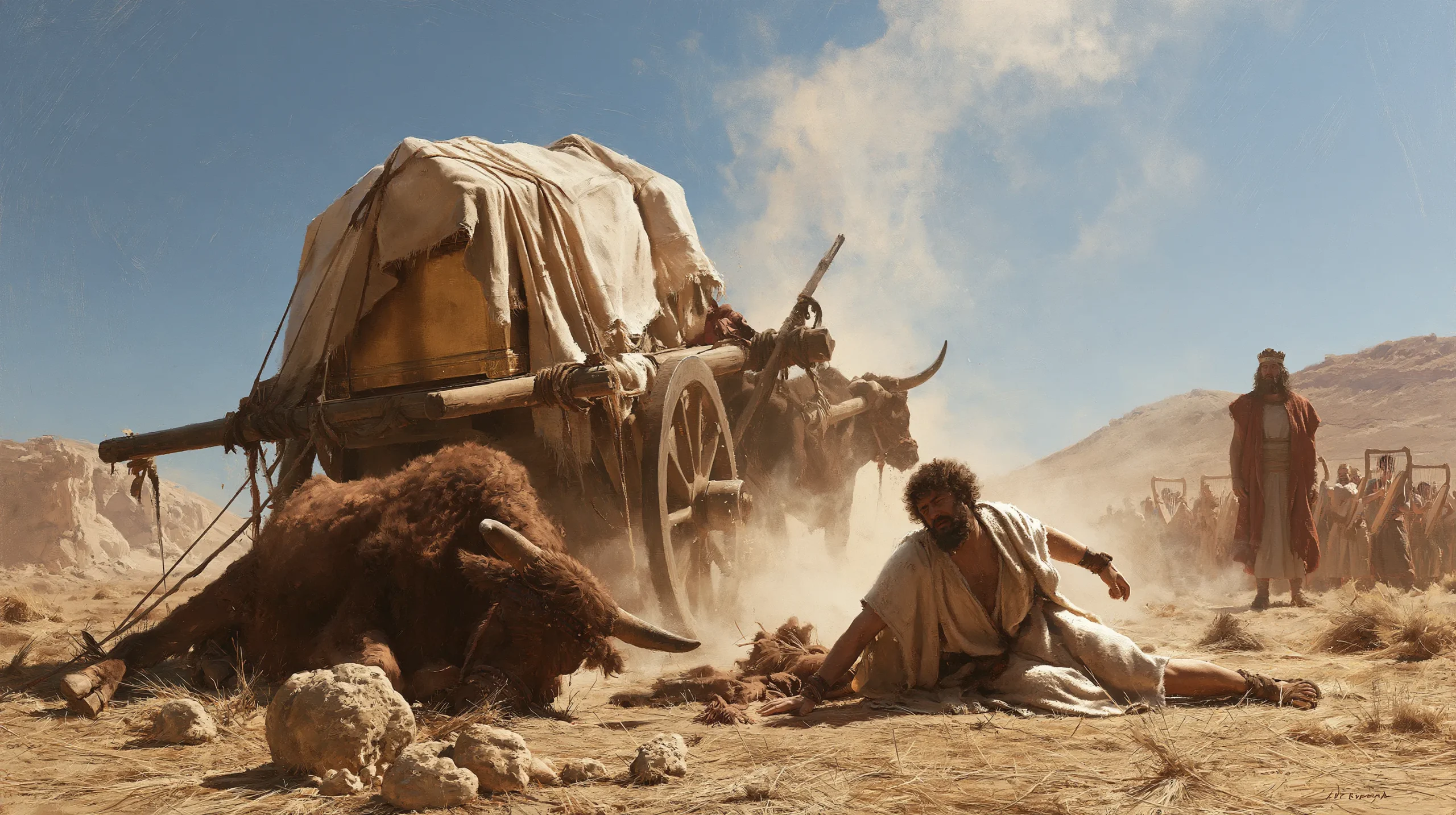
AI reconstruction, not a photograph.
Uzzah died on the spot after he took hold of the Ark of the Covenant. According to 2 Samuel 6, King David was bringing the Ark to Jerusalem on a new cart when the oxen shook it, and Uzzah put out a hand to it. The anger of the LORD was kindled against him, and he died beside the Ark. The scene is among the most unsettling in the Bible, because the motive looks like a good one. This article sets out what the two accounts say, which reasons have been given for his death, how the law of Numbers 4 and the new cart bear on it and how the story relates to a caution reported in Ethiopia today.
What 2 Samuel 6 Says
The scene belongs to the reign of David, which the Center for Online Judaic Studies dates to 1005-965 BCE. David gathers thirty thousand chosen men and sets out from Baale of Judah to bring up the Ark. They set it on a new cart and take it out of the house of Abinadab, and Uzzah and Ahio, the sons of Abinadab, drive the cart while David and all Israel play on harps, timbrels and cymbals (2 Samuel 6:1-5). The Ark had come to that house when the men of Kirjath-jearim fetched it and set apart Abinadab’s son Eleazar to keep it (1 Samuel 7:1).
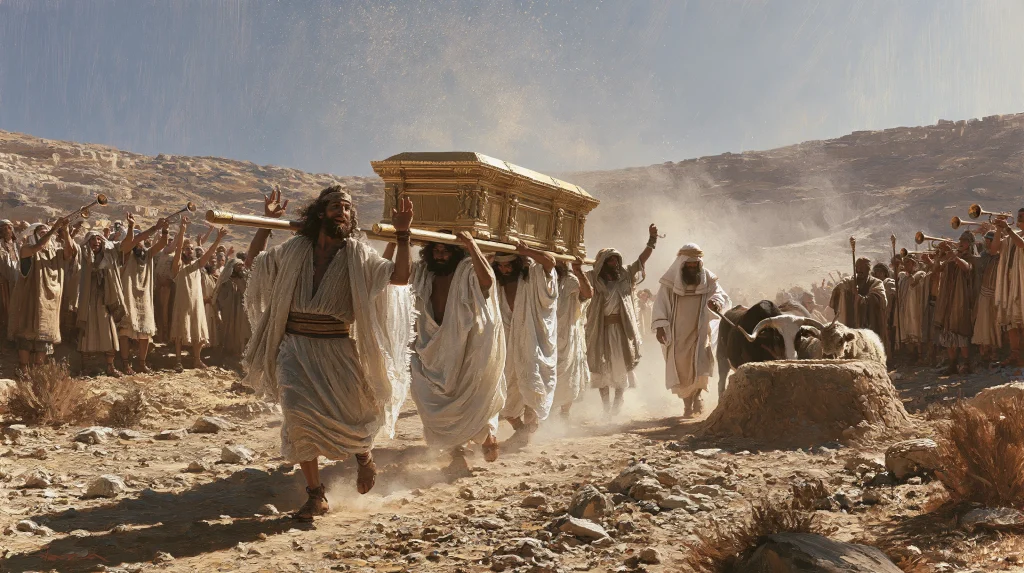
At Nachon’s threshing floor “the oxen shook it”, and Uzzah puts out his hand and takes hold of it. Then “the anger of the LORD was kindled against Uzzah”, and God “smote him there for his error”, and “there he died by the ark of God”. David is “displeased, because the LORD had made a breach upon Uzzah”, and names the place Perezuzzah. He is also “afraid of the LORD that day”, asking “How shall the ark of the LORD come to me?” (6:6-9). He leaves the Ark in the house of Obed-edom, where it stays three months and “the LORD blessed Obededom, and all his household”. When David is told of the blessing he brings the Ark up with gladness, and when “they that bare the ark of the LORD had gone six paces”, he sacrifices oxen and fatlings (6:10-13).
One Word and Two Accounts
The cause is named, but not clearly. On Bible Hub’s page for 2 Samuel 6:7 the English Standard Version has “because of his error”, the New International Version “because of his irreverent act”, the New American Standard Bible “for his irreverence” and the New Revised Standard Version “because he reached out his hand to the ark”. The Strong’s entry for the Hebrew word behind them, shal, glosses it only as “Perhaps error”.
The parallel account in 1 Chronicles 13 reads differently. In the King James Version the oxen “stumbled” there, where Samuel has them shake the cart, and the anger of the LORD is kindled against Uzza, who is smitten “because he put his hand to the ark”. The Chronicler gives the act itself as the cause and leaves out the uncertain word.
Later readers supplied reasons of their own. Josephus, in William Whiston’s translation of his Antiquities, says God struck Uzzah dead “because he was not a priest and yet touched the ark”. Ellicott’s Commentary for English Readers, quoted on Bible Hub, says that “Especial sacredness was by the law attached to the ark” and reads the act as “a want of reverence for the majesty of God as symbolised by the ark”.
Numbers 4 and the Question of the Cart
One law that readers set beside the story is Numbers 4. There Aaron and his sons cover the holy things first, and “after that, the sons of Kohath shall come to bear it”, but “they shall not touch any holy thing, lest they die” (4:15). Numbers 7:9 adds that the sons of Kohath were given no wagons, because their service was that they should “bear upon their shoulders”. The Ark’s own design points the same way. Exodus 25:14-15 has rings and staves “that the ark may be borne with them”, and the staves “shall not be taken from it”.
A cart had carried the Ark before. In 1 Samuel 6:7 the Philistines’ priests and diviners tell them to “make a new cart” for sending it home, and two cows draw it to Beth-shemesh. The books of Samuel draw no comparison with David’s cart.
The account in 2 Samuel does not argue that the cart was the mistake. The Chronicler comes closer, in David’s mouth. In 1 Chronicles 15:2 David says “None ought to carry the ark of God but the Levites”, and in 15:13 he tells the priests and Levites that the LORD “made a breach upon us, for that we sought him not after the due order”. The Levites then bear the Ark “upon their shoulders with the staves thereon”, as Moses had commanded (15:15). Deuteronomy 31:25 likewise names “the Levites, which bare the ark” as those Moses charged.
Two cautions apply. The account calls Uzzah a son of Abinadab and does not say he was a Levite or a priest. And it never says why the second journey succeeded, only that “they that bare the ark of the LORD” covered six paces before the sacrifice.
A Sympathetic Victim, a Severe Verdict
The severity is what unsettles many readers. Uzzah is not attacking the Ark. According to 1 Chronicles 13:9 he “put forth his hand to hold the ark”, and the oxen had stumbled. He is also a son of Abinadab, in whose house the Ark had stood for at least “twenty years” (1 Samuel 7:2).
A Parashah Insights essay on the OzTorah site, whose footer credits Rabbi Dr Raymond Apple, sets out older readings. One view is that Uzzah, as a non-Levite, should not have touched the Ark. Another, attributed to the sages, is that “The Ark sustained those who carried it”, so that his fault was a lack of faith in that principle. The essay also suggests that David’s displeasure arose because those handling the Ark had not been told that mishandling holy things could mean death. It still admits: “Nonetheless, we feel sorry for Uzzah.” It says he “really meant to do a good deed”, and it concludes that even good actions should be weighed in advance.
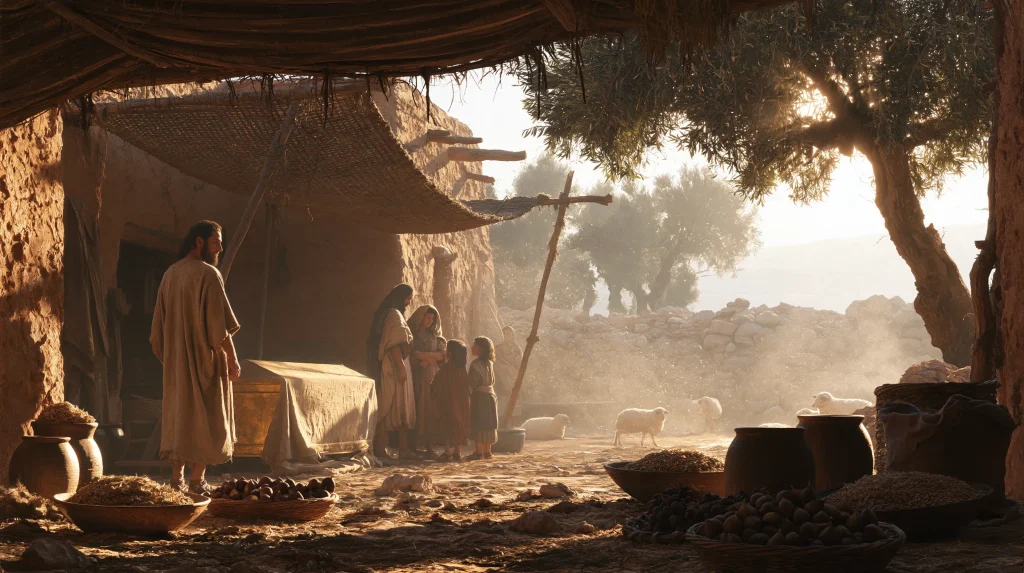
The text never says whether the verdict was fair. The only reactions it records are God’s anger, David’s displeasure and David’s fear. The house of Obed-edom shows that the Ark is not simply lethal, because it stays there for three months and the household is blessed. One reading is that the Ark is an object whose holiness is dangerous to the unprepared.
An Echo in Ethiopia
A similar caution is reported in Ethiopia. Wikipedia says that in Ethiopian Orthodox churches “Only bishops and priests are allowed touch or handle a tabot”, a replica of the Ark, and its article on the church at Axum says only the guardian monk may view the Ark, in line with “the Biblical accounts of the dangers of doing so”. A photojournalist who travelled in northern Ethiopia says he was told that touching the object behind a church curtain would send flames up his nostrils, and he took the warning seriously although he describes himself as a sceptic. His account is one traveller’s report, and the link to Uzzah is an echo, not a documented line of descent. None of the sources consulted says the Ethiopian rule comes from 2 Samuel 6.
What Can Be Said
The account in 2 Samuel 6 gives an act, a death, a king who is displeased and afraid, and one uncertain word for the cause. The Chronicler gives the act itself as the cause, the law of Numbers 4 sits beside the story, and readers have weighed these without agreeing. What can be said plainly is narrow: a man touches the Ark to steady it and dies, and the account gives one uncertain word as its reason.

