Elephantine Letters Say a Jewish Temple Fell in 410 BCE
Biblical History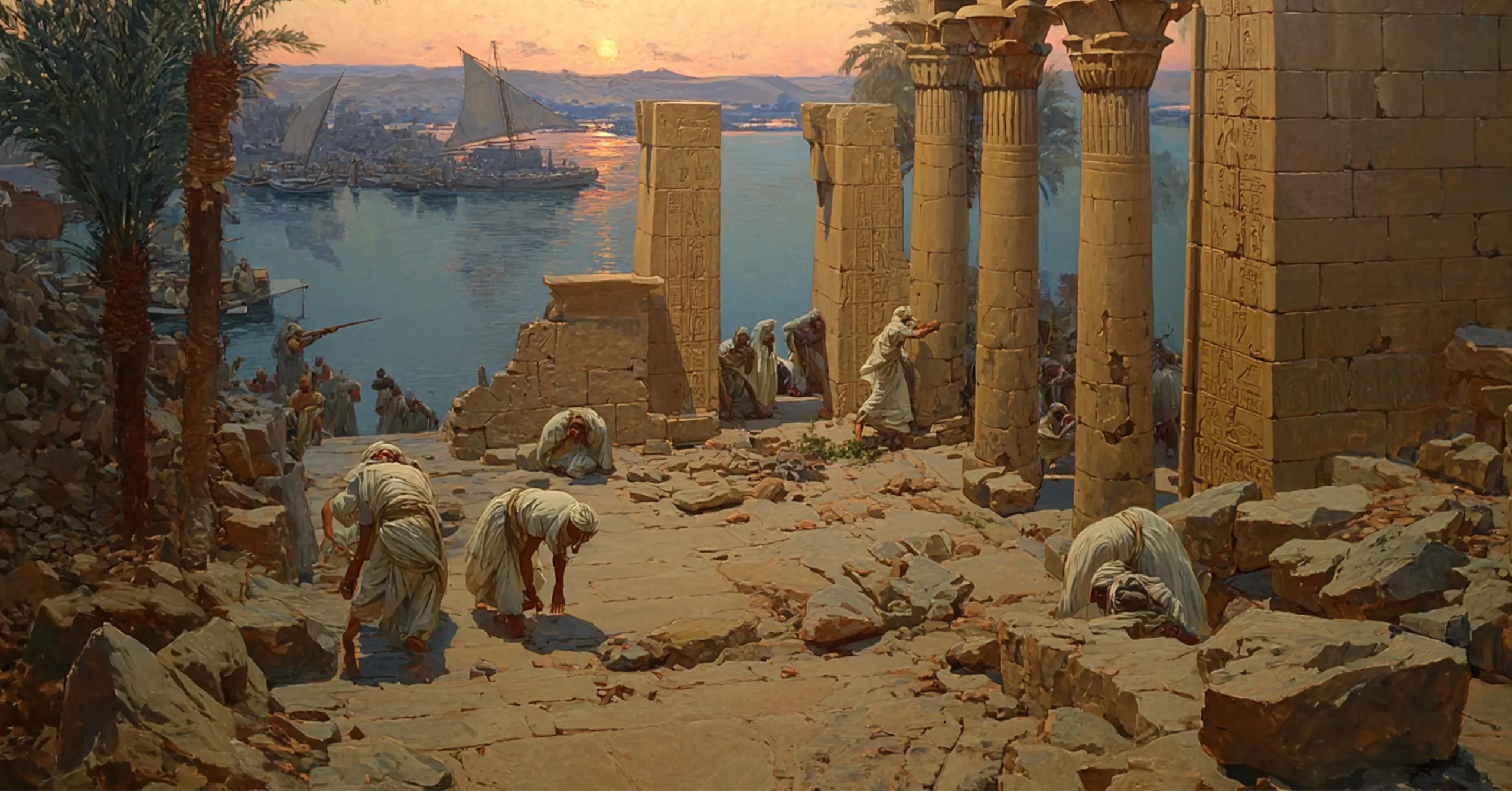
AI reconstruction, not a photograph.
In 410 BCE, according to its own letters, a Jewish community on an island in the Nile lost its temple. Papyri from Elephantine, at modern Aswan in southern Egypt, say that priests of the ram-headed god Khnum and a Persian commander plotted against the sanctuary of YHW, the spelling the community used for the name of its God, and that soldiers pulled it down. Three years later the survivors sent a petition asking the governor of Judah to help them rebuild. This article follows the documents, sets out what became of the request and marks where the evidence comes from one side only.
An Island of Soldiers and Gods
Elephantine forms part of the city of Aswan in Upper Egypt, just downstream of the First Cataract, according to Wikipedia. It was the home of Khnum, whom the same article calls the ram-headed god of the cataracts. Between 1893 and 1910, Wikipedia adds, Aramaic papyri were found and collected on the island: caches of legal documents and letters in Imperial Aramaic. They describe a community of Judean mercenaries and their families who guarded Egypt’s frontier with Nubia. It is not clear when or why they settled.
The community kept a temple of its own. The petition says its ancestors built it and that when Cambyses entered Egypt “he found that Temple built.” A house contract of December 416 BCE, in the Berlin museums’ Elephantine database, gives a boundary as “the Temple of YHW the God,” with the king’s road between. The contract mentions “Vidranga the Troop Commander of Syene,” the name the petition later blames. So the temple’s existence does not rest on the petition alone.
The Attack in Tammuz
The main account is a petition dated the 20th of Marheshvan in year 17 of King Darius, which the Biblical Archaeology Review sidebar converts to 25 November 407 BCE. Its writers place the attack three years earlier, in the month of Tammuz in year 14, when the Persian governor of Egypt, Arsames, was away. The priests of Khnub, as the petition spells the god’s name, acted in agreement with Vidranga, who was “Chief here.” The sidebar says Vidranga ordered the temple removed and that his son Nafayna, garrison commander at Syene, carried out the attack with Egyptian troops.
The petition lists the damage. The attackers smashed the stone pillars, demolished five gateways of hewn stone, burned the doors and the cedarwood roof and took the gold and silver basins. Wikipedia offers two guesses at the motive. Its article on the island says it has been suspected that the priests objected to Jewish rituals, particularly sacrifices at Passover, and its article on Khnum ties tension between the two temples to the Egyptian staff’s wish to expand their own. Neither is a finding.
Sackcloth, Fasting and Silence
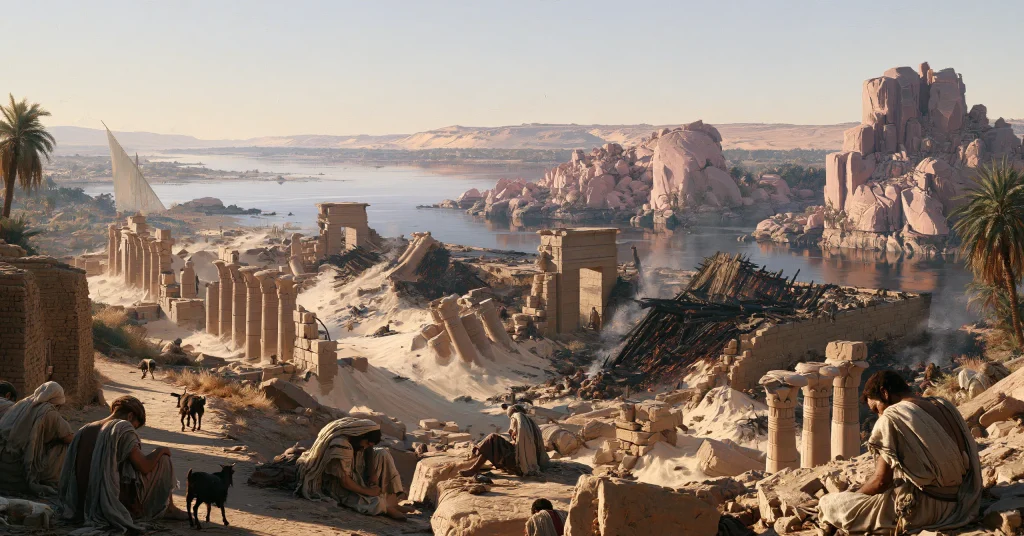
The petition turns to the community’s grief. Its writers say they, with their wives and children, were “wearing sackcloth and fasting.” They report a reckoning too: dogs “removed the fetter from his feet,” and all the goods Vidranga had acquired were lost. That is the petitioners’ own claim, and no second document in the sources used here confirms it.
They also say they had already written for help. The petition names the governor, Jehohanan the high priest and others, and says “They did not send us a single letter.” The Tyndale Bible Dictionary suggests, as a possibility, that Jerusalem’s leaders disapproved of a temple in Egypt.
So a new petition went out in 407 BCE. It is addressed to Bagavahya, also written Bagohi and Bagoas, governor of Judah, and the writers say they sent word as well to Delaiah and Shelemiah, the sons of Sanballat, in Samaria. They promise offerings on the altar of YHW “in your name.” Their case leans on history. The Center for Online Judaic Studies page notes that the papyrus has the Persians knock down “all the temples of the gods of Egypt,” in contrast with the Jewish temple that Cambyses had found built.
The Reply That Survives
No written answer to the petition has been found, the sidebar says. What survives is a torn memorandum, Berlin papyrus P. 13497 and TAD A4.9, which records what “Bagohi and Delaiah said.” In the Berlin database’s translation, the matter of “the Altar-house of the God of Heaven” is to be raised before Arsames, and the temple rebuilt “on its site as it was formerly.” Only the meal-offering and the incense are named for the altar. Burnt offering is not mentioned.
A second, damaged document, TAD A4.10, makes the same bargain from the community’s side. It says “sheep, ox, and goat” would not be offered there as burnt offering, only incense and meal offering, and it offers silver and a thousand ardabs of barley to the house of an unnamed lord.
Did the temple rise again? Accounts differ. Bezalel Porten writes in the Jewish Women’s Archive’s encyclopedia that “both textual and archeological evidence suggest” it was rebuilt. The Tyndale Bible Dictionary infers the same from a document of 402 BCE that mentions the temple of Yahu, and the Seforim Blog says it was eventually rebuilt. The Posen Library says “It is not known whether the Elephantine temple was in fact rebuilt.” Permission seems clear, and completion less so.
One Side of a Quarrel
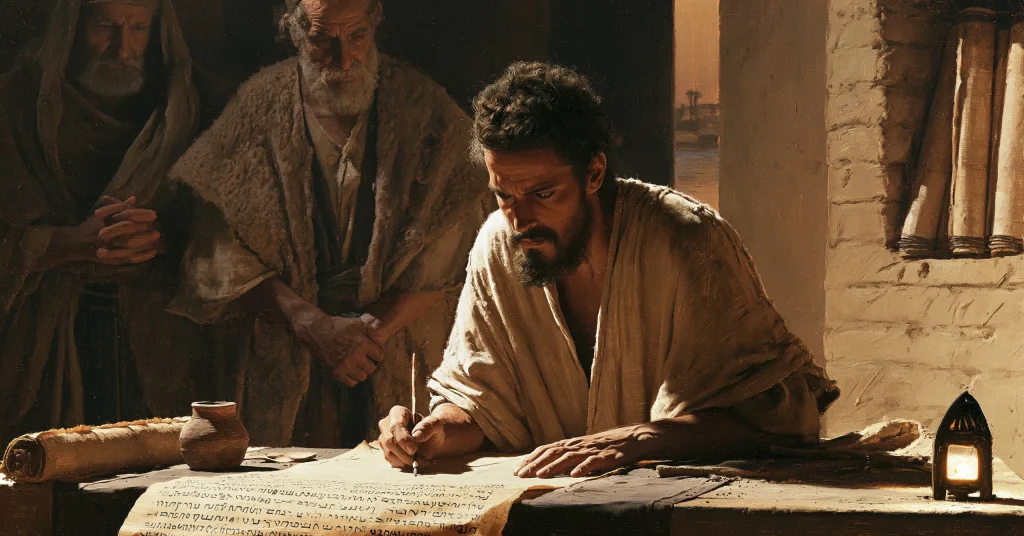
Every detail of the attack comes from the injured party. The Egyptian priests and the Persian commander left no account, and the sources used here contain nothing from their side. The plot, the punishment of Vidranga and the sparing of the temple under Cambyses are the petitioners’ own claims, written to persuade a governor. That does not make them false, and the contract of 416 BCE confirms the temple. But the cause of the attack, its scale and the guilt of the named men rest on a single witness.
A Temple Outside Jerusalem
The temple raises two questions about the people who built it. The first is how it related to the law of one sanctuary. Deuteronomy 12:14 says burnt offerings belong “in the place which the LORD shall choose in one of thy tribes.” The Tyndale Bible Dictionary notes that Hezekiah and Josiah are credited with centralising worship in Jerusalem, yet says the Elephantine Jews “did not seem to think it was wrong” to have a temple in Egypt. A Center for Online Judaic Studies page says the practice “seems to be in opposition to biblical law.”
How to read that is argued. Wikipedia’s article on Josiah calls the accuracy of the accounts of his reform “widely debated,” and notes that some recent scholars place most of the Torah’s composition in the Persian period. If the one-altar rule was not yet binding, Elephantine is unremarkable. If it was, the temple needs explaining. The papyri alone do not decide.
The second question is what the community believed. Bob Becking, in the introduction to Identity in Persian Egypt, a study of the community, writes that their Yahwism “was probably aniconic, but certainly not monotheistic or monolatric,” and lists the minor deities Anat-Yahu, Eshem-Bethel and Herem-Bethel among those venerated. A survey on the Seforim Blog says the academic consensus sees a syncretistic mixture, while some scholars, pointing to the absence of idolatrous names, argue that the community stayed devoted to the God of Israel. How far its members blended with their neighbours is still argued.
What Can Be Said
A Jewish community at Elephantine had a temple of YHW by 416 BCE. Its petition says the temple was destroyed in Tammuz of year 14 of Darius, 410 BCE, and names priests of Khnum and the Persian commander Vidranga as the plotters. In 407 BCE the community asked the governor of Judah for help, and a memorandum records a permission that names only meal-offerings and incense. The latest dated Aramaic document is from 398 BCE, after Egypt had won independence from Persia.
Whether the temple was rebuilt, why it was attacked and how far the community’s worship had drifted from Jerusalem’s remain open. The safest summary is narrow: a Jewish community in Egypt says it lost its temple in 410 BCE, and it asked for help.

