The Instructions of Shuruppak: A Sumerian Father’s Advice
Biblical History
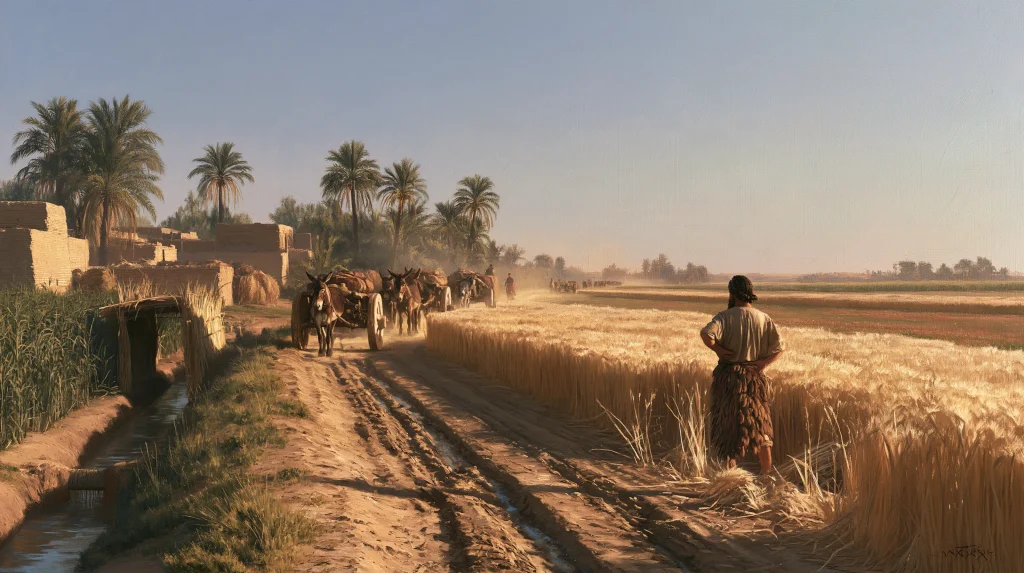
AI reconstruction, not a photograph.
A father tells his son not to put a field beside a road, not to drive away a debtor and not to travel at night. These are lines from the Instructions of Shuruppak, a Sumerian text whose oldest known copy belongs to the middle of the third millennium BCE. Wikipedia says the Instructions contain sayings “reflected in the biblical Book of Proverbs,” which makes the text a regular point of comparison for the Bible’s wisdom writing. This article sets out what the text says, how its famous frame grew and how far the comparison with Proverbs can be pushed.
What the Text Is
According to Wikipedia, the Instructions consist of “admonitory sayings” addressed by Shuruppak to his son. The Abu Salabikh tablet, dated to the mid-third millennium BCE, is the oldest extant copy, and the large number of manuscripts shows how popular the text was. Samuel Noah Kramer dated the composition to about 2600 BCE, Wikipedia’s article on Ziusudra reports, though that is a scholar’s estimate and not a date written on a tablet.
The text kept being copied. Nili Samet, in a 2021 paper, distinguishes an archaic Sumerian version from the mid-third millennium BCE, a classic Sumerian version from the beginning of the second millennium and an Akkadian translation known from the end of the second. Wikipedia dates two fragmentary Akkadian versions to the 15th century BCE. The sources used here give no firmer date for the first copies than the middle of the third millennium.
Advice for Daily Life
The translation that World History Encyclopedia credits to Jeremy Black and colleagues (2006) gives the flavour of the advice. Some of it is purely practical, as Wikipedia puts it: “You should not locate a field on a road.” Another saying warns, “You should not drive away a debtor: he will be hostile towards you.” A third begins “A thief is a lion, but after he has been caught” and ends with the thief a slave. The traveller hears, “You should not travel during the night: it can hide both good and evil.” A son is told, “You should not speak arrogantly to your mother; that causes hatred for you.”
Wikipedia notes that moral precepts are followed by the negative practical results of transgression. A composite translation posted online adds a warning against buying a free man, who “will always lean against the wall,” and against sitting alone in a chamber with a married woman. The sayings range over fields, debts, theft, drink, speech and family, the ordinary frictions of a farming country.
How the Son Got a Name
Wikipedia describes the sayings as addressed to Shuruppak’s son “and eventual flood hero Ziusudra.” The sources suggest that the name came later. Walther Sallaberger, in a 2018 paper, counts about 171 lines in the Early Dynastic version, around 56 of them largely or completely lost, and 290 lines in the Old Babylonian version. In his account the earlier version does not name Ziusudra. The Old Babylonian copies add an opening, “In those days, in those distant days,” that makes Shuruppak the son of Ubara-Tutu, a king listed before the flood, and names the son Ziusudra. The text, Sallaberger writes, is “newly situated in the context of the Deluge.” Wikipedia’s article on Ziusudra likewise says the text “refers in a later version to Ziusudra.”
Ziusudra belongs to the flood tradition. Wikipedia calls him the hero of the Eridu Genesis, a Sumerian flood tale known from a single fragmentary tablet datable by its script to the 17th century BCE, and lists him in one Sumerian King List recension as the last king of Sumer before the flood, son of Ubara-Tutu and king of Shuruppak. The article on the Instructions says Shuruppak is “interpolated as an additional generation” between Ubara-Tutu and Ziusudra, who are “in every other instance father and son.” So the family tree around Shuruppak is not fixed in the sources.
Kramer, quoted by Wikipedia, argued that Ziusudra “had become a venerable figure in literary tradition by the middle of the third millennium,” which leaves open that the later frame rests on an older association. None of the sayings quoted in these sources concerns a flood. The link to the flood hero runs through the names in the opening.
A Father Speaking to a Son
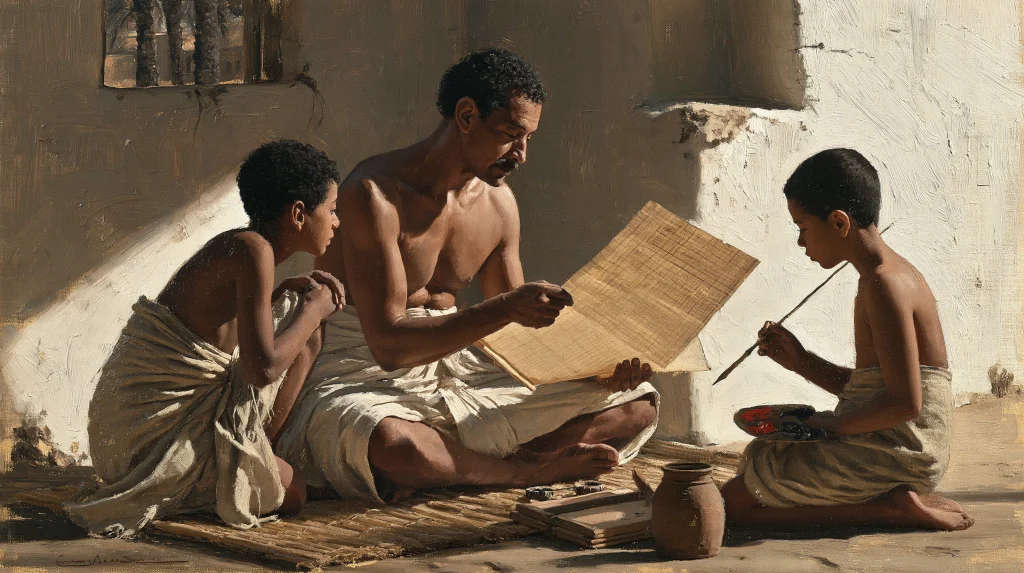
The father-to-son frame is what ties the text to the Bible. Samet describes the Instructions as the earliest known example of the father-to-son pattern, which later became common in wisdom collections. Egypt has it too. The Instruction of Amenemope, which Wikipedia says was most likely composed in the Ramesside period, about 1300 to 1075 BCE, contains thirty chapters of advice and is “ostensibly written by the scribe Amenemope” as a legacy for his son. Its most complete copy, British Museum Papyrus 10474, was acquired at Thebes by E. A. Wallis Budge in 1888 and is dated by Wikipedia to roughly 600 to 500 BCE.
Proverbs addresses a son again and again: “My son, hear the instruction of thy father” (1:8) and “My son, forget not my law” (3:1). Its advice on a mother, “despise not thy mother when she is old” (23:22), touches a subject the Sumerian father raises too. A shared topic is not evidence of borrowing.
Where Proverbs Meets Egypt
The best-known comparison runs to Egypt, and it shows what a stronger case looks like. Wikipedia says Adolf Erman published a list of correspondences between Amenemope and Proverbs in 1924, that a near consensus has since seen a literary connection, and that the majority concluded Proverbs 22:17-23:10 depended on Amenemope. It adds that the direction of influence “remains contentious,” and John Ruffle judged the question “not proven.”
Two parallels show the closeness. Wikipedia gives Amenemope’s “Remove not the landmark from the bounds of the field,” and Proverbs 23:10 reads “Remove not the old landmark.” Proverbs 23:5 says riches “fly away as an eagle toward heaven,” and Bernd Schipper notes that the eagle replaces a Nile goose in the Egyptian text. Schipper argues that only Proverbs 22:17-23:11 depends directly on Amenemope and calls the result “a deliberate adaptation,” neither a translation nor an unsystematic borrowing.
The outlook also differs. Proverbs 22:19 gives the purpose of its teaching: “That thy trust may be in the LORD.” The book’s opening principle is “The fear of the LORD is the beginning of knowledge” (1:7).
Reading the Gap
Nothing of that strength is shown between Shuruppak and Proverbs. The sources used here give no line-by-line parallel of the Amenemope kind. World History Encyclopedia says the Instructions are “thought to have influenced” several biblical texts, Proverbs among them, without saying how or how strongly. Wikipedia adds that they contain precepts similar to those later included in the Ten Commandments, which is likewise a resemblance and not a documented borrowing. Samet’s 2021 paper does not argue a link at all. It uses the Instructions as an “empirical model” of how a wisdom collection can be expanded and revised over centuries, as scholars have proposed for biblical wisdom.
The distance is large. The archaic copies date to the middle of the third millennium BCE, while Proverbs presents itself as the proverbs of Solomon, some of which “the men of Hezekiah king of Judah copied out” (25:1). Well over a thousand years separate the two. Akkadian translations narrow the gap, but no chain of copies or borrowings from Sumer to Judah is shown in the sources. A shared form does not prove that Hebrew writers knew this text.
What Can Be Said
A Sumerian text of fatherly advice was copied from the mid-third millennium BCE and still circulated in Akkadian in the second millennium. It addresses a son, and the later copies name him Ziusudra. Wisdom writing in Egypt and Israel uses the same father-to-son form, and Proverbs 22:17-23:11 is widely held to use Amenemope, though the direction is debated. A direct line from Shuruppak to Proverbs is not shown. The safest summary is narrow: a very early Sumerian text offers a father’s advice to a son, and the Bible’s wisdom books belong to the same long tradition.

