Genesis 9:25 Curses Canaan, Yet Was Used to Defend Slavery
Biblical History
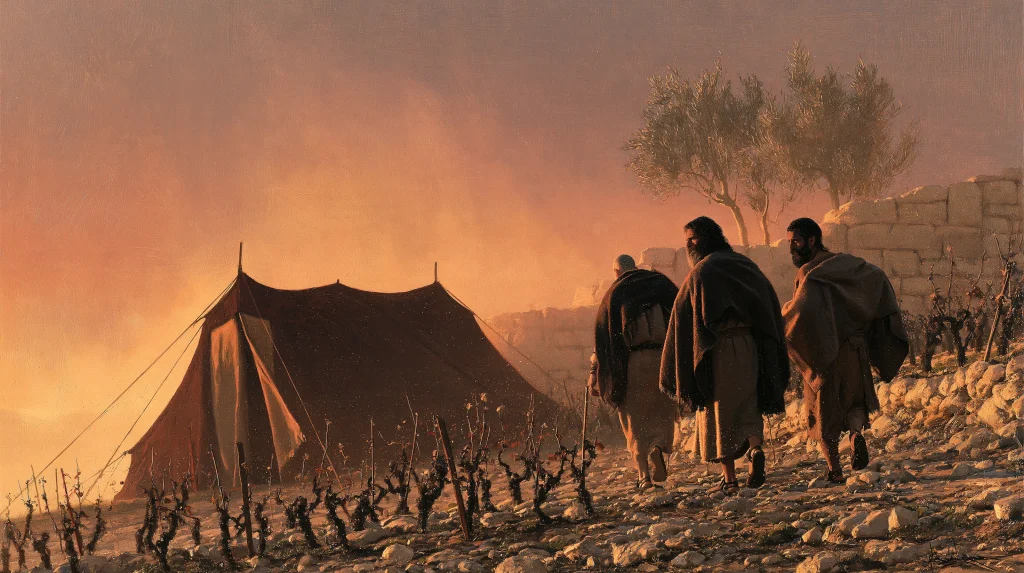
AI reconstruction, not a photograph.
Genesis 9:25 names one man, Canaan, a grandson of Noah. The King James text reads: “Cursed be Canaan; a servant of servants shall he be unto his brethren.” It names neither Ham nor Africa, and it says nothing about skin colour. Yet later readers moved the curse from Canaan to Ham, from Ham to his descendants and from them to Africans, and the result was used to defend slavery. This article sets out what the verse says, how the reading was built one step at a time and why scholars and many churches now reject it.
What Genesis 9 Actually Says
The scene follows the flood. Noah “planted a vineyard,” drank the wine and “was uncovered within his tent” (9:20-21). Ham, “the father of Canaan,” saw his father’s nakedness and told his two brothers outside (9:22). Shem and Japheth laid a garment on their shoulders, walked backward and covered Noah without looking (9:23). When Noah woke and learned what his “younger son” had done, he spoke the curse (9:24-25).
Three points stand out. The curse falls on Canaan, not on Ham. The verse mentions neither skin colour nor Africa. And it sets no time limit, although the idea is repeated: “Canaan shall be his servant” ends both of the blessings that follow (9:26-27). Modern translations such as the New American Bible render the phrase “a servant of servants” as “the lowest of slaves.”
Why Canaan?
Why the curse lands on Canaan rather than on Ham is a puzzle the text leaves open. Verses 18 and 22 both call Ham “the father of Canaan,” which suggests that Canaan’s line mattered to the narrator. Wikipedia lists scholarly proposals, among them that the story justified Israelite dominance over the Canaanites and that it relates to Egypt’s rule over Canaan in the late Bronze Age. The New American Bible’s notes say the Canaanites are counted as Ham’s descendants “because at one time they were subject to Hamitic Egypt.” Wikipedia also reports that a Dead Sea Scrolls commentary, 4Q252, reasons that Ham could not be cursed because God had already blessed him (Genesis 9:1).
The wording is loose in places. Shem and Japheth are Canaan’s uncles, yet the verse calls them his “brethren.” Later books do record Canaanite peoples put to forced labour. Joshua tells the Hivites of Gibeon, whom Genesis 10:17 counts among Canaan’s descendants, “ye are cursed” and makes them “hewers of wood and drawers of water” (Joshua 9:23, 27). Solomon levied “a tribute of bondservice” on the surviving children of such peoples (1 Kings 9:20-21). None of these passages mentions Noah’s curse.
Where Genesis 10 Puts the Canaanites
Genesis 10 places Canaan’s family in the Levant. Canaan’s sons include Sidon and Heth, and the chapter gives the Canaanite border as running from Sidon toward Gerar and Gaza (10:15-19). Those places lie on or near the eastern Mediterranean coast.
Ham’s other sons are another matter. Genesis 10:6 lists “Cush, and Mizraim, and Phut, and Canaan.” The New American Bible’s notes tie Cush to “biblical Ethiopia, modern Nubia,” Mizraim to northern Egypt and Put to either Punt in East Africa or Libya, and the Psalms call Egypt “the land of Ham” (105:23, 106:22). So the Bible does connect some of Ham’s sons with parts of Africa, which gave later readers a hook. But the curse in chapter 9 names Canaan alone, and chapter 10 never mentions a curse at all.
How the Curse Moved From Canaan to Ham
The shift from Canaan to Ham is old. Wikipedia and New World Encyclopedia both cite Sanhedrin 108b in the Babylonian Talmud, which says Ham was “smitten in his skin” for breaking a prohibition aboard the ark, and later commentary read that as dark skin. Wikipedia adds that the Talmud neither passes the punishment to Ham’s descendants nor ties it to slavery. New World Encyclopedia says Origen, an early Christian writer who died around 254, linked Ham’s descendants, the Egyptians among them, with servitude.
David Goldenberg’s book The Curse of Ham (2003) follows the idea through Jewish, Christian and Islamic sources. A review in the Bryn Mawr Classical Review reports his finding that writers from the second century on claimed the curse also fell on Ham or on all his descendants, and that the insistence grew with the number of black African slaves, first in the Islamic East, then in the Christian West and America. The review adds that he finds no real link between the name Ham and blackness. Not every reader agreed: New World Encyclopedia notes that the Muslim historian Ibn Khaldun argued that the Torah does not tie the curse to skin colour and that pigmentation comes from climate.
From the Slave Trade to the Pulpit
Laura Mitchell, reviewing Stephen Haynes’s book Noah’s Curse in Books & Culture, says Ham was “rarely racialized” before European exploration of West Africa in the fifteenth century. As the slave trade began, the curse was reinterpreted to link Africans with Ham’s descendants, and a racial version had reached America by the early colonial period.
By the nineteenth century the argument was common in defences of slavery in the American South. In an essay called “Original Dishonor,” Haynes lists writers who used it, among them the Mississippi Presbyterian James Smylie, who argued in 1836 that Noah doomed Ham’s posterity, supposedly the ancestors of Africans, to serve the others. Haynes finds that most of these writers read the story as one of dishonour, Ham’s failure to honour his father. A Christian Century review says Benjamin Morgan Palmer, a Presbyterian minister in New Orleans, used Noah’s family to argue for a natural separation of the races. A document from the Indiana Historical Society called “Shackling Sermons” says proslavery pastors in the antebellum and Civil War South used the curse to argue that slavery was God’s design.
Each step needed words the verse does not contain: Ham where it says Canaan, a whole line of descendants where it names one man, Africans where Genesis 10 says Canaanites, and permanent inherited slavery where it says only that Canaan will serve.
How Abolitionists Answered
Critics answered at the time. In his late-1830s pamphlet The Bible Against Slavery, Theodore Weld called Noah’s prophecy “the vade mecum of slaveholders, and they never venture abroad without it.” He argued that the verse names only Canaan, that it foretells a nation paying tribute rather than individuals held as property, and that a prophecy of a wrong does not excuse those who commit it. Canaan’s descendants, he said, were subjected in turn to the Israelites, the Persians, the Greeks and the Romans, while Africans descend from Mizraim and Cush.
Haynes’s survey adds that abolitionists made four main points: the curse was a prediction, it was aimed at Canaan, it was fulfilled in Israel’s conquest of Canaan or in some other earlier event, and Africans, though Hamites, were not Canaanites.

What Scholars and Churches Say Now
New World Encyclopedia says the racial reading has been largely abandoned since the mid-twentieth century, even by conservative theologians, and Wikipedia reports that most modern scholars reject it. In 2018 the Southern Baptist Convention, meeting in Dallas, adopted a resolution renouncing the doctrine of the curse of Ham as a justification for racism. It says many Southern Baptist churches once endorsed a false reading of Genesis 9:25-27 and that the doctrine has been used to justify slavery.
What Can Be Said
Popular retellings that call Ham’s whole line a cursed bloodline repeat the same mistake in softer form. Genesis 9 curses Canaan, and Genesis 10 places his family in the Levant. As written, the verse describes a future relationship among peoples and gives permission to no one. What can be said plainly is narrow: the verse curses Canaan, and everything built beyond that was added by readers.

