Genesis 9’s Rainbow Was a Sign Meant for God to See
Biblical History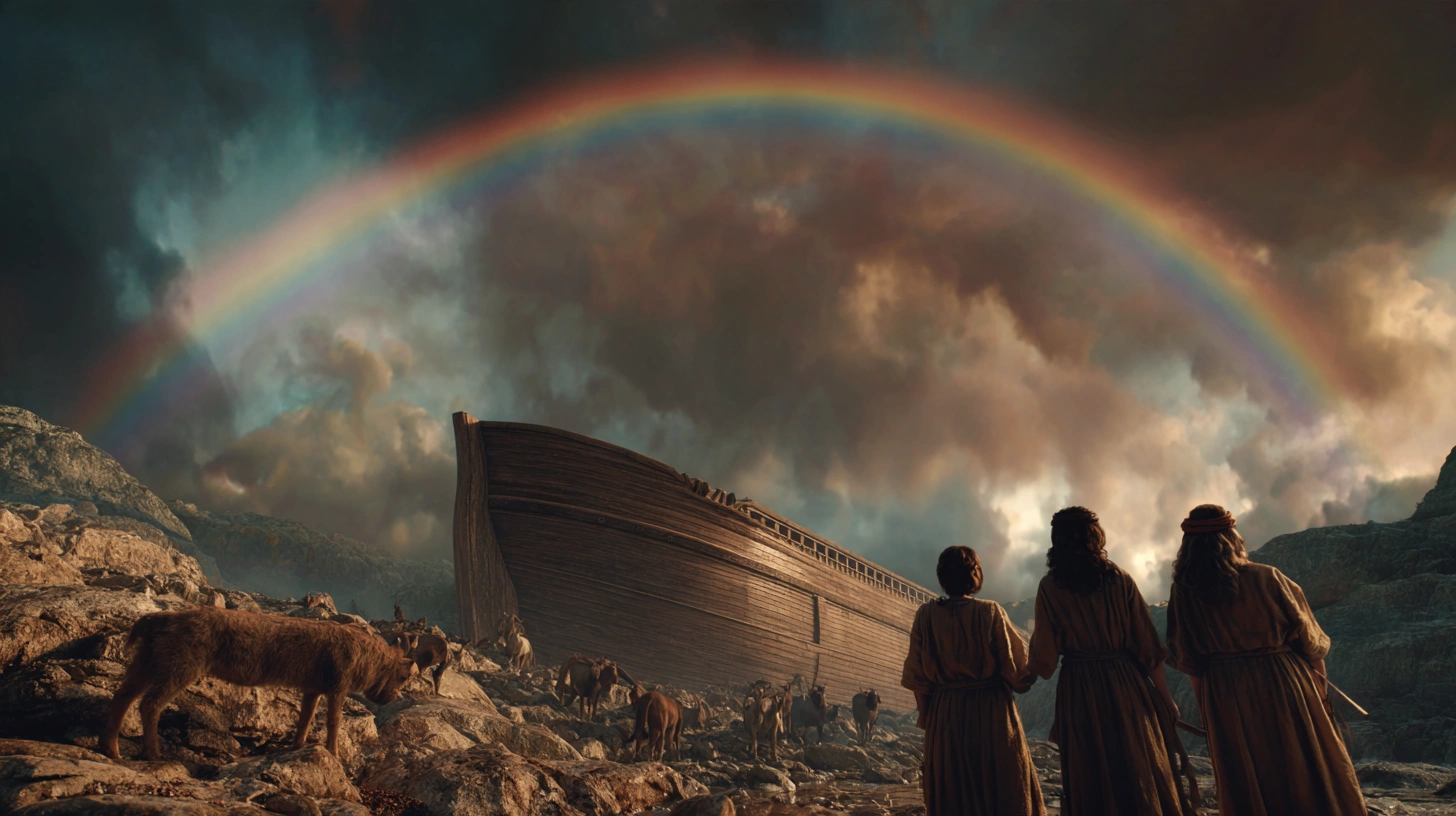
AI reconstruction, not a photograph.
Genesis 9 puts a strange detail at the center of its covenant scene. The rainbow set in the clouds after the flood is not described primarily as something for Noah’s descendants to notice and remember. The text says it is there for God to see, a small but genuinely distinctive shift in perspective that separates this covenant sign from every other one recorded in the surrounding books of the Torah.
A Flood Chronology That Runs Just Over a Year
Genesis dates the flood with unusual precision for an ancient narrative, tracking it almost like a ship’s log rather than a loosely remembered legend. It begins in the six hundredth year of Noah’s life, on the seventeenth day of the second month, when, in the text’s own words, the fountains of the deep burst open and the sky itself gave way. Rain falls for forty days and nights, and the waters continue rising and prevailing over the earth for a hundred and fifty days in total. The ark comes to rest on the mountains of Ararat five months in, on the seventeenth day of the seventh month, the moment the waters had finally begun to fall rather than rise. Waters continue receding through the tenth month, and by the first day of the following year’s first month, the tops of the mountains and then the ground itself become visible again for the first time. Genesis does not call the story finished there, though. It is not until the twenty-seventh day of the second month of that new year that the text describes the earth as fully, completely dry. Counted out from beginning to end, the interval from the flood’s first day to the earth’s last comes to something just over a year, roughly 370 days by the calendar the narrative implies, a little over twelve months spent almost entirely inside the enclosed space of the ark.
Mountains, Not One Mountain
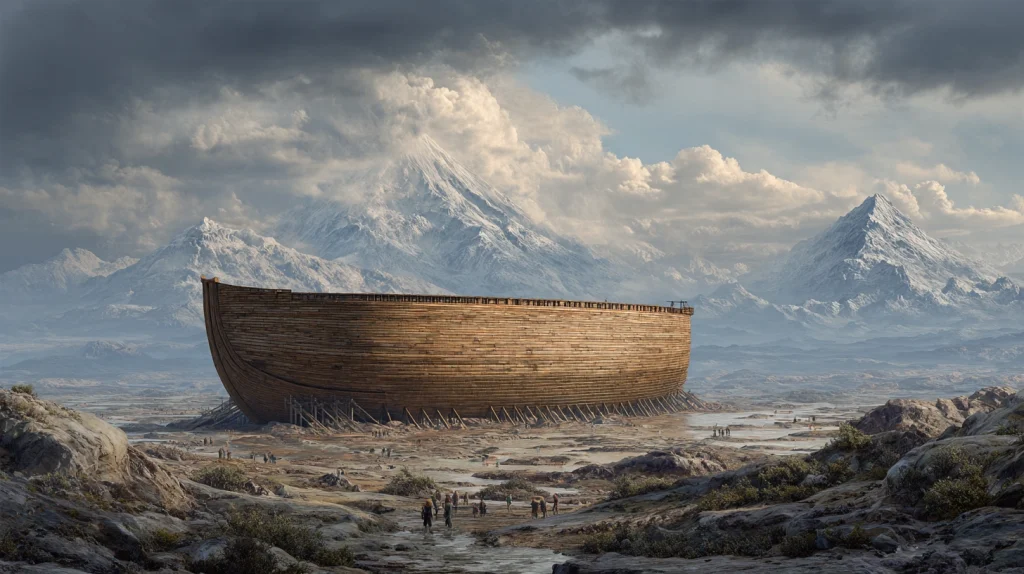
The landing site Genesis names is, in the Hebrew text, the mountains of Ararat, a plural, regional description rather than a single identified peak. The now-familiar identification with the specific mountain in eastern Turkey that modern maps label Mount Ararat is a later tradition that developed well after Genesis itself was written, not a detail the biblical text specifies with that precision. What Genesis actually gives readers is a general highland region, somewhere in the mountains associated with ancient Urartu, rather than coordinates for one particular summit.
A Sign Meant for God to See
The covenant scene itself, in Genesis 9:8 through 17, unfolds after this long chronology of enclosure and gradual drying, once Noah, his family, and the animals had finally stepped back onto solid, fully dry ground. God’s bow is set in the clouds as, in the text’s own words, a token of the covenant between God and the earth. What follows is the detail that sets this passage apart from other covenant signs elsewhere in Genesis and Exodus. Circumcision, given as the sign of the covenant with Abraham in Genesis 17, and the Sabbath, given as the sign of the covenant at Sinai in Exodus 31, are both framed as signs for the human parties to notice and remember, marks carried on a body or observed on a day, meant to jog the memory of the people bound by the agreement. Genesis 9 reverses that direction entirely. The text states plainly that when the bow appears in the clouds, God will see it and be reminded of the covenant, language that some commentators have read as a strikingly direct, almost anthropomorphic way of describing how the sign functions, closer to a formal marker God has set for divine recollection than a purely symbolic gesture aimed at human memory alone.
A Weapon Turned Toward the Sky
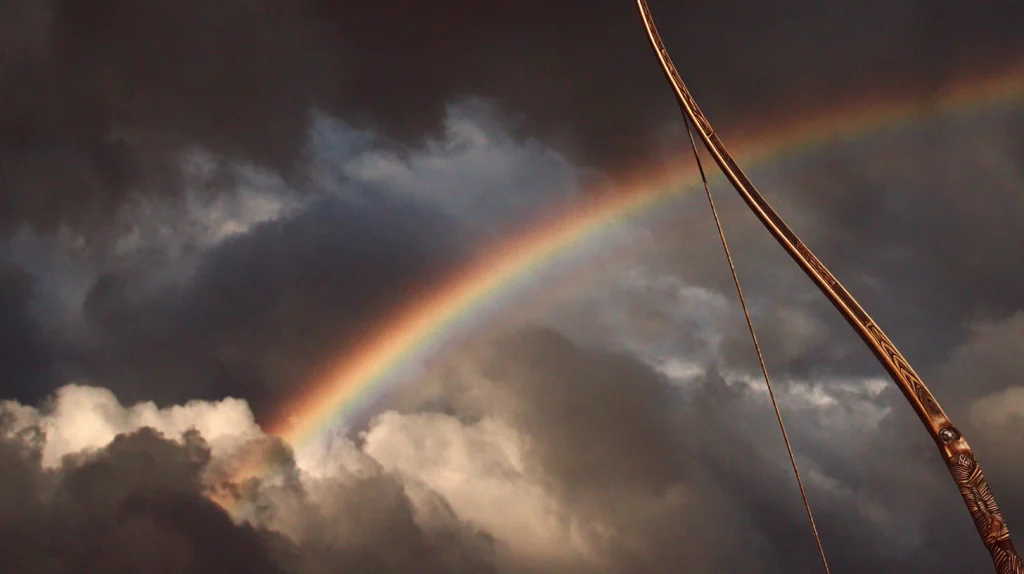
Part of what makes that framing land with extra weight is the Hebrew word Genesis actually uses for the bow. Qeshet appears dozens of times elsewhere in the Hebrew Bible, and in nearly every other instance it refers to an archer’s bow, the standard weapon of war in the ancient world, not to a rainbow, whether in the hands of a hunter or a soldier on a battlefield. Only here, and in one visionary passage in Ezekiel that explicitly echoes this scene, does the word clearly mean the arc of color that follows rain. Read against that background, God setting a qeshet in the clouds carries the shape of a weapon being deliberately laid down, strung but arrowless, aimed away from the earth rather than at it, a martial image repurposed into a sign of restraint immediately after the most destructive event in the narrative so far.
An Echo of “God Remembered”
The covenant scene’s language of divine memory is not an isolated flourish confined to this one passage. Earlier in the flood account, Genesis 8:1 marks the turning point of the entire story with almost the same phrase: God remembered Noah, and every living thing with him in the ark, and the waters began at last to recede. The covenant scene at the story’s close answers that opening turn directly, with God declaring that the sign in the clouds exists so that the covenant will be remembered again, whenever the same kind of storm returns to darken the sky. The flood narrative, read this way, is framed on both ends by the same verb, opening with the remembering that ends the disaster and closing with a sign built to guarantee that same remembering forever afterward, long after the last living witness to the flood itself has died.
A Covenant With No Conditions Attached
The agreement itself is described in unusually broad and unconditional terms. It extends past Noah to every living creature that came off the ark with him, not humanity alone, covering birds, cattle, and every other animal in the same breath as Noah’s own household, and the text calls it an everlasting arrangement rather than one requiring renewal or reaffirmation by later generations. Genesis 9:13 identifies the rainbow specifically as the sign of that covenant. Unlike some later biblical covenants, which set out obligations for both parties, requiring something of the human side in exchange for the promise, this one places no requirement on Noah or his descendants at all. It is God’s own commitment, marked by God’s own weapon set down in the sky, and kept, according to the text, by God’s own memory each time the sign appears, a promise structured, from beginning to end, around what God alone will do and remember rather than anything humanity is asked to observe in return.

