Giants’ Spirits After the Flood: What the Sources Say
Biblical History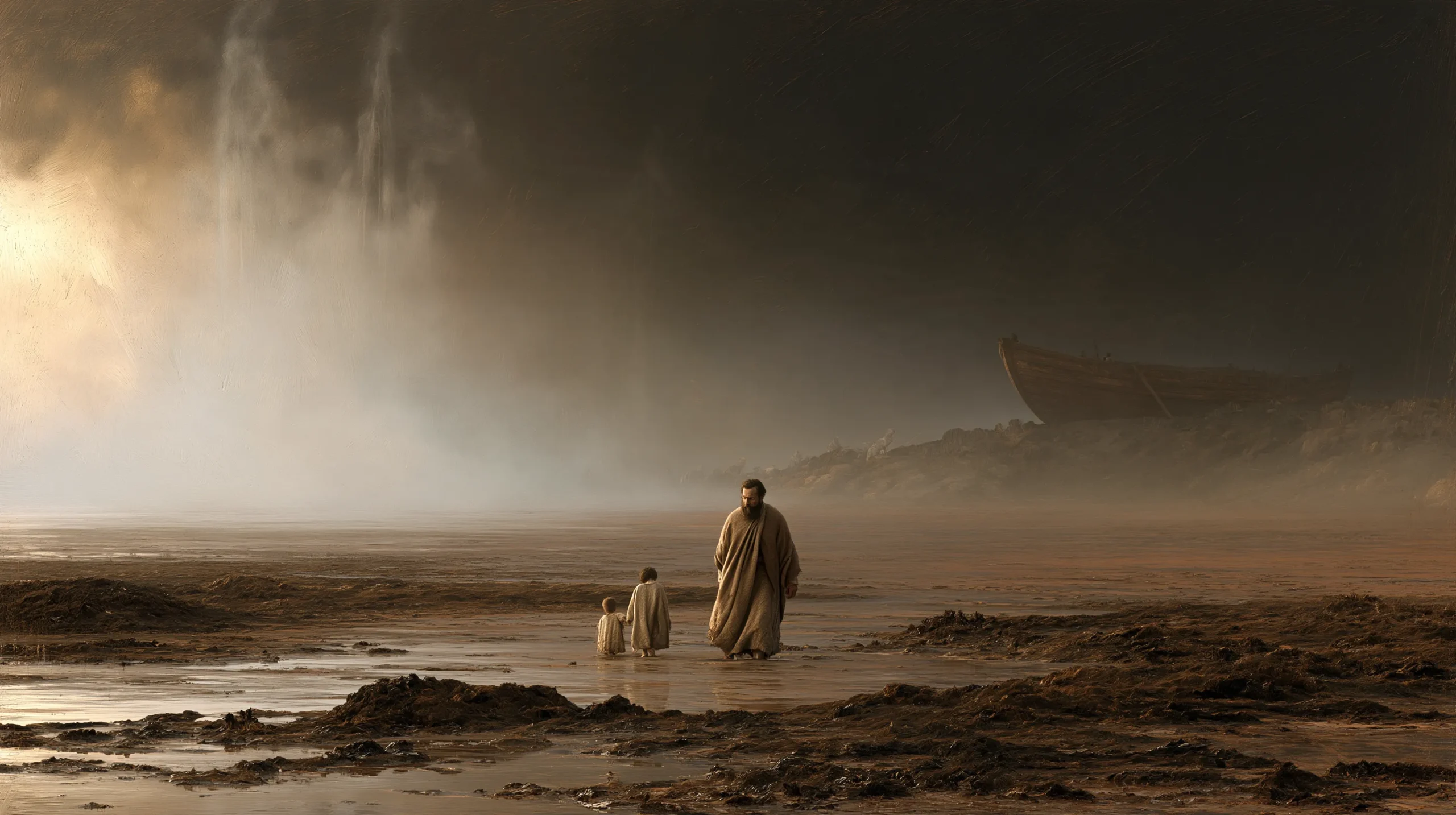
AI reconstruction, not a photograph.
A retelling of the Book of Giants says that after the flood the giants’ bodies lay dead and too large to bury, while their spirits stayed on earth, hungry and bodiless, and learned to enter living creatures, becoming the first cases of possession. Parts of that picture rest on real ancient texts, and parts appear in none of the pages consulted. This article sets out what the Qumran fragments preserve, what Genesis, 1 Enoch and Jubilees say, where spirits entering bodies appear in later texts, and which details the retelling adds.
What the Qumran Fragments Preserve
The Book of Giants survives as Aramaic fragments from Qumran. Wikipedia says they were “found in caves 1, 2, 4, and 6 at the site”, and James Davila says “nine or ten manuscripts of it survive from the Qumran library”. None of the pages dates those manuscripts. Wikipedia says the composition “has been dated to before the 2nd century BC”, and a reference entry on the book reports Beyer’s late third century BCE and Milik’s 125 to 100 BCE, a range it says “rests upon several arguable points”. No page names the first century BCE.
The fragments stop before the aftermath. Davila’s summary reaches the point where “Enoch warned them that they faced imminent ruin” and referred to “a time of blessing coming” after the flood, and then “The placeable fragments of the Aramaic Book of Giants end here”. The reference entry agrees: “At this point in the story the Qumran fragments break off”. The nearest thing to spirits is a conjecture. In his tentative reconstruction of one fragment Davila writes “Perhaps a conversation continues in which the giants anticipate with dread” their coming destruction, when they will be “stripped of their form and reduced to being evil spirits”. That looks ahead to the flood instead of describing what followed.
Dry Ground and Dead Giants
Genesis supplies the timescale. The flood begins “in the second month, the seventeenth day of the month” (7:11), and the earth is dry a year and ten days later, since “on the seven and twentieth day of the month, was the earth dried” (8:14). Genesis says nothing of grinding the mountains smooth. The ark rests “upon the mountains of Ararat” (8:4), and in the tenth month “were the tops of the mountains seen” (8:5). No verse in Genesis 6 to 9 mentions filled valleys, new ocean basins or the bodies of giants, and the survivors are Noah and “they that were with him in the ark” (7:23).
In 1 Enoch and Jubilees the giants die in a war among themselves. In 1 Enoch 10:9 Gabriel is told to “send them one against the other that they may destroy each other in battle”, and Jubilees 5:9 says “they began to slay each other till they all fell by the sword”, well before that chapter reaches the flood. Davila’s summary has the archangels incite a war “until all (or nearly all?) of them were dead”, before a flood in which some also seem to have died. The retelling puts their height at hundreds of feet. In Charles’s translation of 1 Enoch 7:2 it is “three thousand ells”, and the Wikipedia page on the book gives no height.
Spirits That Hunger and Thirst
The best match for the retelling’s hungry spirits is 1 Enoch 15. The giants are “produced from the spirits and flesh” and “shall be called evil spirits upon the earth”, and “Evil spirits have proceeded from their bodies” (15:8 and 15:9). Verse 10, printed in square brackets on the page, ties their dwelling to their birth: “as for the spirits of the earth which were born upon the earth”, “on the earth shall be their dwelling”. Verse 11 supplies the hunger: “the spirits of the giants afflict, oppress, destroy, attack”, and “they take no food, but nevertheless hunger and thirst”. Verse 12 says they “shall rise up against the children of men” and the women.
Chapter 16 dates their activity. The spirits go forth “From the days of the slaughter and destruction and death” of the giants (the Charles page marks the phrase naming the giants as an editorial insertion) and “shall destroy without incurring judgement” “until the day of the consummation” (16:1). The lines consulted do not tie their release to the flood, and in 1 Enoch 10:9 the giants’ death is a battle among themselves. Nor do they say the spirits enter bodies.
Jubilees and the Spirits After the Flood
Jubilees 10 sets such spirits in the world after the flood. In verse 1 “the unclean demons began to lead astray” Noah’s grandchildren, and in verse 2 his sons report “the demons which were leading astray and blinding and slaying his sons’ sons”. Noah prays, “Thou knowest how Thy Watchers, the fathers of these spirits, acted in my day”, and asks God to “imprison them and hold them fast in the place of condemnation” (10:5). Mastema, chief of the spirits, asks God to “let some of them remain before me”, and God leaves “the tenth part of them” (10:8 and 10:9). Angels teach Noah “all the medicines of their diseases”, and he “wrote down all things in a book” (10:12 and 10:13).
That is aftermath and affliction, linked to the Watchers, but not entry into bodies: the page does not mention it, and in the lines consulted it never calls these spirits the giants’ spirits. Davila reads 1 Enoch and Jubilees together as turning the giants into “disembodied demonic forces” that afflict people with illness and suffering.
Entering Bodies in Later Texts
Spirits that enter people appear later, and not always with the giants. Davila notes there is “no reference in the New Testament to the origin of these spirits”. The Synoptics, he writes, give no account of where demons come from, but “they may assume their origin from the giants”. He suggests that an aside about a spirit wandering through “waterless places” (Matthew 12:43) possibly alludes to a tradition in 1 Enoch that “the damned disembodied spirits of the giants are thirsty”. In Mark 5 the order of the retelling is reversed, since “the unclean spirits went out, and entered into the swine” (5:13), leaving a man for animals.
The closest match is the Clementine Homilies, which one reference entry dates to the fourth century. In Peter Peterson’s translation, Homily 9.10 says demons, “Being spirits, and having desires after meats and drinks, and sexual pleasures”, lack “organs fitted for their enjoyment” and so “enter into the bodies of men”. Homily 9.11 says they “tarry for a while with the weak in faith” but “they cannot remain even for a moment” with those who thoroughly believe, which concerns faith, not will. Homily 8.18 says “the souls of the deceased giants were greater than human souls”, and Stuckenbruck writes that in Homilies 8.12 to 18 the giants “are said to have survived the Flood in the form of disembodied” large souls. Homily 9, in the lines consulted, does not name the giants.
What the Retelling Adds
Several details have no source in the pages consulted. Ground-smooth mountains, filled valleys and renewed ocean basins are absent. No page has the giants’ bodies lying unburied, or the spirits barred from heaven and from the place of dead humans because they were not fully human; 1 Enoch 15 puts them on earth because they were born there. No page has spirits entering animals before people, a bird or goat failing to satisfy them, a distant hungry look, a lowered voice, unlearned languages or memories of life before the flood. Mark 5 gives a loose parallel for strength in a man whose chains “had been plucked asunder by him”, but names no giants. No page calls these the first cases of possession.
What Can Be Said
What can be said is narrow. The Qumran fragments break off before the aftermath, and one scholar’s cautious reconstruction has the giants reduced to evil spirits. 1 Enoch gives hungry, thirsty spirits that attack people, and Jubilees puts spirits in the world after the flood. Spirits entering bodies appear in the Gospels, which give them no origin, and in the Clementine Homilies, centuries later. The retelling’s single account of all this is in none of the pages consulted.

