Nimrod’s Star: What Jasher Says About Abraham’s Birth
Ancient Near East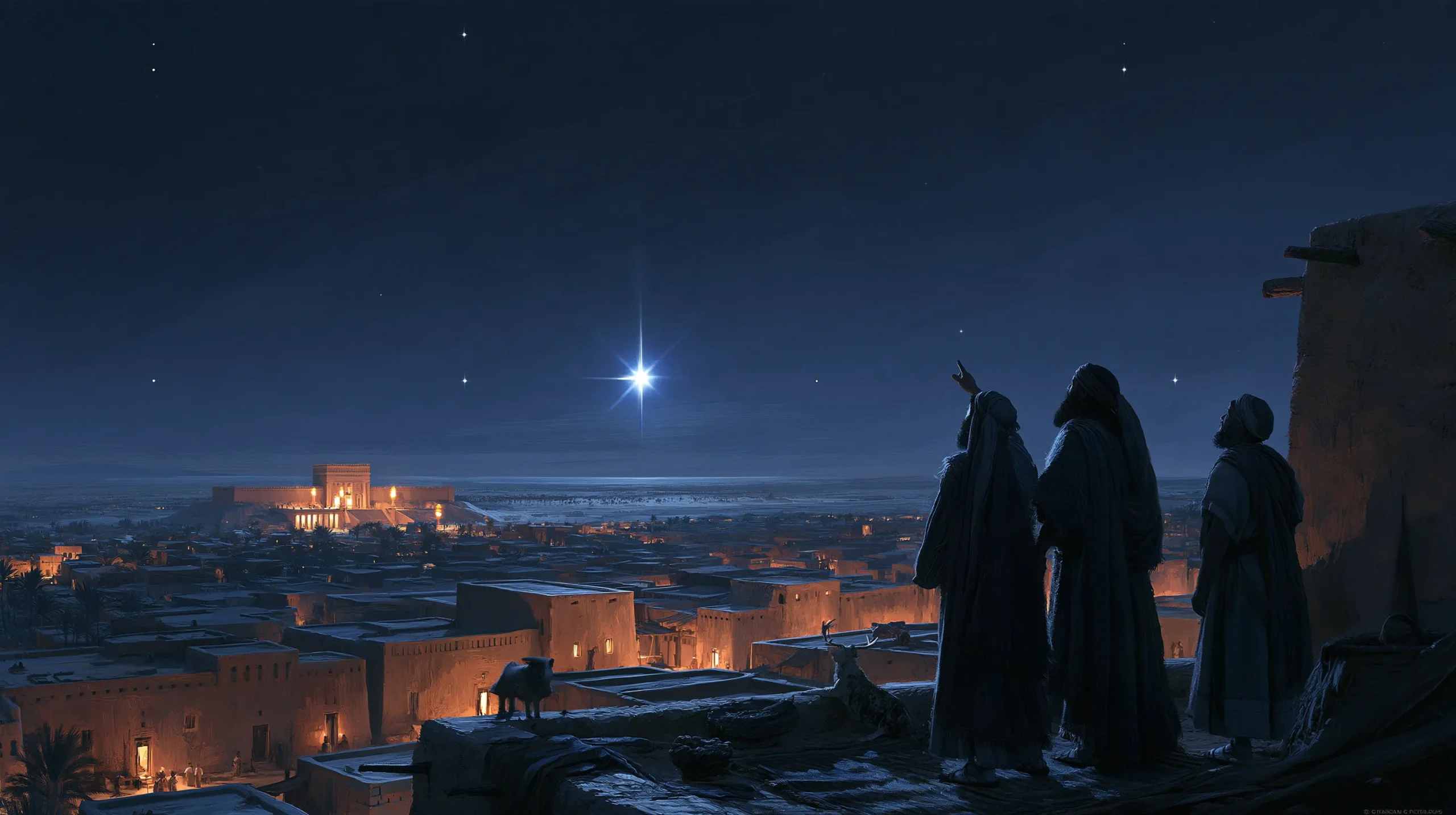
AI reconstruction, not a photograph.
A retelling of the Book of Jasher says that on the night Abraham was born a star swallowed four others, that Nimrod’s wise men read it as the birth of his future conqueror, and that Nimrod demanded the child. The star story is in a real book, but the book is late, and the retelling adds claims that neither Genesis nor the book makes. This article sets out what the book is, what it says about that night, what Genesis says of Abraham’s birth, how the chronology works, where the parallels lie, and which details the retelling adds.
What the Book of Jasher Is
The book in question is the Hebrew Sefer haYashar. Wikipedia calls it “a medieval Hebrew midrash” and says “Scholars have proposed various dates between the 9th and 16th century for its composition”. The earliest extant version “was printed in Venice in 1625”, and “The Venice 1625 text was heavily criticised as a forgery by Leon Modena”. Although it is presented as the original book of Jasher, “it is not accepted as such in rabbinical Judaism”. Joshua 10:13 asks “Is not this written in the book of Jasher?”, and 2 Samuel 1:18 cites it too, but this midrash is a different matter.
What Jasher Says About the Night
In Jasher 8 the servants and “all the wise men of Nimrod” feast in Terah’s house on the night Abram is born. Leaving, they “saw a great star coming from the east”, which “swallowed up four great stars, from the four sides of the heavens”. They read it: “This only betokens the child that has been born to Terah this night”, and “he and his seed will slay great kings, and inherit their lands”. The wise men call Terah “the prince of thy host”, so the sign points at the child of the king’s own commander.
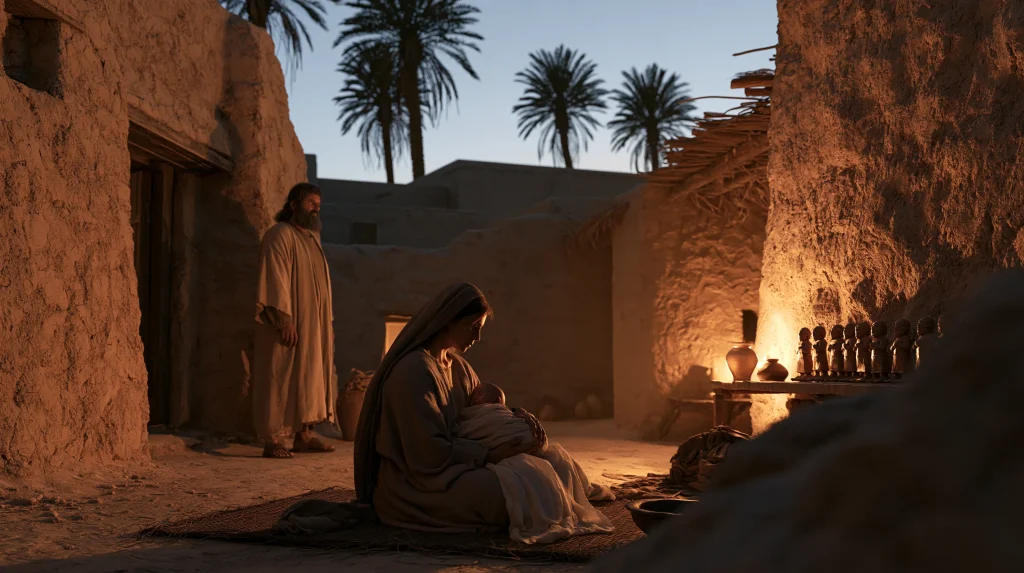
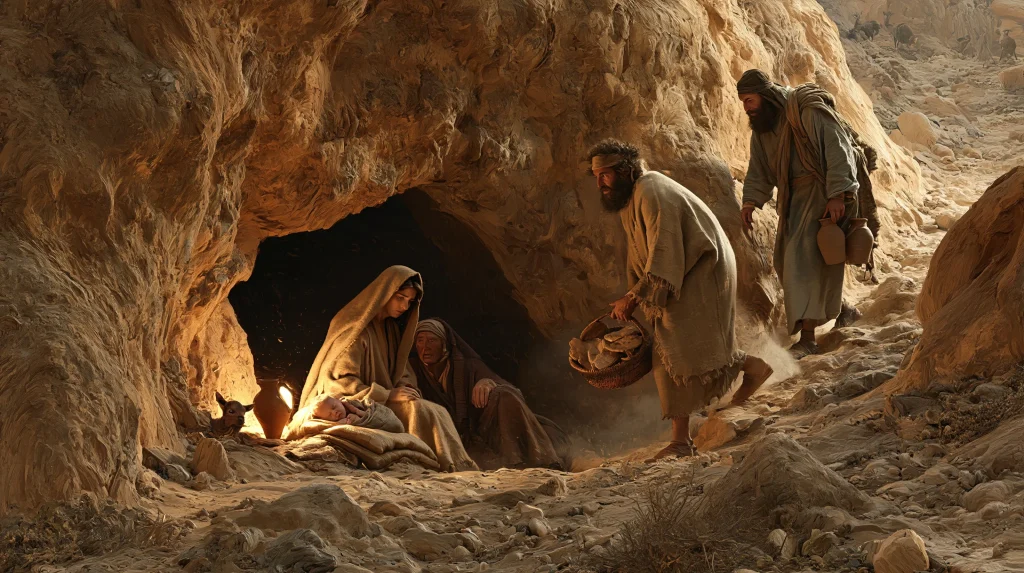
The king tells Terah, “give me the child, that we may slay him”, and offers “thy house full of silver and gold”. Terah stalls, then takes “a child from one of his servants” and brings it to the king, who kills it believing it to be Abram. The real child is hidden with his mother and nurse in a cave, where “Abram was in the cave ten years”.
What Genesis Says
Genesis gives the birth one clause: “Terah lived seventy years, and begat Abram, Nahor, and Haran” (11:26). There is no star, no king and no Nimrod. Haran “died before his father Terah in the land of his nativity”, in “Ur of the Chaldees” (11:28), and the family later went forth “from Ur of the Chaldees” (11:31). Genesis never says Abram was born in Ur. Ramban wrote that “Our father Abraham was not born in the land of Chaldaea”, so Ur as the birthplace is an inference. Genesis mentions no idols; Joshua 24:2 says only that Terah’s family “served other gods”.
Nimrod stands elsewhere. Genesis 10:9 calls him “a mighty hunter before the LORD”, and “the beginning of his kingdom was Babel, and Erech, and Accad, and Calneh” in Shinar (10:10). The family is named in 11:26 to 31, then comes the call: “Get thee out of thy country, and from thy kindred, and from thy father’s house” (12:1). That fits a man called to leave everything behind.
The 292 Years and Noah
The figure of 292 years is arithmetic from Genesis 11. Arphaxad is born “two years after the flood” (11:10), the births that follow come at 35, 30, 34, 30, 32, 30 and 29 years, and Terah is “seventy years” old at Abram’s birth. Noah lived “three hundred and fifty years” after the flood (9:28), so he outlived Abram’s birth by 58 years. Seder Olam Rabbah, in Sefaria’s English text, puts Abraham at 48 when languages divided, 340 years after the flood: the same 292. Jasher also has Noah alive: Abram “went to Noah and his son Shem” and “Abram was in Noah’s house thirty-nine years” (9:5 and 9:6), leaving in “the fiftieth year of the life of Abram” (11:13).
The count has a weak point. Terah died at 205 in Haran (11:32) and Abram left Haran at 75 (12:4). If Abram left after his father’s death, Terah was 130 at the birth, and a reference article reckons “from the Flood to the birth of Abraham was three hundred and fifty-two years”. Noah, dying at 350, would then have died two years before Abraham was born. The same article says the flood dates are “differently given in the Septuagint, the Hebrew, and the Samaritan Pentateuch”. Noah was alive on the 292 count, and only on that reading.
Frightened Kings in Exodus and Matthew
Exodus and Matthew are the retelling’s two parallels, and both differ from Jasher. In Exodus 1 the king fears a people: Israel is “more and mightier than we”, and he fears “lest they multiply”. He orders “if it be a son, then ye shall kill him”, and later “Every son that is born ye shall cast into the river”. No prophecy and no single child appear. That comes with Josephus, whose king is warned by “One of those sacred scribes” that “there would a child be born to the Israelites”. In Matthew, “wise men from the east” say “we have seen his star in the east”, and Herod “was troubled” and slays all the children in Bethlehem.
Jasher has Matthew’s star and eastern sign and Josephus’s warning scribes, but not Exodus’s fear of numbers. Any date proposed for the book falls long after Matthew and Josephus, so its teller may have known them, though the texts cannot show it. Its king also differs from Herod: he seeks one child and kills a substitute, where Chabad’s modern retelling has “all new-born baby-boys would have to die”. The shared thread is the hidden child. Moses’ mother “hid him three months”, Joseph and Mary flee to Egypt, and Abram goes into a cave.
Other Tellings of Nimrod and Abraham
In Josephus, Nimrod is a tyrant at Babel. “Now it was Nimrod who excited them to such an affront and contempt of God”, and he “persuaded them not to ascribe it to God”, “gradually changed the government into tyranny” and bound them to “a constant dependence on his power”. In the Josephus passage on Abraham quoted by the Intertextual Bible, the trouble comes from the Chaldeans and Mesopotamians, not a king.
The furnace story, in which Nimrod threatens Abraham as a young man, is rabbinic. Rashi on Genesis 11:28, citing Genesis Rabbah 38:13, says Terah “accused his son Abram before Nimrod of having smashed his idols to pieces”, and Nimrod “cast him into a fiery furnace”. A scholarly estimate dates Genesis Rabbah to 500 CE. Tellings also differ on detail: Jasher has “ten years” in the cave, while Chabad has “For three years little Abraham remained in the cave”.
What the Retelling Adds
Several details are not in the sources. The camps that ran to Nimrod are not in Jasher 7, which has a “mighty hunter in the earth” and nations that “gathered themselves to him”. The ruler who taught people to trust his strength is Josephus’s Nimrod, not Jasher’s, and in Jasher the hunt for the child is not his last act. Chapter 8 comes before the tower in chapter 9, where “king Nimrod reigned securely”, and before the four cities of chapter 11. Jasher’s wise men speak of a child who will “slay great kings”; the wording about overthrowing a kingdom is the retelling’s. That a tyrant is always afraid of a baby is a generalisation no text states, and Exodus gives the fear as one of numbers. Genesis names no king at Abram’s birth and no land of idols.
What Can Be Said
The star story is in Jasher 8, a midrash that scholars date between the 9th and 16th century and that is not accepted as the book Joshua cites. Genesis has none of it: one clause for the birth, a family tied to Ur and a call in chapter 12. On the Hebrew count Abraham was born 292 years after the flood with Noah alive, which Jasher itself assumes, though a longer reading removes Noah. The star in the east and the warning wise men echo Matthew and Josephus more than Exodus. And Jasher’s king offers silver, is put off and kills a substitute, rather than killing every boy.

