Lot Was Taken as Loot: Genesis 14 and the Plunder of Sodom
Biblical History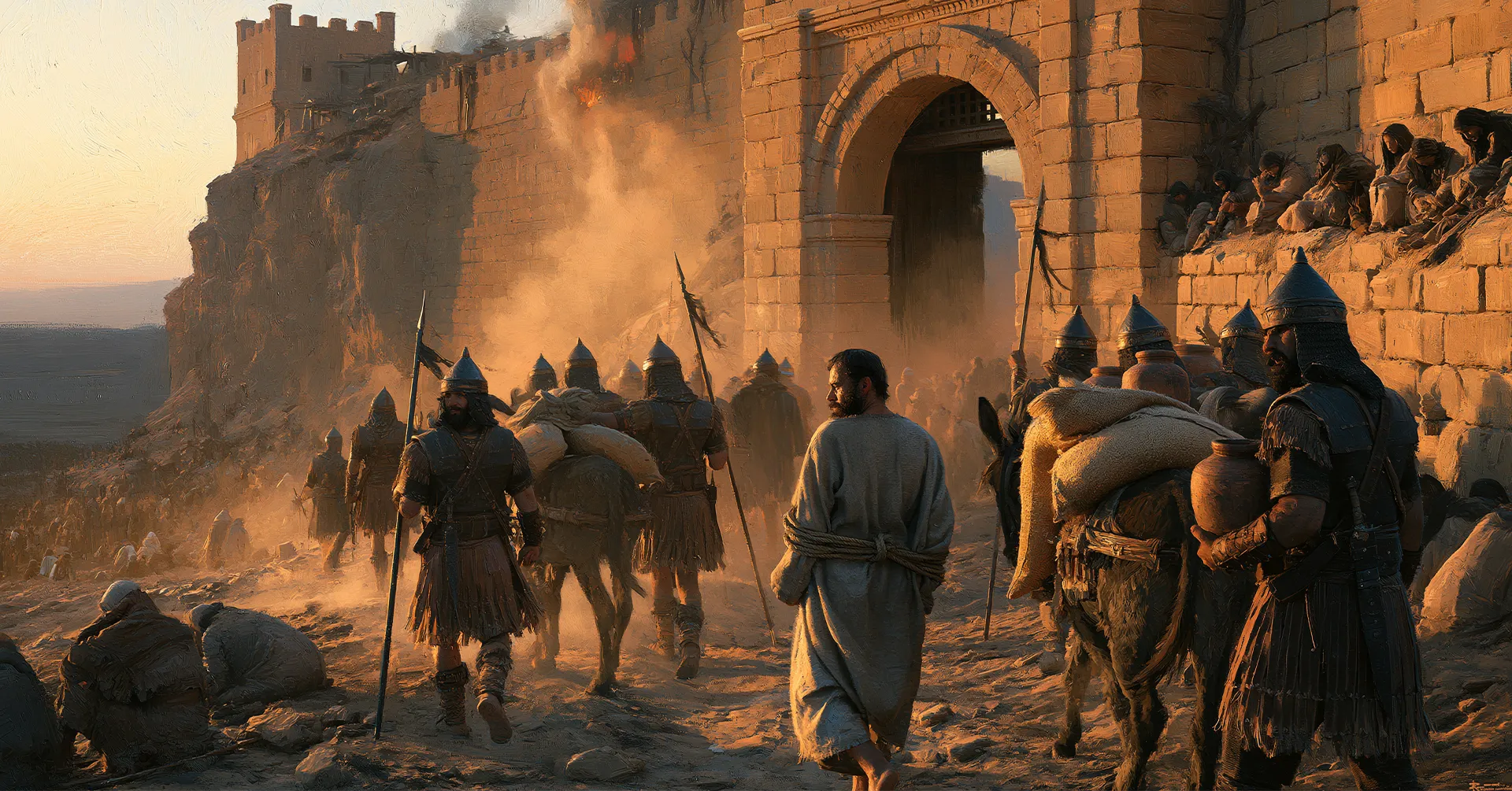
AI reconstruction, not a photograph.
Genesis 14 records a defeated city’s losses in two short verses. The invading kings “took all the goods of Sodom and Gomorrah, and all their victuals”, and they “took Lot, Abram’s brother’s son, who dwelt in Sodom, and his goods” (14:11-12). The text gives no date, no number of captives and no reason for Lot’s capture beyond where he lived. This article sets out what the verses say, how Lot came to be in Sodom, what ancient records show about captives and who carried the news to Abram.
What the Verses Say
Four kings from the east, led by Chedorlaomer of Elam, had gone to war against five kings of the plain, those of Sodom, Gomorrah, Admah, Zeboiim and Bela, “which is Zoar” (14:1-2). Verse 4 gives the cause: “Twelve years they served Chedorlaomer, and in the thirteenth year they rebelled.” The Encyclopedia of the Bible calls the identities of Chedorlaomer’s allies uncertain, and Genesis gives no date for the war.
The battle takes three verses (14:8-10). The valley of Siddim was “full of slimepits”, the kings of Sodom and Gomorrah “fled, and fell there”, and the survivors fled to the mountain. Then come the two verses about the spoil. Their verbs are plain: the victors “took”, “went their way” and “departed”. There is no description of fire, killing or the road away from the city. The text records the haul and not the cost.
Only one captive is named, but he was not the only one. When Abram later recovers the goods, verse 16 lists “the women also, and the people” beside Lot. Genesis never says how many were taken.
How Lot Came to Be in Sodom
The story of Lot’s choice is in Genesis 13. Lot, like Abram, had flocks, herds and tents, and the land “was not able to bear them” (13:5-6). After a quarrel between their herdsmen, Abram let Lot choose first (13:7-9). Lot looked at “all the plain of Jordan, that it was well watered every where”, and chose it (13:10-11). The narrator compares the plain to “the garden of the LORD, like the land of Egypt”, yet already speaks of the day “before the LORD destroyed Sodom and Gomorrah”. Lot then “dwelled in the cities of the plain, and pitched his tent toward Sodom” (13:12), and the next verse says “the men of Sodom were wicked and sinners before the LORD exceedingly”.
By Genesis 14 the tent toward the city has become a home in it. Translations differ on what the clause adds. The King James text and the NKJV read “who dwelt in Sodom”, which says only where Lot lived. According to the Bible.com comparison page, the CSB and the NASB 2020 read “for he was living in Sodom”, and the NIV reads “since he was living in Sodom”. Those versions make the address the reason for the capture. Either way, the only link the text offers between Lot and the war is his address.
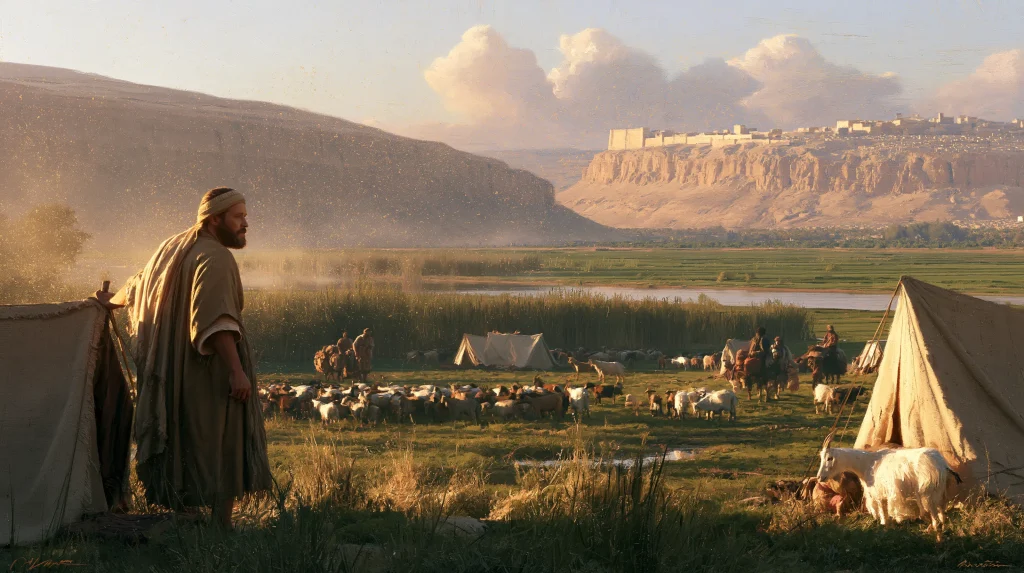
Genesis does not say that Lot took part in the rebellion, which verse 4 puts on the kings, plural. It does not say he held office. It says he lived in the city that lost. In a few verses the text moves Lot from the edge of that society to its centre and then shows him among the losers.
Captives in the Ancient Near East
Genesis does not say what awaited Lot, but records from the region show how captives were counted: in the same lists as horses, chariots and cattle. Breasted’s translation of the annals of Egypt’s Thutmose III, in the version hosted by Fordham University, lists 340 living prisoners after the capture of Megiddo, beside mares, chariots and cattle. Sargon II of Assyria is quoted on the COJS website as saying “I besieged and conquered Samaria and led away as booty 27,290 inhabitants of it”. Wikipedia’s page on Neo-Assyrian resettlement says untrained captives were often enslaved and skilled workers were placed according to their trades, and that Assyrian art shows some deportees travelling with their families and possessions and others in shackles. A 1963 study of Hittite warfare by V. Korošec refers to booty in the form of deportees, cattle and sheep.
Ransom was also known. Law 32 in Hammurabi’s code, in the Johns translation, says an official in the king’s service who is ransomed by a merchant should pay his own ransom if he has the means, otherwise the temple treasury should pay, and failing that the state. The law concerns an official and not a townsman, so it shows that ransom existed, not that it was open to everyone. Israel’s own law counted people among the spoil too. Deuteronomy 20:13-14 says that when a distant city that refuses peace is taken, every male is to be put to the sword and “the women, and the little ones, and the cattle” kept as spoil.
Genesis 14 itself keeps persons and goods apart. In verse 21 the king of Sodom tells Abram, “Give me the persons, and take the goods to thyself”. None of the records above comes from the setting of Genesis 14, which the text leaves undated. They show common practice. They do not tell what happened to Lot.
The Man Who Escaped
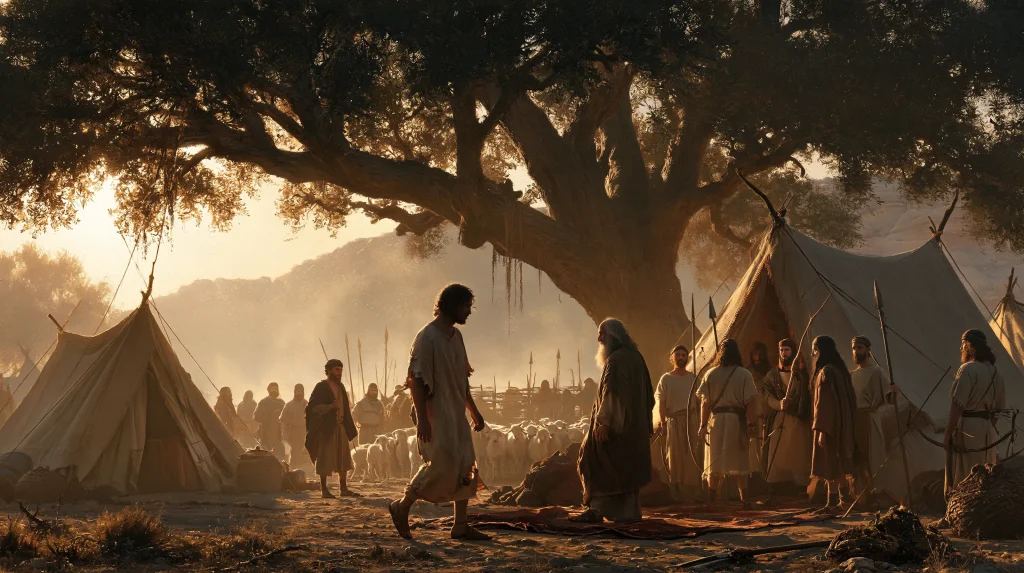
Verse 13 turns on one unnamed person: “one that had escaped, and told Abram the Hebrew”. Abram was living in the plain of Mamre the Amorite, and Mamre and his brothers Eshcol and Aner “were confederate with Abram”. Without the fugitive the story would end with a relative lost and no one looking for him.
TheTorah.com says this is the first place the word “Hebrew” appears in the Bible, and adds that scholars have not agreed on its origin. The text never names the fugitive, but a medieval commentary does. Rashi, as quoted on the website Wide Torah, says the plain meaning is that he was Og, who escaped when the invaders struck the Rephaim at Ashteroth-karnaim (14:5). Deuteronomy 3:11 says “only Og king of Bashan remained of the remnant of giants”. The same page reports a midrashic motive: Og hoped Abram would die in the fight so that he could marry Sarah. Genesis says none of this.
Two Rescues
Lot is brought out of danger in Sodom twice. In chapter 14 Abram “brought again his brother Lot” (14:16). In chapter 19, as the cities are about to be overthrown, the angels “laid hold upon his hand” and the LORD is “merciful unto him” (19:16), and verse 29 says “God remembered Abraham, and sent Lot out of the midst of the overthrow”. The wording ties Lot’s survival to Abraham both times. In the King James text, verse 29 also ends on the same verb as 14:12, saying God overthrew “the cities in the which Lot dwelt”. Whether chapter 14 is meant as an early warning for chapter 19 is a reading, not a statement of the text.
What Can Be Said
Genesis 14:11-12 records the plunder of a defeated city in a few plain verbs and names one captive. It gives no figure for the others, no reason for Lot’s capture beyond where he lived and no account of how he was treated. What can be said plainly is narrow: a city falls, its goods are stripped and a man is taken because of where he lived.

