Six Peoples Fell Before Sodom: The Long March in Genesis 14
Biblical History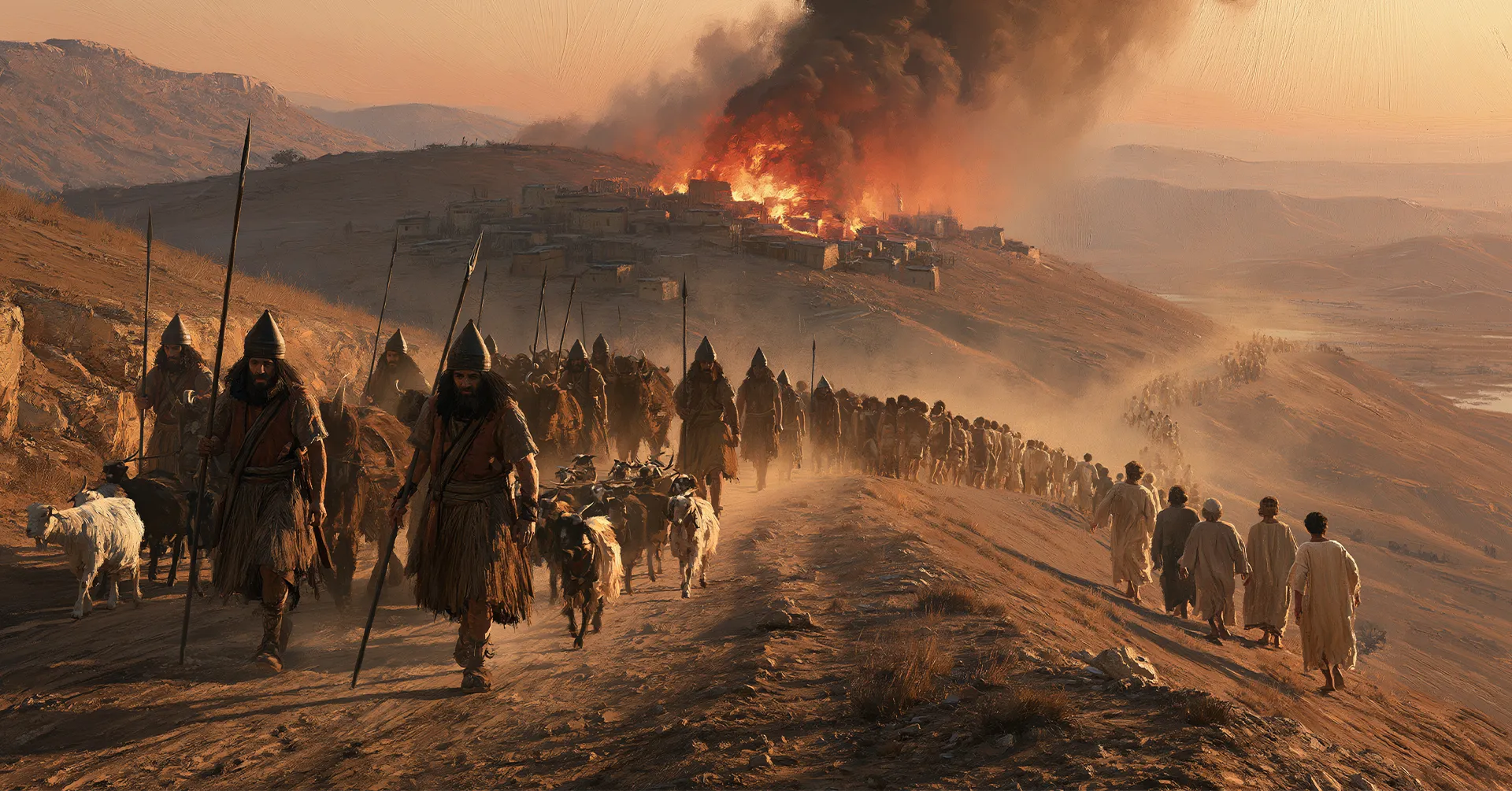
AI reconstruction, not a photograph.
Before the battle at the centre of Genesis 14 there is a long march. Verses 5-7 say Chedorlaomer and “the kings that were with him” struck six groups of people on a loop through Transjordan and the south: the Rephaim, the Zuzim, the Emim, the Horites, “all the country of the Amalekites” and the Amorites of Hazezon-tamar. The text gives no date, no figures and no reason. This article sets out the list, traces the route, weighs the motives that have been suggested and asks what Deuteronomy says about the peoples who were struck.
The Six Peoples
The passage reads like a ledger. In the fourteenth year Chedorlaomer “smote the Rephaims in Ashteroth Karnaim”, “the Zuzims in Ham” and “the Emims in Shaveh Kiriathaim”, and then struck “the Horites in their mount Seir, unto Elparan, which is by the wilderness” (14:5-6). The kings “returned” to En-mishpat, “which is Kadesh”, and “smote all the country of the Amalekites”, and also the Amorites “that dwelt in Hazezontamar” (14:7).
The detail is thin. The text gives no count of the dead, no description of a siege and no statement that any town was destroyed. It names peoples and places and moves on. It also names no ruler: four of the five kings of the plain have names (14:2), but none of the peoples struck on the march has a leader in the text. The fourteenth year follows the rebellion of the thirteenth (14:4-5), but Genesis does not say how long the march took.
Tracing the Route
Several of the names are uncertain, so the route can only be sketched. One dictionary entry identifies Ashteroth-karnaim with the Ashtaroth of Bashan, where Joshua 12:4 says Og, who was “of the remnant of the giants”, dwelt. The International Standard Bible Encyclopedia suggests Tell Ashtarah as a site but calls the whole question obscure. It places Shaveh-kiriathaim in Moab and identifies it with the modern Kureiyat. The sources consulted for this article do not locate Ham, where the Zuzim were struck. Mount Seir is Edom’s hill country, which Deuteronomy 2:5 says was given to Esau, and Genesis 36:20 speaks of “Seir the Horite, who inhabited the land”. The Encyclopedia of the Bible calls it highly probable that El-paran, the southern end of the march, is Elat on the Gulf of Aqaba.
Then the kings turned back. En-mishpat is Kadesh, which an unsigned commentary on the site The Bible Says places in the southwest Negev. The commentary suggests that coming back by that route let the kings approach the cities of the plain from the west, an unexpected direction. Hazezon-tamar is En-gedi, as 2 Chronicles 20:2 states. En-gedi stands on the western shore of the Dead Sea, which verse 3 identifies with the vale of Siddim, so the loop ends where the main battle will be fought.
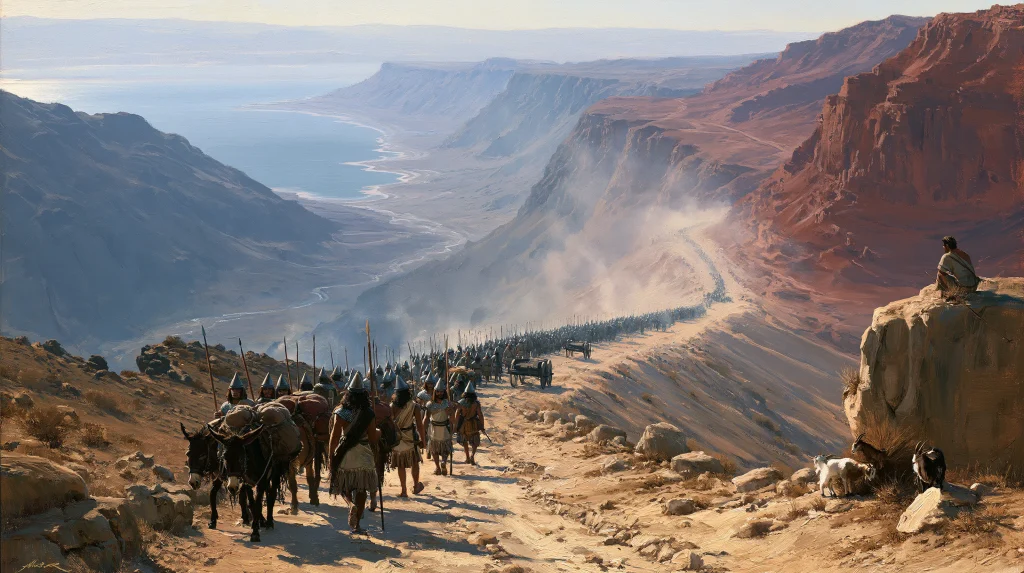
The scale is large. A straight line from Damascus to modern Eilat, the two ends of the King’s Highway as the Encyclopedia of the Bible describes it, measures about 460 km, according to a calculation from the coordinates on their Wikipedia pages. If Ashteroth-karnaim lay in Bashan and El-paran was at Elat, the north-south span was somewhat less than that. Out and back by Kadesh and En-gedi, the march covered far more ground than any single span.
Why March So Far?
Genesis explains the war at Siddim, a rebellion after twelve years of service (14:4), but not the march before it. The sources offer several suggestions. The Encyclopedia of the Bible says the invasion apparently followed the King’s Highway, a road that existed well before 2000 BCE, and that control of the road probably lay behind it. Wikipedia says Edom, Moab, Ammon and the Aramaean states depended largely on that road for trade. Israel itself asks Edom and Sihon for passage on “the king’s high way” in Numbers 20:17 and 21:22. Wikipedia’s page on Chedorlaomer gives a different aim, to show Elam’s might to the territories under its authority, and the unsigned Bible Says commentary says the kings were enforcing tribute.
These are inferences, not statements of the text. Whether the kings were conquerors, tax collectors or raiders, Genesis does not say.
Not every scholar reads the chapter as a memory of a real march. Wikipedia summarises Astour’s view, in the Anchor Bible Dictionary, that Genesis 14 is anti-Babylonian propaganda from the exile, and the Encyclopedia of the Bible mentions a reading of the chapter as an early midrash. The same encyclopedia also points to cuneiform texts in which coalitions of kings march long distances in the second millennium BCE, and to archaeological evidence from Transjordan, the Negev and Sinai that it says shows a civilisation ending abruptly.
Peoples Already Gone
Deuteronomy 2 looks back on several of these peoples as earlier occupants of land that later belonged to Israel’s neighbours. The Emim, it says, were “a people great, and many, and tall, as the Anakims”. They “dwelt therein in times past”, and “the Moabites call them Emims” (2:10-11). The Horims “dwelt in Seir beforetime; but the children of Esau succeeded them” (2:12). In Ammon’s land “giants dwelt therein in old time; and the Ammonites call them Zamzummims”, and “the LORD destroyed them before them” (2:20-21). Dictionary entries collected on the Biblical Training site call the Zamzummim the Ammonite name for the people called Rephaim. A late echo of the Rephaim at Ashteroth-karnaim comes in Deuteronomy 3:11: “only Og king of Bashan remained of the remnant of giants”.
The same entries suggest that the Zuzim of Genesis 14:5 may be the Zamzummim, a guess based on the similar names. If so, the same people appear under different names in different accounts. Deuteronomy treats the displacement as part of a pattern, “as Israel did unto the land of his possession” (2:12), which makes Genesis 14 one blow in a longer history. Genesis 15:19-21 later lists the Rephaim and the Amorites among the peoples whose land is promised to Abram’s descendants.
Names That Look Later
Two details in the list stand out. Amalek is a grandson of Esau in Genesis 36:12, so he belongs to a later generation than Abram, yet verse 7 speaks of “the country of the Amalekites”. The Encyclopedia of the Bible says this need not be an anachronism. It reads the phrase either as a different Amalek or, as it prefers, as a name for the land that later became the home of Esau’s Amalekite descendants.
The Amorites are the second detail. Those struck at Hazezon-tamar are Amorites, and in verse 13 Mamre the Amorite and his brothers Eshcol and Aner are Abram’s allies. The text does not say whether the two groups were connected, only that the same label appears on both sides of the story.
What Can Be Said
Genesis 14:5-7 records six peoples struck on a loop of hundreds of kilometres, with no figures, no sieges and no stated motive. Deuteronomy remembers some of them as ancient and gone, and the sources suggest reasons for the march that the text never gives. What can be said plainly is narrow: a procession of defeated peoples, a long march and no account of the cost.

