Romans 10:13 and Revelation 9 Both Draw on the Book of Joel
Biblical History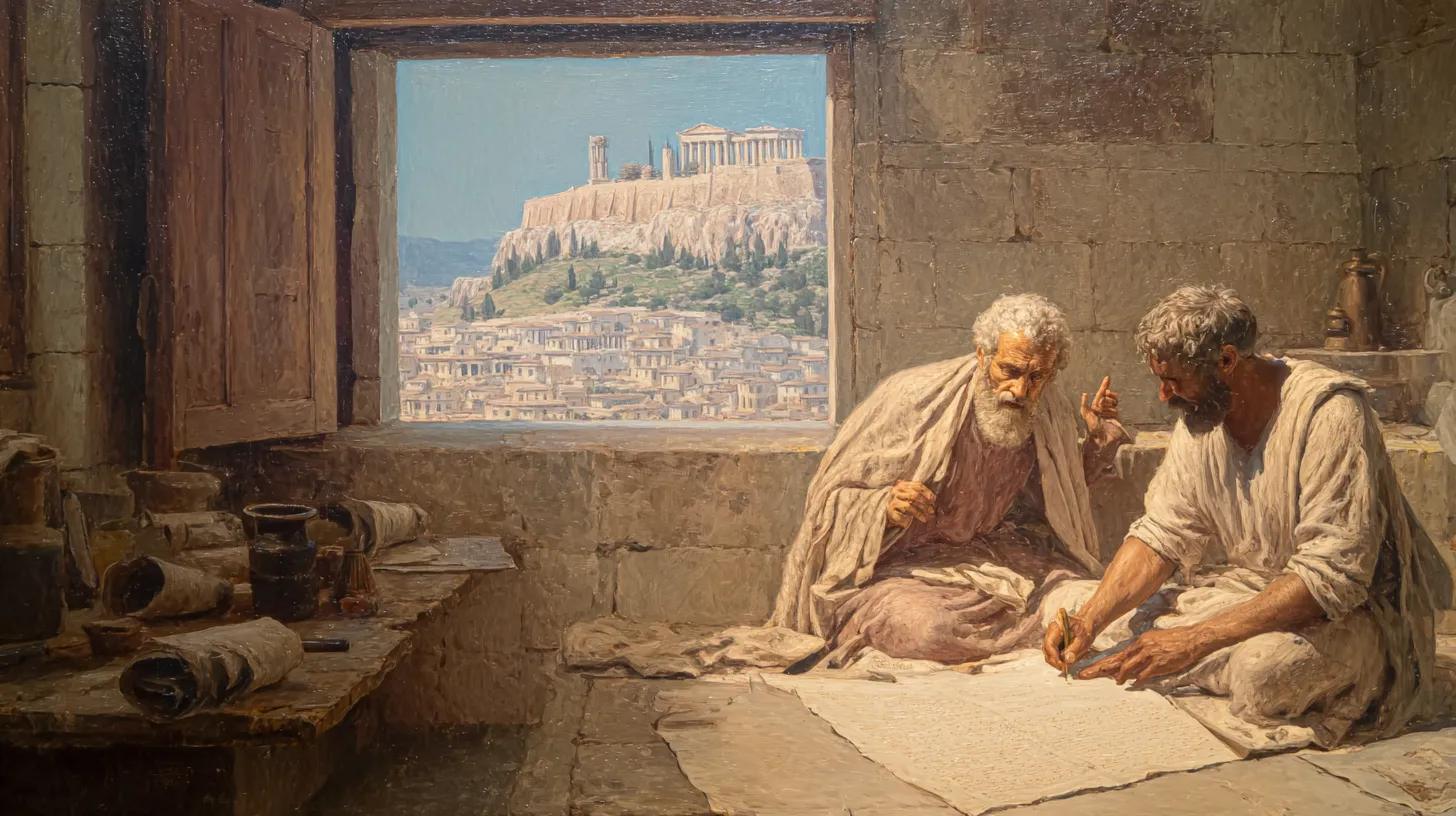
AI reconstruction, not a photograph.
Paul’s promise in Romans 10:13 that everyone who calls on the name of the Lord will be saved is a quotation from the prophet Joel, the same book whose locust army is echoed in the plague of Revelation 9. That shared source explains why readers keep setting the two passages side by side. It does not mean Paul and John were answering each other, and what Paul does with the line is plainer, and narrower, than the pairing suggests.
A Line From the Prophet Joel
The King James Version has Joel 2:32 say that “whosoever shall call on the name of the LORD shall be delivered.” Hebrew Bibles number the same verse Joel 3:5. It closes a passage in which God promises to pour out his spirit on “all flesh,” the sun is “turned into darkness,” and “the great and the terrible day of the LORD” arrives. The verse then offers deliverance in Zion and Jerusalem to “the remnant whom the LORD shall call.”
The book names no datable events, so scholars have placed it anywhere from the ninth century BC to about 350 BC. The Septuagint, the Greek translation of Joel, has the clause with the word pas, “every” or “whoever,” and Paul’s Greek follows that wording almost exactly.
What Paul Does With It
Paul wrote Romans in the mid-50s AD, most likely at Corinth in the house of Gaius, and his scribe Tertius adds a greeting of his own in the last chapter (Romans 16:22). Its first readers in Rome were Christians of both Jewish and Gentile background. Chapter 10 opens with Paul’s prayer that Israel “might be saved,” and by verse 9 he links salvation to confessing “the Lord Jesus” and believing in the resurrection. Then he states the principle: “there is no difference between the Jew and the Greek,” because “the same Lord over all is rich unto all that call upon him.” Verse 13 supplies the proof from Joel.
So the “everyone” belongs to an argument about who may call. Paul faults his own people for “going about to establish their own righteousness” (10:3) and says Christ is “the end of the law for righteousness to every one that believeth” (10:4). As the chapter runs, the offer does not depend on heritage or on keeping the law. The verse is not a ranking of who is good enough.
One more shift is easy to miss. The King James Version prints Joel’s “LORD” in capitals, its convention for the divine name. In Romans the word is plain “Lord,” in a chapter that has just spoken of “the Lord Jesus,” and a 2020 study in the journal In die Skriflig, by Span, Rochester and van Rensburg, argues that Paul’s context makes Jesus the Lord whose name is called on.
Verse 14 then adds a limit: “How then shall they call on him in whom they have not believed?” Verse 13 promises that everyone who calls will be saved. It does not say that everyone will call.
Peter’s Speech in Acts Ends the Same Way
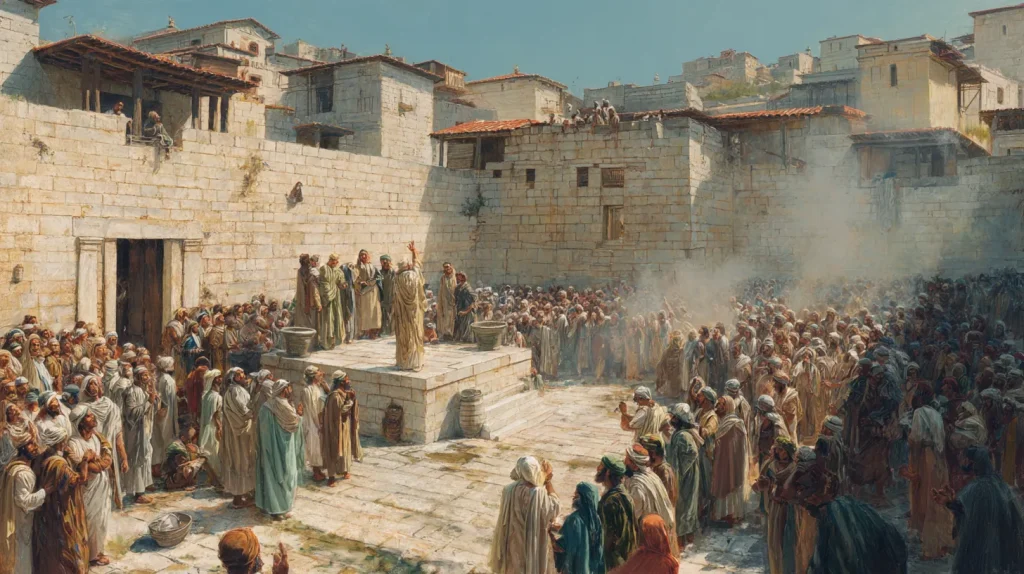
Paul was not the only New Testament voice to use Joel’s closing line. In Acts 2, as Luke tells it, Peter answers the charge that the apostles are drunk by saying “this is that which was spoken by the prophet Joel,” quotes the passage to its end, and finishes on the same sentence as Romans 10:13 (Acts 2:16, 2:21). He closes the speech by declaring that God has made Jesus “both Lord and Christ” (2:36).
The phrase soon worked as a label for believers. Acts 9:14 has Ananias say that Saul, later Paul, held authority “to bind all that call on thy name,” and Paul writes to the church at Corinth together “with all that in every place call upon the name of Jesus Christ.” The words also echo Genesis 4:26, which says that in the days of Enos “then began men to call upon the name of the LORD.”
Joel’s Locusts, Revelation’s Locusts
Joel opens with a locust plague, and chapter 2 describes an invading host. The appearance of the invaders is “as the appearance of horses,” their noise is “like the noise of chariots,” and “the LORD shall utter his voice before his army.” Revelation 9 describes locusts rising from the pit under a king named Abaddon, shaped “like unto horses prepared unto battle,” with wings that sound “as the sound of chariots of many horses running to battle” and teeth “as the teeth of lions.”
A United Bible Societies handbook on Revelation, by Bratcher and Hatton, traces the horse-like shape to Joel 2:4 and the lion-like teeth to Joel 1:6. John does not name Joel, and Paul, writing some forty years before the 90s AD date usually given for Revelation, could not have cited it. What links Romans 10:13 to Revelation 9 is a shared source, not a reference in either direction.
Where Revelation 9 Ends
The locusts of Revelation 9 are told to hurt only “those men which have not the seal of God in their foreheads” (9:4). After them the sixth trumpet looses four angels bound at the Euphrates to kill a third of mankind (9:13-15). The chapter then ends on a refusal. The people who survive the plagues “yet repented not of the works of their hands,” and the text lists murders, sorceries, fornication and thefts they did not give up (9:20-21).
Readers who set Romans 10:13 beside this ending find a contrast: refusal on one side and an open call on the other. That is a reading. Romans 10:13 does not mention Revelation, angels or the Euphrates, and it gives no time frame. Revelation 9 does not mention anyone calling on the Lord.
Hebrews 10:31 and the Pairing
Some teachers add a third verse, Hebrews 10:31: “It is a fearful thing to fall into the hands of the living God.” In its setting the warning is aimed at readers who have “received the knowledge of the truth” and then sin wilfully (10:26), and verse 30 quotes Deuteronomy: “The Lord shall judge his people.” The two verses are often read as a pair, one pointing to the seriousness of judgment and the other to the open door of rescue. Neither letter sets them side by side, and they answer different questions: Hebrews warns a community that already knows the truth, and Romans says who may call.

What the Verses Establish
What the verses establish is narrow and clear. Joel promised deliverance to whoever calls on the LORD, and Peter and Paul both took up the line. Paul used it to say that Jew and Greek share one Lord. Revelation 9 ends on a refusal to turn, and Romans 10:13 states in plain words who may call and what follows when they do.
Readers also differ on how literally to take Revelation 9. Some read the angels, the army and the death toll as events, others as symbolic language, and neither Romans nor Hebrews settles it. The pairing comes from later readers, not from the Bible itself.

