Pi-Ramesses Taken Apart: How Its Stones Ended Up in Tanis
Archaeology & Sites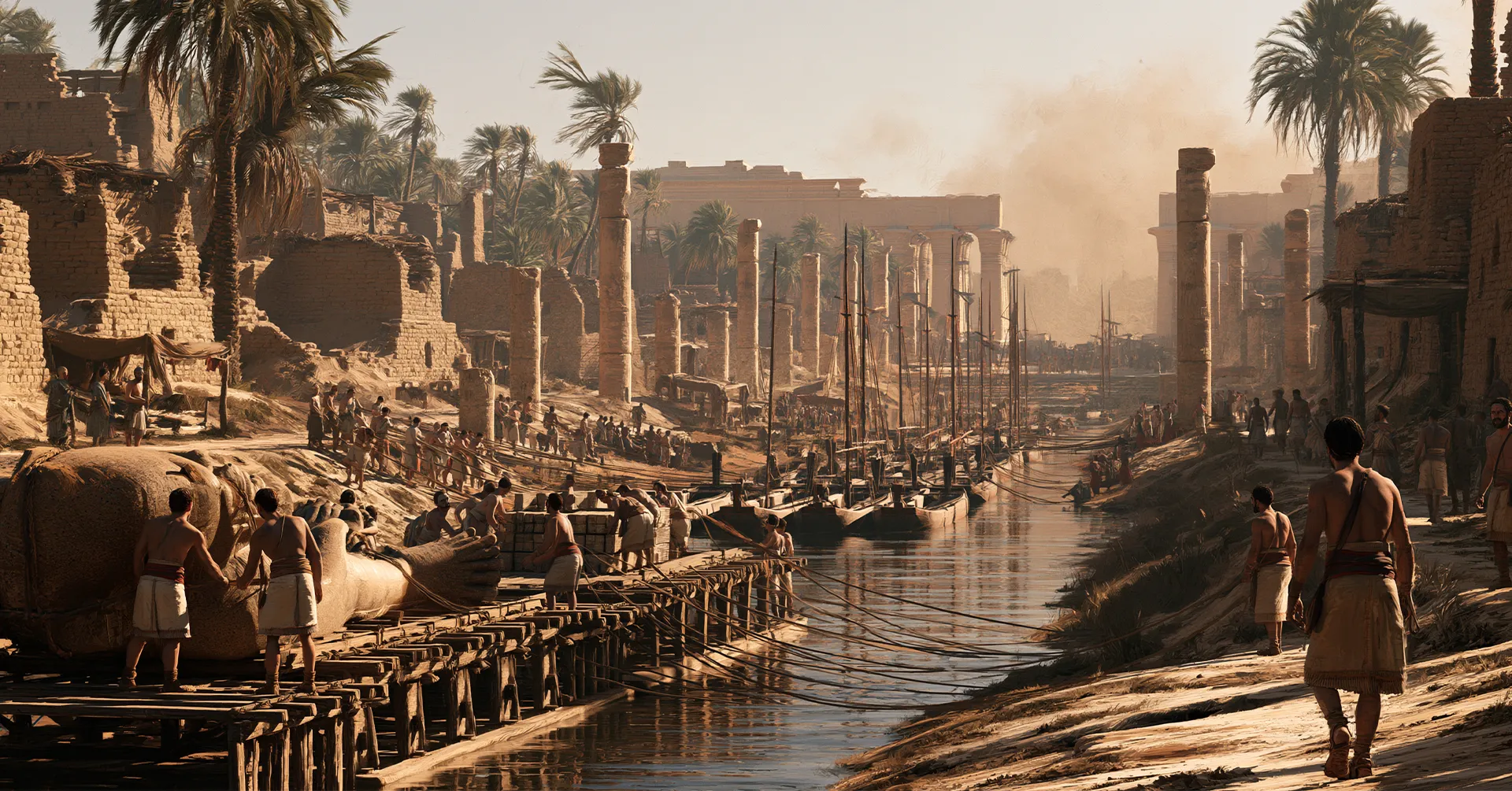
AI reconstruction, not a photograph.
Ramesses II built his capital, Pi-Ramesses, in the eastern Nile Delta of Egypt, and within about two centuries of his death it was being taken apart. Its stones went to Tanis, about 20 km to the north, where later kings used them to build a younger capital. Archaeologists sorted this out only in the twentieth century, between the late 1920s and the 1970s. This article sets out where the old capital stood, what the stones in Tanis show, why they may have moved and how the city then all but vanished.
Where the Capital Stood
Wikipedia says Ramesses II built Pi-Ramesses “at Qantir, near the old site of Avaris”. The Austrian Academy of Sciences places Qantir about 2 km north of Tell el-Dab’a, the site of Avaris, the Hyksos capital. The Piramesse exhibition website says that Seti, his father, began expanding the city around 1290 to 1280 BCE and that it was renamed “House of Ramesses” at the start of the new reign, about 1279 BCE.
Tanis lies to the north. The coordinates on Wikipedia give a straight-line distance of about 20 km (12.6 miles), and an English-language presentation of the site on the website of the École Pratique des Hautes Études (EPHE) says Tanis lay “some twenty kilometers from Piramesse (Qantir)”. Wikipedia in one passage, the Austrian Academy and the exhibition website give about 30 km, so published figures differ, probably because of the points measured or the route taken.
What the Stones at Tanis Show
Wikipedia says Tanis was the capital of the 21st and 22nd Dynasties and that many of its monuments were brought there from nearby cities, “mainly from the previous capital of Pi-Ramesses”. The French Institute of Oriental Archaeology (IFAO) dates the founding of the new capital to the turn from the New Kingdom to the Third Intermediate Period, in the 11th century BCE, and says that many of the reused monuments carry inscriptions that are mostly Ramesside, of the 19th and 20th Dynasties. The Qantir team’s research history adds that Tanis shows no sign of settlement before the end of the New Kingdom. Peter Brand, in the UCLA Encyclopedia of Egyptology, says the pharaohs of the 21st and 22nd Dynasties “transported hundreds of inscribed stone monuments from Pi-Ramesse and elsewhere”.
The evidence is in the walls. The EPHE presentation says that around 800 BCE, under Shoshenq III, a new monumental gateway was built from older granite monuments, among them “fragments of obelisks and colossi of Ramesses II” and “blocks of Kheops”. Brand describes the gateway as “composed of reused blocks dating to the Old, Middle, and New Kingdoms”, and a caption in his entry shows blocks from monuments of Ramesses II among them. That is roughly four centuries after Ramesses II died. Some of his statues were already second-hand: the EPHE presentation says they were “originally made for earlier kings” and had been reused at Pi-Ramesses before they went to Tanis.
How the Mistake Was Corrected
Tanis was dug long before anyone doubted that it was the Ramesses city. According to a Bible-lexicon entry by Karl Jansen-Winkeln, J. Rifaud found statues there in 1825, Auguste Mariette began excavating in 1860 and Flinders Petrie dug in 1884, and earlier scholars took Tanis for the Ramesses city. The Qantir team says that Pierre Montet, who worked at Tanis from the late 1920s, held that Tanis was both Avaris and Pi-Ramesses, and did not recognise that none of the obelisks stood where they had first been set up.
The correction came in steps. Mahmoud Hamza dug at Qantir from 1928 to 1930 and argued that it, not Tanis, was Pi-Ramesses. Labib Habachi’s article of 1954 carried the case further, and Manfred Bietak’s Tell el-Dab’a II, published in 1975, convinced the remaining sceptics, the team’s research history says.
When and How the Stones Moved
The World History Encyclopedia dates Ramesses II’s reign to 1279 to 1213 BCE. The sources do not agree on when his capital ended. A 2022 paper by James Hoffmeier and Gary Rendsburg gives its occupation as roughly 1270 to 1135 BCE, the Austrian Academy puts its abandonment around 1100 BCE and Wikipedia dates the start of the Nile silting to about 1060 BCE. The exhibition website says the city became a quarry from the start of the 21st Dynasty, about 1070 BCE, and that the process “took at least 100 years”. Counted from 1213 BCE, the stone-taking began about 140 years after Ramesses II died and, if it lasted a century, ended about 240 years after. WiBiLex, a German Bible lexicon, adds that pottery suggests a smaller settlement continued.
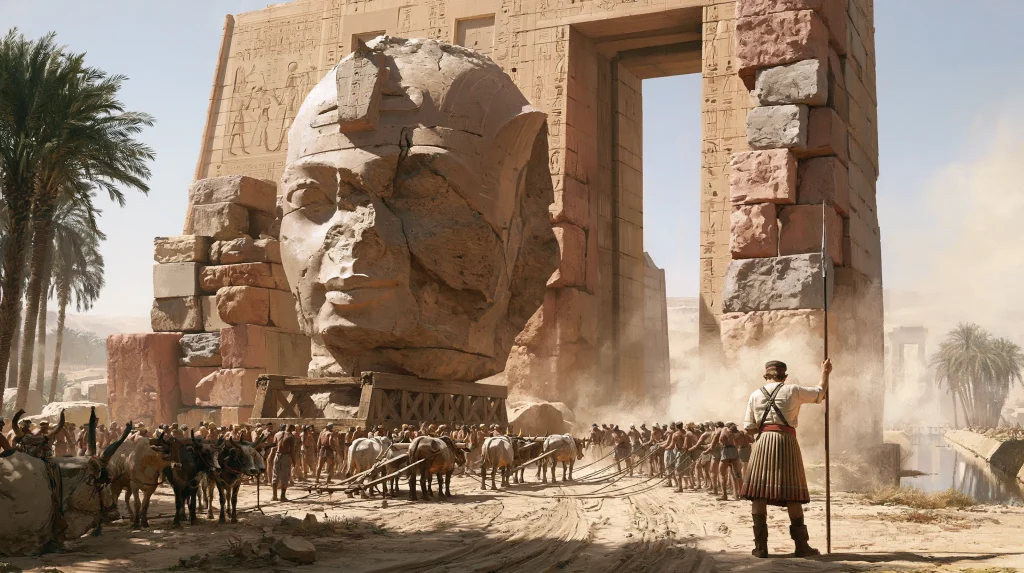
Almost everything made of stone went. Wikipedia says the 21st Dynasty pharaohs “transported all the old Ramesside temples, obelisks, stelae, statues and sphinxes”, and that the obelisks and statues, “the largest weighing over 200 tons, were transported in one piece”. The EPHE presentation adds that some of the stones were re-erected at Tanis and others cut into building blocks. Reuse itself was widespread. Brand notes that materials were scarce and valuable, and gives two main reasons rulers reused monumental stone: expediency, since nearby older masonry was cheaper than new stone quarried from a distance, and ideology, since inscribed blocks from earlier kings lent legitimacy to new work.
Why Move the Stone?
The sources consulted point to no ancient text that explains the decision, so every reason here is a reconstruction. The one most often given concerns the Nile. Wikipedia says the Pelusiac branch of the river “began silting up c. 1060 BC”, while the Austrian Academy says only that the city was abandoned around 1100 BCE, “presumably due to the silting up of the Pelusian branch”. IFAO says the city was abandoned when that branch changed course.
Two further reasons fit the evidence. IFAO says the old stone buildings became “une source de matériaux avantageusement proche” for the sanctuaries of the new capital, a conveniently close supply of material, and the EPHE presentation says they “served as stone quarries for construction during the Third Intermediate Period”. And Brand says dozens of obelisks, colossal statues and stelae of Ramesses II were used at Tanis “to emphasize the link between the Tanite kings and their illustrious royal ancestor”. These reasons do not exclude one another, and the sources do not rank them.
The City Vanishes a Second Time
The stone was not the only loss. In RAWI magazine, the Egyptologist Garry Shaw writes that the most striking thing about Pi-Ramses today is “its complete disappearance”. In the Delta, he says, “any mud-brick remains have long since been ploughed away into the fields”. Describing the surviving feet of a statue of Ramesses II at Qantir, he says the king is “stuck in a field, surrounded by crops, farmers and an inquisitive water buffalo”. Live Science wrote in 2017 that “nothing of the city’s glorious past can be found at the surface”.
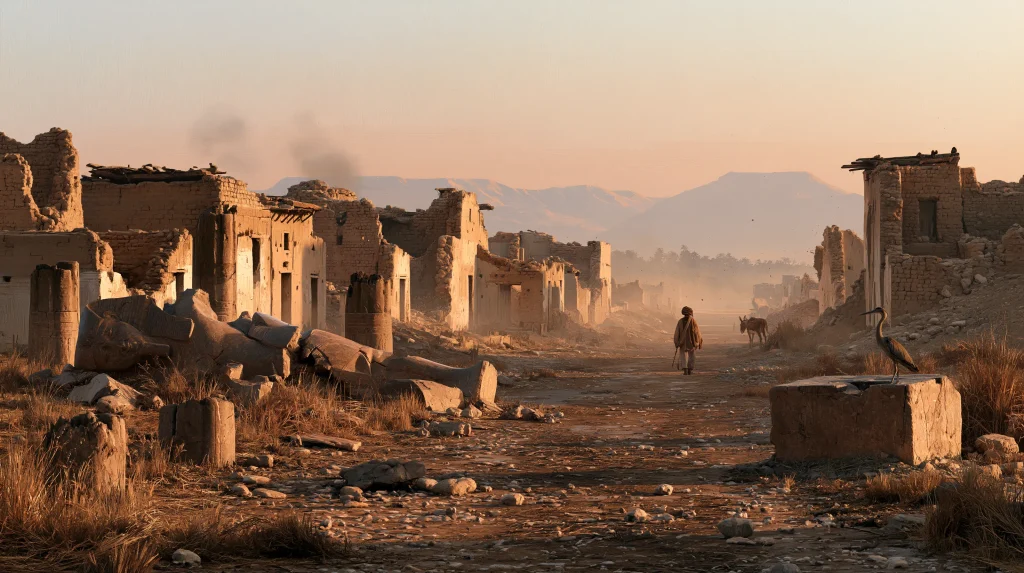
Why the later layers are missing is not settled. The project’s account of its 2016 and 2017 seasons says four small trenches at one area, Q VIII, found no layers later than the end of the 19th Dynasty or the start of the 20th, and that it cannot yet be said whether this reflects erosion, removal of higher layers or a lack of later use. Most of the capital has not been dug. The exhibition website says about 0.5% of the city centre has been excavated and about 30% surveyed by magnetometer, which maps buried structures without digging.
So the city went twice: first at the hands of the king’s successors, who reused its stone, and then from the surface, where Shaw says the mud brick has been ploughed into the fields.
What Can Be Said
Pi-Ramesses was the capital of one of Egypt’s best-known kings, and within about two centuries of his death it was being quarried for a younger city about 20 km away. Its stones now stand in the walls of Tanis, and what is left at Qantir lies mostly under fields and a modern village. What can be said plainly is narrow: a famous king’s capital was taken apart by those who came after him, and the sources consulted do not record why.

