The Bible Never Says What the Mark of Cain Looked Like
Biblical History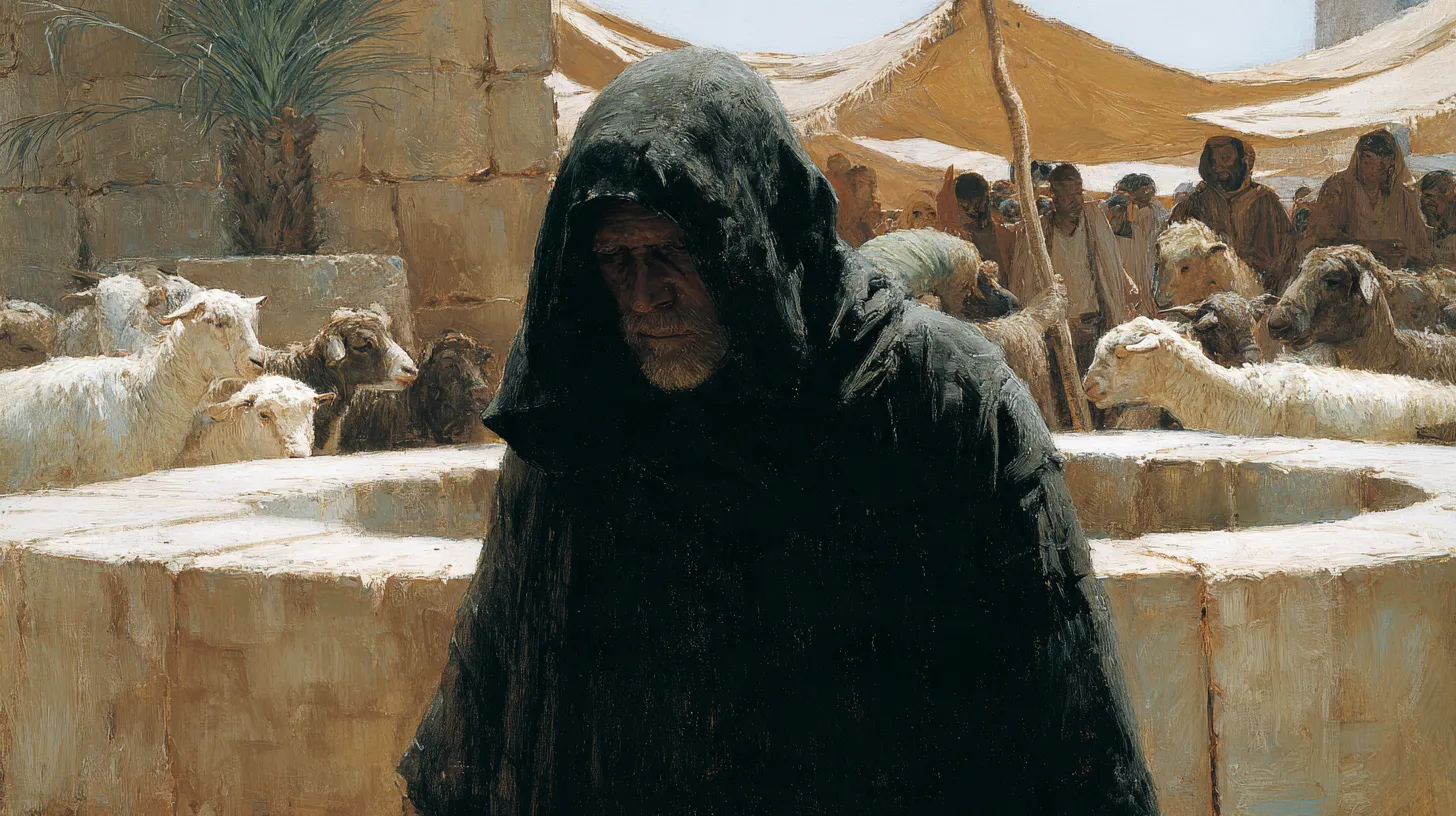
AI reconstruction, not a photograph.
God put a mark on Cain so that no one would kill him, and the Bible never says what it looked like. Genesis is exact about everything around the mark: why it was needed, what it was meant to prevent, and what would happen to anyone who killed Cain anyway. The one thing it leaves out is the mark itself.
The Sentence Cain Called Too Heavy
The scene belongs to the first generation after Adam and Eve. God has looked with favor on Abel’s offering from his flock and not on Cain’s from the ground, and Cain, furious, kills his brother out in a field (Genesis 4:3–8). God’s sentence begins with the ground, which has opened its mouth to take Abel’s blood. Cain is cursed away from it: when he works the soil it will no longer yield its strength to him, and he is to be a fugitive and a wanderer on the earth (4:11–12). The Hebrew pairing behind that last phrase, na va-nad, appears only in this story.
Cain’s reply can be read two ways. The Hebrew can mean “my punishment is greater than I can bear,” or, because the noun can mean guilt and the verb can also mean “forgive,” “my guilt is too great to be forgiven.” What he says next is plain: whoever finds him will kill him (4:13–14).
What God Says, and What He Leaves Out
God’s answer has two parts. Anyone who kills Cain will face vengeance sevenfold. And the LORD sets a sign for Cain, “lest any finding him should kill him” (4:15, King James Version). Then Cain goes out from the presence of the LORD and settles in the land of Nod, east of Eden (4:16). The name Nod echoes the Hebrew word for wanderer, so the place name repeats the sentence.
That is all the text provides. The purpose and the penalty are stated. The shape, size and position of the sign are not, and nothing says whether it could be seen from a distance or only up close. The purpose points toward strangers who would meet Cain on the road, but the passage never says how they would know the sign when they saw it.
A Sign, Not Necessarily a Brand
Part of the puzzle begins in English. The Hebrew word is ot, the ordinary word for a sign. It is the word used for the rainbow after the flood (Genesis 9:12), for circumcision (17:11) and for the lights God sets in the sky “for signs” (1:14). The Septuagint, the ancient Greek translation, renders it “sign,” and so does the Latin Vulgate. The King James Version rendered it “mark,” and with that word came a picture of something stamped on Cain’s skin.
The Hebrew also says the sign was set “for” Cain, not “upon” him, and the American Standard Version follows that closely: “appointed a sign for Cain.” A sign given to someone can be a pledge rather than a brand, the way the rainbow is a pledge. Whether Genesis means a visible mark on the body or a guarantee handed to Cain, the text does not say.
Readers Filled the Blank Several Ways
The silence invited answers. Genesis Rabbah, a collection of rabbinic commentary compiled in Palestine in late antiquity, around the fifth century CE, sets competing views side by side. One teacher said God made the sun shine for Cain, another that leprosy broke out on him. One said God gave him a dog, and another that a horn grew on him.
The Aramaic translation known as Targum Pseudo-Jonathan describes a letter of the divine name set on Cain. The medieval commentator Rashi places that letter on his forehead, while another midrash, Pirqe de-Rabbi Eliezer, puts a letter on his arm. Those readings draw on a later meaning of ot, a letter of the alphabet. Ibn Ezra and Radak, also medieval, argued that no physical sign was involved at all: God simply took away Cain’s fear.
The Greek Septuagint words the sentence differently: Cain will be “groaning and trembling” on the earth (4:12). The Syriac Christian tradition read that as a real physical affliction that let others recognize him.
A Tribal Mark, Some Scholars Suggest
Some biblical scholars have proposed another origin. Encyclopaedia Britannica reports the view that the story may have been meant to explain why a tribe called Cain wore a distinctive tattoo, avenged its murdered members severely and lived as nomads, and that some biblical critics identify that tribe with the Kenites, a people named elsewhere in the Bible. Britannica presents this as a possibility, not an established fact. It is a hypothesis about where the story came from, and Genesis itself never calls the sign tribal.
When the Blank Did Harm
Silence also left room for prejudice. One anti-Jewish reading made Cain a stand-in for the Jewish people. Another, common from the eighteenth century into the twentieth, held that the mark was dark skin, a claim often tangled up with the separate story of Noah’s son Ham and used in America to defend slavery. Genesis supports none of it. The Hebrew word never refers to skin color, and the text never says the sign passed to Cain’s descendants.
Who Was Cain Afraid Of?
The fear behind the sign raises its own question. If Adam, Eve and Cain were the only people alive, who would find Cain and kill him? The text hints at an answer without giving one. In the verses that follow, Cain has a wife and a son and builds a city (4:17), and Genesis never says where she came from. It also says Adam fathered “sons and daughters” (5:4), but it places them after Seth’s birth, so that line does not settle who was alive when Abel died.
Readers have offered two explanations. One is that other children of Adam and Eve already existed and the text never discusses them. The other is that Cain and Abel were already old when they quarrelled, since Genesis gives its early generations lifespans of centuries, so several generations of the family may have been alive. Both are inference. The text gives no ages for the brothers and says only that the offerings came “in process of time” (4:3, King James Version).
The text does set an outer limit. Seth was born after Abel’s death (4:25), when Adam was 130 in the Hebrew text or 230 in the Greek Septuagint (5:3). The killing fell somewhere inside that window, and Genesis never says where.
Protection That Cuts Both Ways
Some readers see a second edge in the sign. If no one could kill Cain, no one could end his suffering early, so the protection kept the sentence running to its end. That is a reading, not a line of the text. Early rabbinic commentary pulled in both directions too, making Cain an example to murderers in one reading and an example to penitents in another. Ruth Mellinkoff’s 1981 book The Mark of Cain, a survey of how readers explained the mark, found that commentators’ views depended on whether they saw Cain as given time to repent or as further shamed.
The sevenfold promise surfaces again a few verses later in the mouth of Cain’s descendant Lamech. He tells his wives that he has killed a man for wounding him, and that if Cain is avenged sevenfold, he will be avenged seventy-sevenfold (4:23–24). Mellinkoff traced how a mistranslation of that passage turned Lamech into Cain’s killer, who mistook him for an animal, and how the horned Cain of Cornish drama, Irish saga and cathedral reliefs developed from it.
In everyday English, the “mark of Cain” now means a badge of shame. In Genesis, the sign was given to stop a stranger’s hand, and nothing on the page says what that stranger was supposed to see.

