The Vikings’ Mistake May Have Saved Them From Rome
Vikings & Norse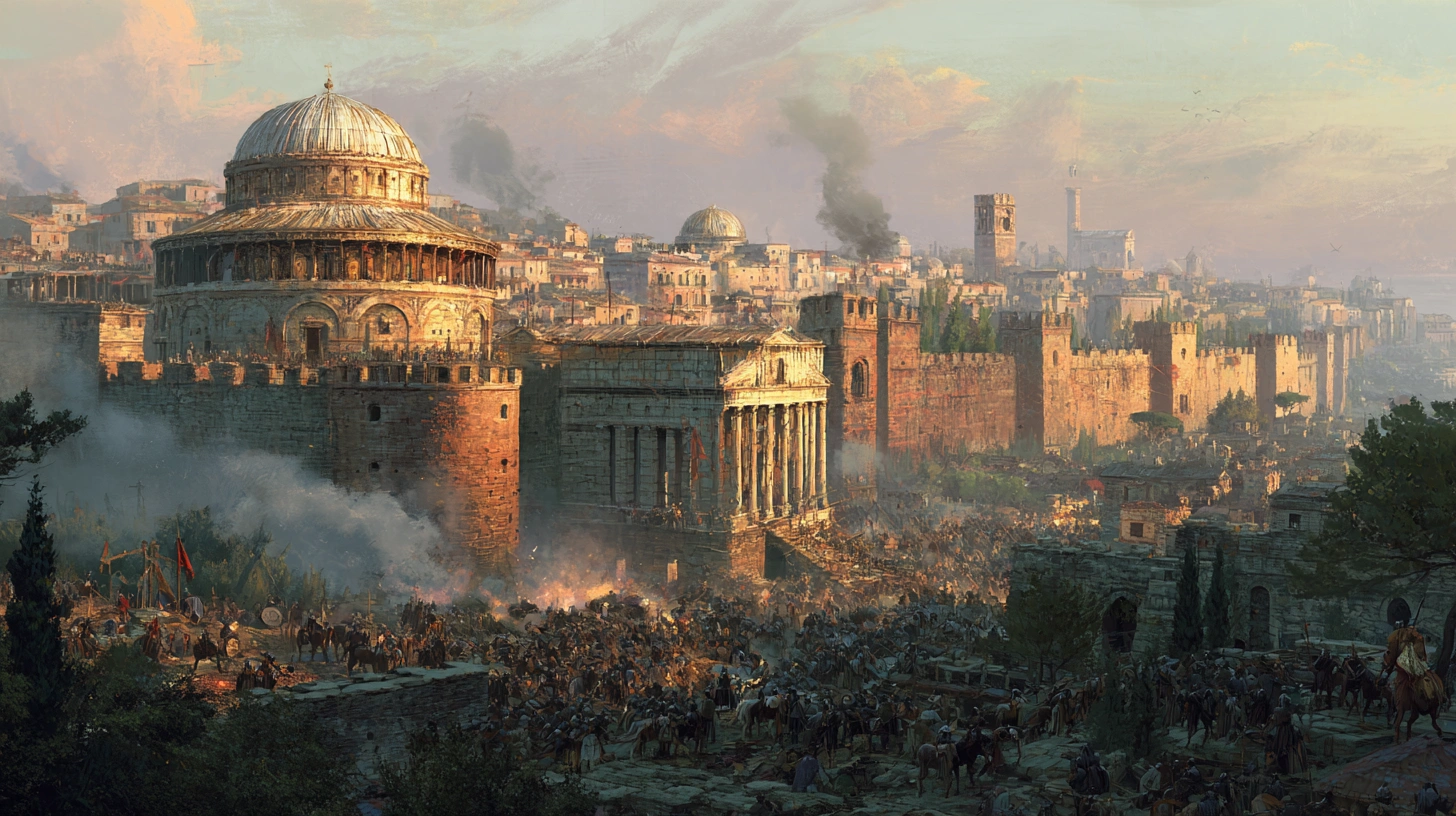
AI reconstruction, not a photograph.
Getting the wrong city may have been the one thing that kept Hastein and Björn Ironside’s fleet from sailing into a disaster considerably worse than a navigational error. Rome in 860 CE was not an easy target, and the Vikings appear to have had no real sense of exactly how badly outmatched they would have been if they had actually found it.
A City That Remembered 410
Rome’s reputation as a vulnerable prize traced back to a much earlier disaster. In 410 CE, Alaric and a Visigothic army had breached the city’s defenses and sacked it, the first time Rome had fallen to a foreign army in roughly eight hundred years, an event that shocked the late Roman world to its core and echoed through European memory for centuries afterward. By the ninth century, though, more than four centuries had passed, and Rome had changed considerably from the city Alaric’s forces entered. It now functioned as the seat of the papacy, a city whose importance rested on religious and political authority stretching across Western Christendom, not simply on its own walls and garrison the way a purely secular capital might have. A raiding fleet weighing an attack on Rome in 860 was not, in other words, facing the same city that had fallen so dramatically four hundred and fifty years earlier.
A Recent, Real Attack
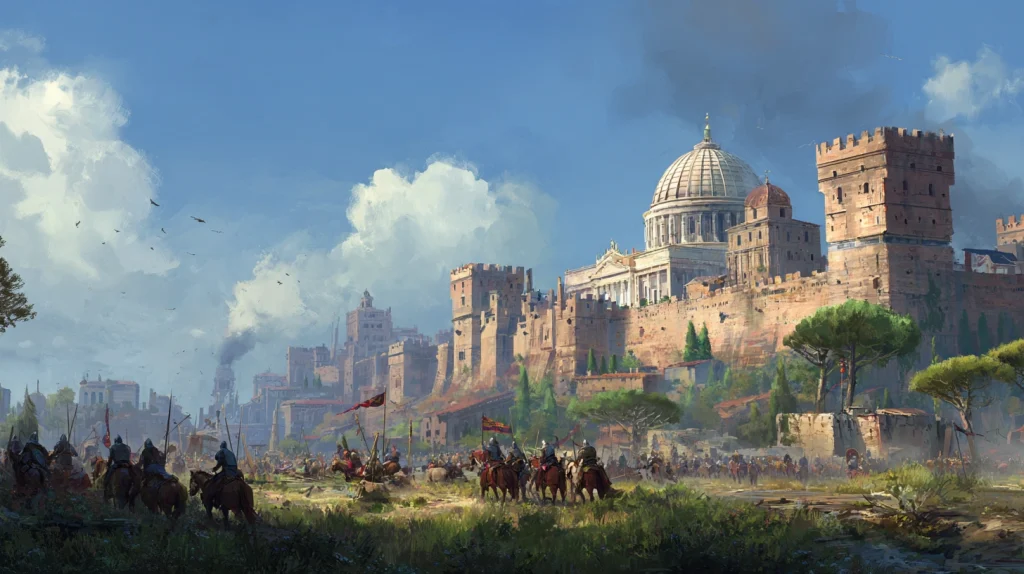
Rome’s ninth-century defenses were not untested theory. In 846, an Arab raiding force, estimated at some eleven thousand men arriving on dozens of ships, landed near the city and plundered its outskirts, sacking the basilicas of Old St. Peter’s and St. Paul’s-Outside-the-Walls, both of which sat, fatefully, beyond the protection of the city’s ancient Aurelian Walls, which had themselves been standing since the third century CE. The raiders stripped the basilicas of centuries of accumulated treasure, including a silver altar table donated by Charlemagne himself, and even damaged the tomb of Saint Peter in the process. But the Aurelian Walls held, and the raiders never breached the city proper, retreating after several days of plunder rather than pressing an assault they had no real means of winning. Rome’s core survived the attack intact specifically because its fortifications worked exactly as intended, even against an army several times the size of the fleet Hastein and Björn would bring fourteen years later.
Walls Built From a Lesson Already Learned
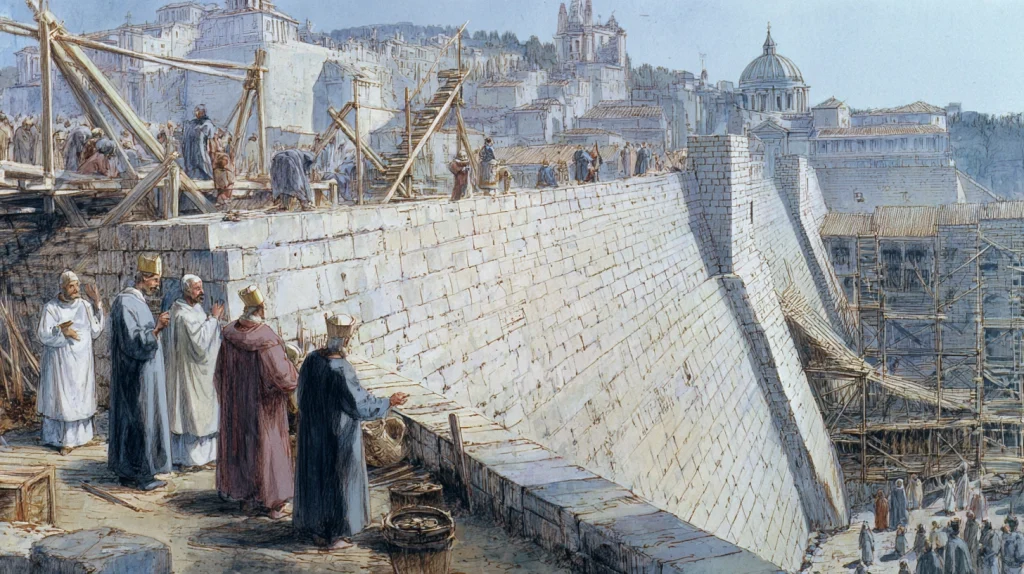
The 846 raid did not leave Rome’s defenses unchanged. Pope Leo IV, elected the following year with the memory of the attack still fresh among the city’s population, oversaw the construction of an entirely new fortified circuit, built specifically to close the gap the Arab raiders had exploited, enclosing St. Peter’s Basilica and the surrounding district within its own walled perimeter for the first time in the church’s history. Completed and consecrated in June 852, in a ceremony Leo reportedly walked barefoot to attend, these Leonine Walls meant that the one obvious weak point Rome had shown eight years earlier no longer existed by the time any new raiding fleet might come calling. Leo IV also organized a coalition of Italian forces, drawing on troops from the Frankish Empire, the Duchy of Spoleto, and the Duchy of Naples alongside Rome’s own, and won a decisive naval victory against a Saracen fleet off the coast at Ostia in 849, demonstrating that Rome could marshal outside military support on short notice when the threat was serious enough. By the time Hastein and Björn’s fleet reached Italy in 860, Rome had spent the better part of the preceding decade demonstrating, in very concrete terms, exactly how seriously it took the threat of seaborne raiders, and exactly how capable it had become of organizing a coordinated, multi-state response to one. According to the fullest surviving account of the expedition, once Hastein and Björn learned that the city they had actually sacked was Luna rather than Rome, they briefly considered pressing on to find the real thing, only to abandon the idea once word reached them of exactly how well prepared Rome’s defenders were.
A City Backed by Rival Kings
Rome’s defenses were not only physical. By the ninth century, the city’s protection was bound up with the political and religious authority of the entire Christian West rather than resting on its own walls and garrison alone. An attack on Rome specifically, rather than a wealthy but ultimately replaceable provincial city like Luna, carried the risk of uniting the competing Carolingian kings of Western Europe, rulers who otherwise governed fragmented and often rival territories carved up by treaty and inheritance since the death of Charlemagne, into a single coordinated response against the fleet.
Luna’s fall, however devastating for its own population, did not carry that same unifying political weight. Its bishopric, though significant regionally, was not the seat of papal authority, and its destruction, while a serious blow to one Ligurian community, did not threaten the symbolic and political center that held Western Christendom loosely together. A genuine assault on Rome itself might have provoked exactly the kind of unified continental response that a fleet of a few thousand raiders, however skilled, would have had little hope of surviving, drawing in forces from kingdoms that otherwise spent as much energy fighting each other as cooperating on anything at all.
The political landscape surrounding Rome in 860 only reinforced how costly that kind of unified response could have been for the Vikings. Charlemagne’s empire had already been carved into three rival kingdoms by the Treaty of Verdun in 843, divided among his grandsons, and by 860 that fragmentation had deepened further still, following the death of the emperor Lothair I in 855 and the subsequent division of his own territory among his sons. These were rulers who spent much of the mid-ninth century contesting borders and inheritance claims with one another rather than cooperating on shared defense. A raid on a minor Ligurian port was unlikely to change that pattern. An attack that damaged Rome itself, and by extension the papacy every one of those rulers depended on for legitimacy, was a different matter entirely, the kind of provocation that could plausibly override even long-standing rivalries, at least for as long as it took to drive the threat away.
What the Counterfactual Suggests
Whether Hastein and Björn ever considered this risk before setting out is not something the surviving sources address, and there is no reason to think either man weighed the political consequences of striking the papal city in quite these terms. What the counterfactual highlights is a strange possibility built into the entire episode: the Vikings’ catastrophic navigational error may, in an entirely unintended way, have kept the expedition from ending far worse than it did, sparing a fleet already thousands of miles from home a confrontation with an enemy considerably larger, and considerably better organized, than any single Ligurian bishopric.

