Tikal Went Silent Once Before It Went Silent for Good
Maya & Mesoamerica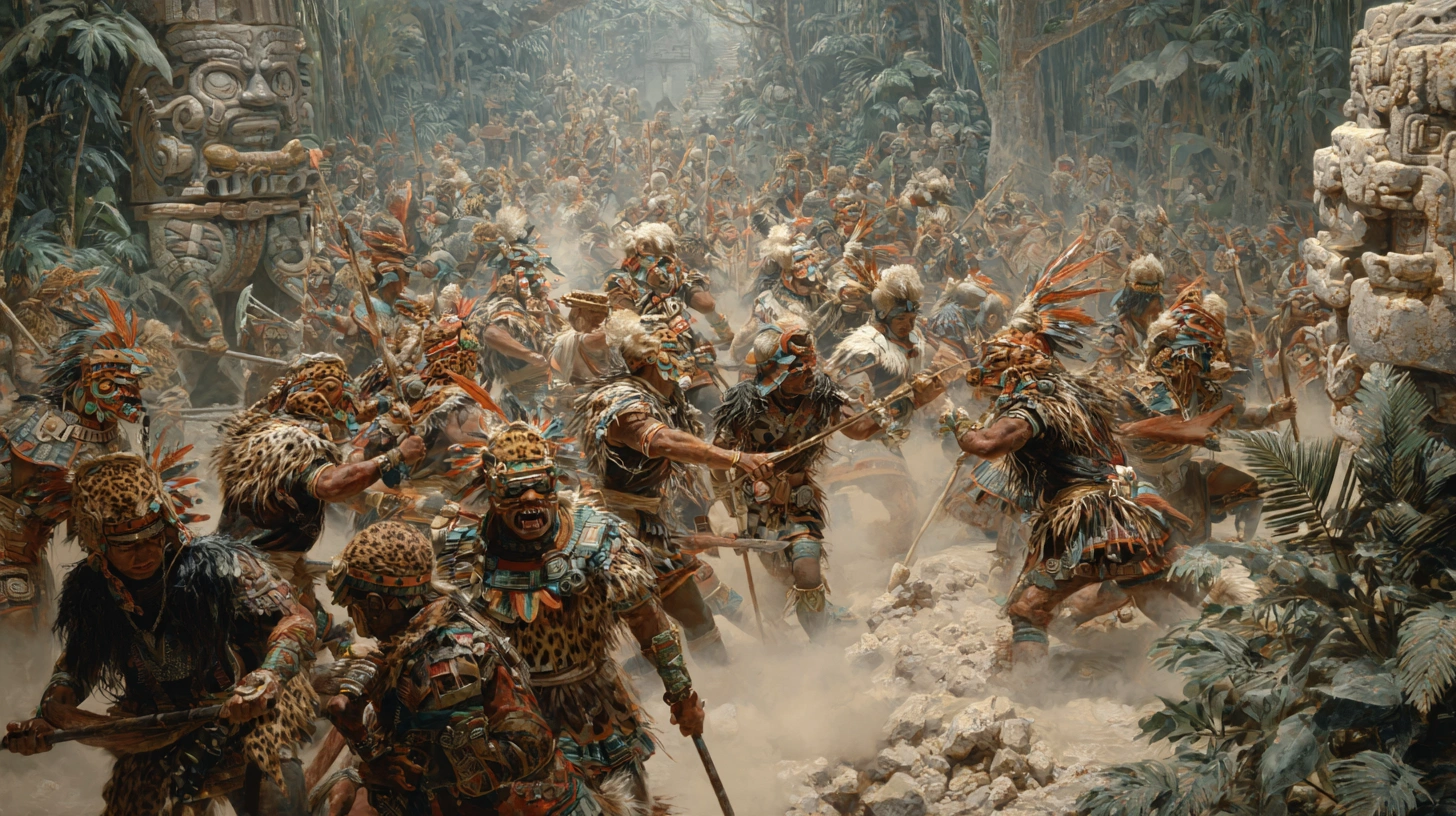
AI reconstruction, not a photograph.
Tikal fell silent once before it fell silent for good. Two centuries before its final abandonment in the ninth century, the greatest city of the southern Maya lowlands went through a strikingly similar collapse in its own stone record, a decades-long gap that archaeologists now call the hiatus. And then, unlike the silence that followed centuries later, this earlier one ended. Tikal came all the way back, and the manner of that recovery still shapes how archaeologists read the later, larger silence today.
A Defeat That Silenced Tikal’s Monuments
In 562 CE, Tikal suffered a serious military defeat. The king of the Kaanul dynasty, a ruler known to epigraphers as Sky Witness, overcame Tikal’s own king, Wak Chan K’awiil, and installed his own son on Tikal’s throne in his place. The Kaanul dynasty, the same royal house that would later rule from the city of Calakmul, had spent years building a network of allied and subordinate courts across the southern lowlands, and this defeat effectively pulled Tikal into that network as a diminished, subordinate power rather than the regional leader it had been. Tikal was, at the time, arguably the single most important city in the Maya lowlands. Losing to Kaanul was not a border dispute; it was the toppling of a capital.
The clearest evidence of what followed is not a triumphant inscription from the winning side, but an absence on the losing one. For decades afterward, Tikal’s rulers stopped erecting the dated stone monuments, stelae, that Maya kings across the region used to record their accessions, anniversaries, and victories. Modern archaeologists call this gap the hiatus, and it stands as one of the clearest examples in Maya archaeology of a city’s political fortunes being readable directly in what its rulers stopped commissioning.
What a Gap in the Stone Record Actually Means
Classic Maya kings marked time in public, on stone, almost obsessively. A stela cycle, a new carved monument every five years, every twenty years, at a coronation, at a major military victory, was standard practice at a healthy royal court with the resources and the confidence to commission one. When that practice stops, archaeologists cannot always read an explicit confession of defeat into the silence, because a losing dynasty rarely inscribes its own humiliation in detail. What they can read is the absence itself: a court that no longer had the resources, the security, or perhaps the standing to keep marking its own history in the usual way. Tikal’s hiatus, running for roughly a century, is exactly this kind of silence, a gap that historians infer from what stopped appearing rather than from a monument that explains it directly. It is a reminder that much of what is known about Classic Maya political history comes from reading patterns of presence and absence in a carved record, not from anything resembling a written chronicle of events as they happened.

A Slow, Uneven Recovery Under Nuun Ujol Chaak
Tikal’s return to prominence did not happen in a single clean moment. The king most associated with trying to reverse the city’s fortunes, Nuun Ujol Chaak, took the throne sometime before 657 CE and spent much of his reign fighting on more than one front. He was already at odds with his own brother, who had split off to rule a rival court at Dos Pilas, when Calakmul’s king Yuknoom Ch’een II struck directly at Tikal in 657 CE, forcing Nuun Ujol Chaak to flee his own capital. He later attacked Dos Pilas in an attempt to settle the family conflict in his favor, holding the city for several years and destroying or capturing at least a few of the smaller courts allied with his brother, before Calakmul intervened again on his brother’s side and reversed his gains. Nuun Ujol Chaak disappears from the record around 679 CE, most likely killed in the fighting that followed. His reign shows a city actively trying to claw its way back into relevance for over two decades, fighting a two-front war against a brother and an empire at once, without fully managing it in his own lifetime.
Jasaw Chan K’awiil’s Reversal in 695 CE
The decisive turn came under Nuun Ujol Chaak’s son, who took Tikal’s throne in 682 CE as Jasaw Chan K’awiil I, three years after his father’s disappearance from the record. Thirteen years into his reign, in 695 CE, he led Tikal to a defeat of the Kaanul king Yuknoom Yich’aak K’ahk’, going so far as to capture an effigy of one of Calakmul’s own patron gods, an act recorded on a carved wooden lintel inside the temple built as his own tomb, the structure now known as Tikal Temple I. The victory did not simply avenge a single lost battle. It marked the end of the hiatus altogether, restoring Tikal to the position of regional power it had held before 562 CE, and it set up decades of further military success for Jasaw’s own son and successor against the same rival dynasty, campaigns that, within another fifty years, would end Calakmul’s dominance over the region for good.

Why an Earlier Collapse Complicates the Later One
Tikal’s sixth and seventh century hiatus matters for more than its own sake. When the same city, and dozens like it across the southern lowlands, stopped erecting stelae again in the ninth century, in a much larger and more widespread version of the same pattern, that earlier precedent gave archaeologists a genuine reason for caution about drawing quick conclusions. A gap in the monumental record at Tikal had, once before, been a genuine low point in an ongoing rivalry rather than a final ending. Dynasties could go quiet for generations and still stage a real comeback.
That does not mean the two silences turned out the same way. Tikal’s ninth and tenth century decline never produced a second Jasaw Chan K’awiil. This time, the stelae did not resume, the city was not reoccupied at its former scale, and the same pattern that had once signaled a temporary setback turned out, on that later occasion, to be the end. Archaeologists studying the later collapse know this history well, which is part of why the Terminal Classic silence has been treated with such caution for so long: the region had already proven, once, that a hiatus was not necessarily a death sentence, so ruling one out in advance was never safe either. The earlier hiatus does not predict what happened afterward. It only proves that silence in the stone record, on its own, was never a reliable signal of how a story like this had to end, one way or the other.

