Jewish Exiles in Babylon After 587 BCE: Legend and Evidence
Biblical History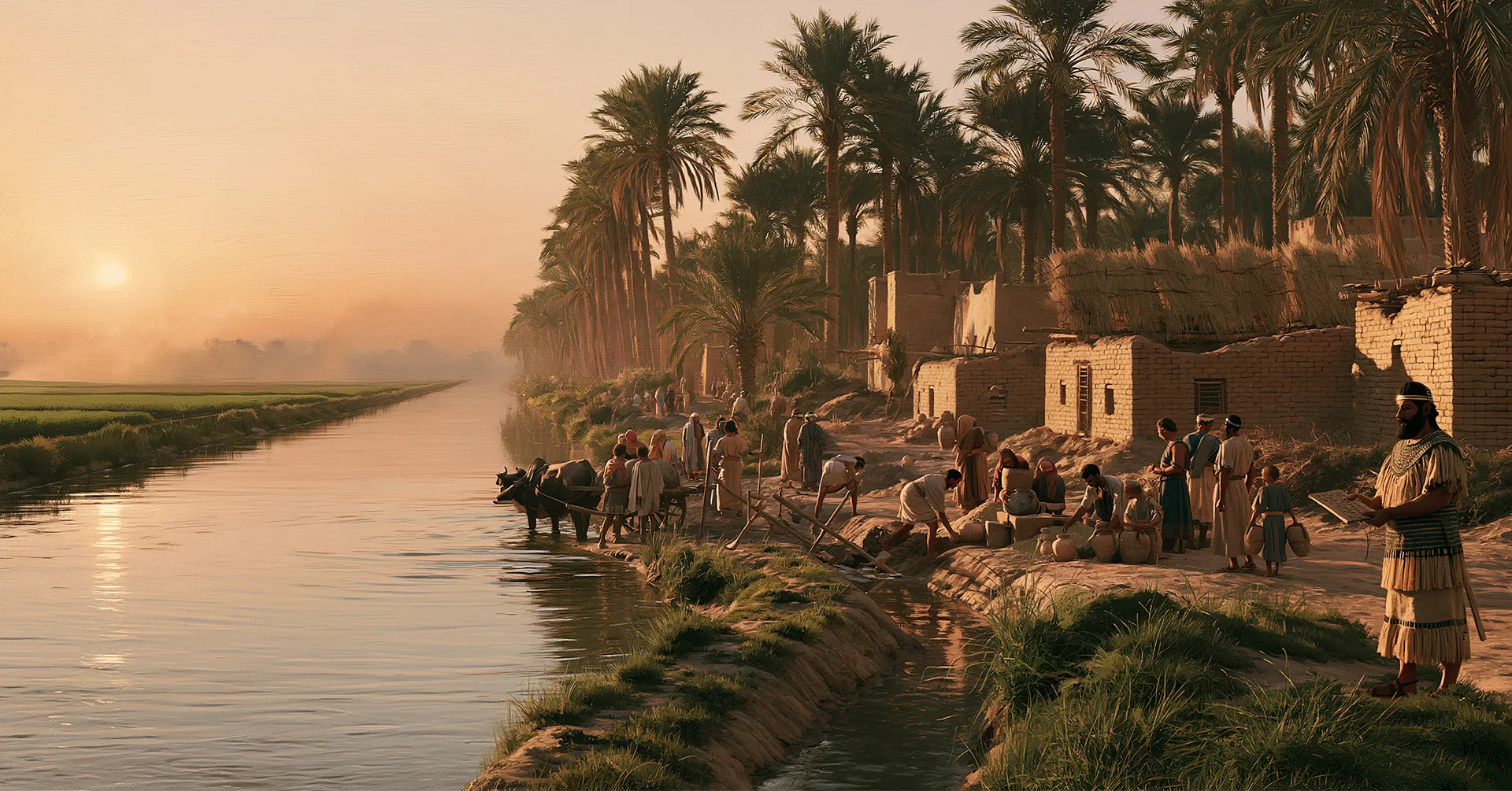
AI reconstruction, not a photograph.
When Jerusalem fell, Nebuchadnezzar of Babylon carried part of Judah’s people to Babylonia. In Louis Ginzberg’s Legends of the Jews he makes the captives march naked while he and his princes celebrate on their vessels, and he has the handsomest youths massacred after Babylonian women are seized with passion for them. The Bible does not tell this story, and the Babylonian documents that mention the exiles show a different life. This article sets out how many people the Bible says were taken, where the legend comes from, what the sources say of life in exile, and what is known of the Hanging Gardens and of a royal museum.
How Many Were Taken
The fall of Jerusalem, in 587 or 586 BCE, was not the first deportation. After Jehoiachin’s three-month reign Nebuchadnezzar “carried out thence all the treasures of the house of the LORD”, with the king’s treasures, and took “even ten thousand captives” in one verse (2 Kings 24:13-14) and “even seven thousand” men of might in another (24:16). The Center for Online Judaic Studies puts the deportees at “about 8 to 10 thousand of them”, and Wikipedia at “around 7,000 individuals”. Jeremiah 52:28-30 gives smaller totals: “three thousand Jews and three and twenty” in the seventh year, “eight hundred thirty and two persons” in the eighteenth, 745 in the twenty-third, and “all the persons were four thousand and six hundred”.
The Bible’s totals are therefore thousands, not tens of thousands, and the land was not emptied: “none remained, save the poorest sort of the people of the land” (2 Kings 24:14), and after the fall the captain of the guard left “the poor of the land” to work the fields (25:12). Zedekiah followed later, after the Chaldeans “put out the eyes of Zedekiah, and bound him with fetters of brass” (25:7). No source consulted says that a majority of the population was taken. Wikipedia reports estimates that Judah’s population fell “from roughly 110,000 to somewhere between 15,000 and 40,000 inhabitants”, and adds that deportation was only part of the fall.
The March in the Legend
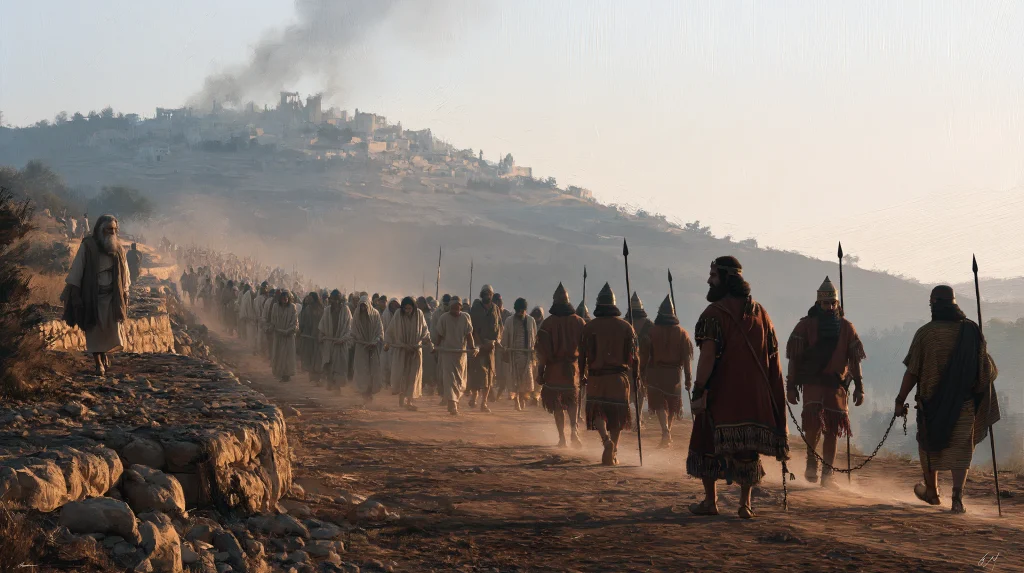
The march comes from Ginzberg’s Legends of the Jews, which retells rabbinic tradition, in the section “Transportation of the Captives” in volume 4. On the way the captives pass the city of Bari, whose inhabitants are “not a little astonished at the cruelty of Nebuchadnezzar”, who “made the captives march naked”, while “Nebuchadnezzar and his princes on their vessels celebrated their victory amid song and music”. The page does not say that the king watched the march from a ship, and the numbered notes that would give Ginzberg’s sources are not on it.
The Bible has one glimpse of the road. In Jeremiah 40:1 the prophet is found at Ramah “bound in chains among all that were carried away captive”, and Nebuzaradan frees him (40:4). The psalm of the exiles begins “By the rivers of Babylon, there we sat down, yea, we wept” (137:1) and says nothing of nakedness. A march of captives “naked and barefoot” is described in Isaiah 20:4, but of Egyptians and Ethiopians led away by the king of Assyria, and no text consulted says it of the Judeans taken by Babylon.
The Beautiful Youths
The massacre of the youths is in another section of Ginzberg’s volume, “Ezekiel Revives the Dead”. The page has the Babylonian women “seized with a great passion for them”, has Nebuchadnezzar order “a bloody massacre of the handsome youths”, and speaks of “their graceful bodies mutilated”. It gives no source for the story either.
The Bible’s handsome youths have a different fate. In Daniel 1:3-4 the king tells his chief eunuch to bring young captives “in whom was no blemish, but well favoured”, to be taught “the learning and the tongue of the Chaldeans” and fed for three years so that they might “stand before the king” (1:5). Daniel and three companions were among them (1:6). Young men are killed elsewhere in the text, but in Jerusalem: the king of the Chaldees “slew their young men with the sword in the house of their sanctuary” (2 Chronicles 36:17), and Lamentations says “They took the young men to grind” (5:13). No Babylonian document consulted mentions a massacre of youths.
Where the Exiles Lived
The Bible places the exiles beside a river, not in a procession. Ezekiel was “among the captives by the river of Chebar” (1:1) and came “to them of the captivity at Telabib, that dwelt by the river of Chebar” (3:15). The Encyclopedia of the Bible, on Bible Gateway, says that the Babylonian nāru kabari, a great canal through Nippur, is probably Ezekiel’s Chebar, and that nāru can mean either canal or river. Jeremiah’s letter to the exiles tells them to “Build ye houses, and dwell in them; and plant gardens” and to “seek the peace of the city” (29:5, 7).
Tero Alstola, in ANE Today (7 June 2022), writes that “Most of the Judean deportees were settled in the Babylonian countryside around Nippur”, in villages such as “Yahudu, the village of Judah”. They received land to cultivate in return for taxes, work and military service, a “semi-free status as state dependents”. About 200 tablets from Al-Yahudu, dated 572 to 477 BCE, survive according to Wikipedia, and Alstola counts roughly 250 known texts, mainly “promissory notes, leases, and receipts”. Wikipedia says the Judeans “operated on the daily economic level, like other Babylonians”.
The royal archive at Babylon adds a king. Wikipedia says tablets excavated by Robert Koldewey between 1899 and 1917 name Jehoiachin as “king of the land of Yahudu”, with “his five sons listed as royal princes”, among those receiving oil rations. 2 Kings 25:27-30 says that Evil-merodach later “did lift up the head of Jehoiachin” and gave him “a continual allowance”.
The Hanging Gardens and the Museum
Nebuchadnezzar, who reigned from 605 to 562 BCE according to the New World Encyclopedia, is “credited with the construction of the Hanging Gardens of Babylon”, but the credit comes from one late report. In William Whiston’s translation of Josephus’s Against Apion, which summarises the lost work of the Babylonian priest Berossus, Nebuchadnezzar “erected very high walks, supported by stone pillars” because his queen “had been brought up in Media” (livius.org). Wikipedia calls Berossus “the only source to credit that king with the construction of the Hanging Gardens”, says “No extant Babylonian texts mention the gardens” and “no archaeological evidence has been found at Babylon for the Hanging Gardens”, and adds that there is “no mention of Nebuchadnezzar’s wife Amytis”. Its page on Amytis calls her the daughter of the Median king Cyaxares but says “Historical evidence, however, does not lend support to this tradition”. Stephanie Dalley has proposed, Wikipedia reports, that the gardens were the well-documented ones that Sennacherib built at Nineveh, and that the two places were confused over the centuries.
No source consulted places a public museum in Nebuchadnezzar’s palace. A Penn Museum Bulletin article describes a museum belonging to Bel-shalti-Nannar, a daughter of the later king Nabonidus, where a small clay column was “one of the curiosities exhibited in her museum”. In a 2021 Bible Archaeology article, John C. Lennox is quoted as saying that Nebuchadnezzar’s treasure house “may well have been in the Esagila temple complex” and was “presumably much like a museum”. That is a treasure house in a temple, offered as a guess.
What Can Be Said
The Bible records deportations of thousands, a letter telling the exiles to build houses and plant gardens, and a captive king kept on rations. It attributes the burning of the temple to Nebuzaradan, “a servant of the king of Babylon” (2 Kings 25:8-9), and no source consulted records an order of public humiliation. The naked march and the massacre of the youths come from a collection of legends whose sources are not given on the page consulted, while the Bible’s handsome youths are enrolled in the king’s service. What can be said plainly is narrow: the exiles are recorded beside a canal and on farms in Babylonia, and the legends add scenes that the records do not.

