Zedekiah Blinded at Riblah: What the Bible Records
Biblical History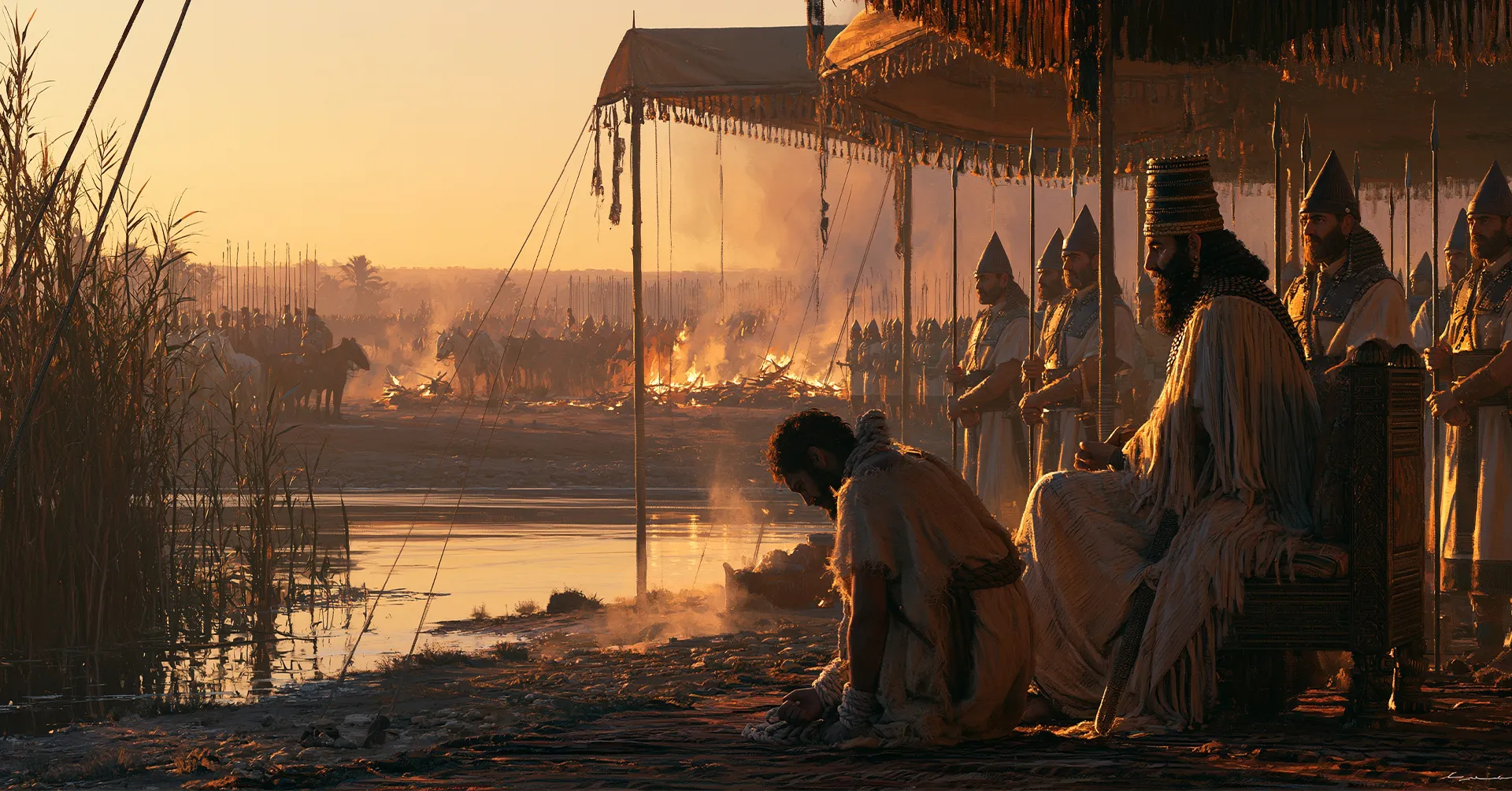
AI reconstruction, not a photograph.
Zedekiah, the last king of Judah, was overtaken on the plains of Jericho, brought to Nebuchadnezzar at Riblah and made to watch his sons killed, and then he was blinded, bound with bronze fetters and carried to Babylon (2 Kings 25:4-7). The text does not say that he fled through an underground passage, it places the judgement at Riblah before the burning of the temple, and no source consulted says that Jehoiakim was dragged through the streets. This article sets out what the Bible records at Riblah, where the story of the tunnel comes from, how the order of events runs, why Zedekiah rebelled and what the sources say about Jehoiakim and about Nebuchadnezzar’s earlier campaigns.
What Happened at Riblah
The Chaldean army “overtook him in the plains of Jericho”, and “all his army were scattered from him” (2 Kings 25:5). The captors took the king to Riblah, “and they gave judgment upon him” (25:6). Jeremiah 52:10-11 names the king of Babylon as the judge: he “slew the sons of Zedekiah before his eyes” and “slew also all the princes of Judah in Riblah”, then “put out the eyes of Zedekiah”, bound him in chains and “put him in prison till the day of his death”. On the order of the verbs, the death of his sons was the last thing he saw.
Riblah was Nebuchadnezzar’s base. The Encyclopaedia Judaica says he “chose Riblah as his headquarters during his last campaign against Jerusalem”, and Wikipedia places the tell near the town of Ribleh “on the Syrian side of the border with Lebanon”, 35 miles north-east of Baalbek. The judgement reached beyond the king. 2 Kings 25:18-21 says that the chief priest, other officers and sixty men of the land were brought to Riblah, where the king of Babylon “smote them, and slew them at Riblah in the land of Hamath”.
The Flight and the Tunnel Tradition
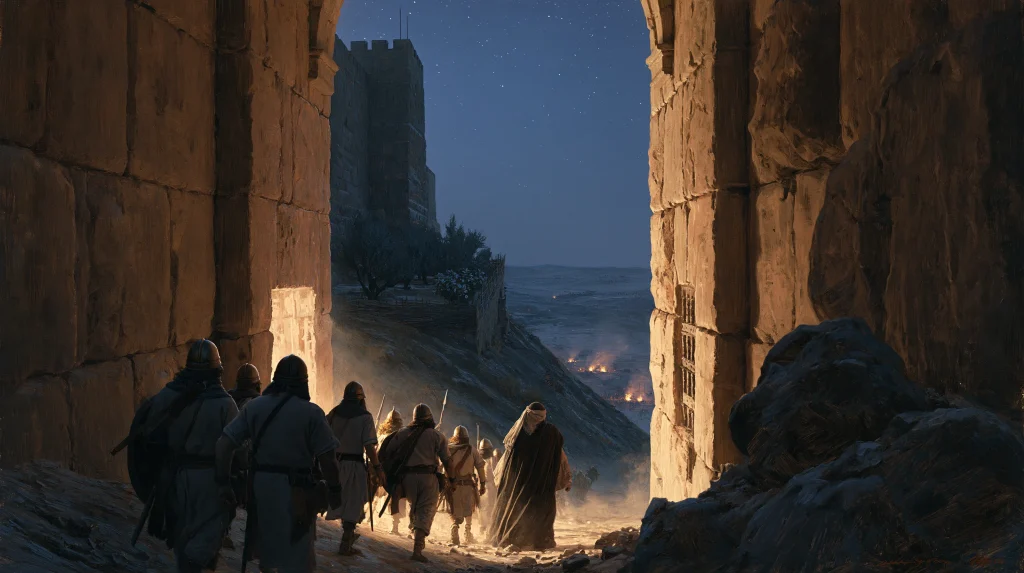
The text describes the escape plainly. When “the city was broken up”, the men of war fled by night “by the way of the gate between two walls, which is by the king’s garden”, and “the king went the way toward the plain” (2 Kings 25:4). No passage under the ground appears in that account. The text says his army was scattered, and Josephus, in William Whiston’s translation, says the enemy took him “deserted by all but a few”.
The tunnel comes from later tradition. Rashi, on Jeremiah 39:4, writes that “He had a cave from his house to the plains of Jericho”, and says a deer sent by God led the Chaldeans to the cave’s mouth. Louis Ginzberg’s Legends of the Jews, which retells rabbinic tradition, says that Zedekiah “tried to escape through a cave extending from his house to Jericho”. A quarry under the Old City bears his name: Zeev Lewy of the Geological Survey of Israel says it is also called “Zedekiah Cave”, “as if King Zedekiah, the last king of Judea, fled through it”, and he cites no biblical passage for such a flight. Ezekiel 12 comes nearest, with a sign-act in which the prince’s party “shall dig through the wall to carry out thereby” (12:12), but that is a hole in a wall and not a passage to Jericho.
Before or After the Fire?
In 2 Kings 25 and Jeremiah 52 the judgement at Riblah comes before the burning of the temple. The breach is dated to the ninth day of the fourth month (Jeremiah 52:6-7), the flight, capture and judgement follow, and only then, “in the fifth month”, does Nebuzaradan, “a servant of the king of Babylon”, come to Jerusalem and burn “the house of the LORD” (2 Kings 25:8-9). The text gives no date for the judgement, so the interval is unknown, but on the order given the temple and the houses were burned after Zedekiah had been sentenced. A sequence in which the temple burns first and Zedekiah is judged afterwards reverses the order of the text. The year is 587 or 586 BCE, as scholars date the fall.
Prophecy fits the blinding. Jeremiah had said that Zedekiah would “speak with him mouth to mouth” and that “his eyes shall behold his eyes” (32:4), meaning the king of Babylon’s, and Ezekiel that he would be brought to Babylon, “yet shall he not see it, though he shall die there” (12:13). Jeremiah 34:4 had also said “Thou shalt not die by the sword”, and the text records no death by the sword, only prison until his death.
Why Zedekiah Rebelled
Zedekiah “reigned eleven years in Jerusalem” (2 Kings 24:18) as Nebuchadnezzar’s appointee and “rebelled against the king of Babylon” (24:20). 2 Chronicles says the king of Babylon “had made him swear by God” (36:13). Ezekiel says that Babylon “hath taken an oath of him” (17:13) and that Zedekiah “rebelled against him in sending his ambassadors into Egypt”, asking for “horses and much people” (17:15). Wikipedia says he “entered an alliance with Pharaoh Hophra”. The promise of loyalty and the conspiracy with Egypt are both in the text. Josephus, in Whiston’s translation, has Nebuchadnezzar call him “a wicked wretch, and a covenant-breaker”.
Jehoiakim and the Claim of Dragging
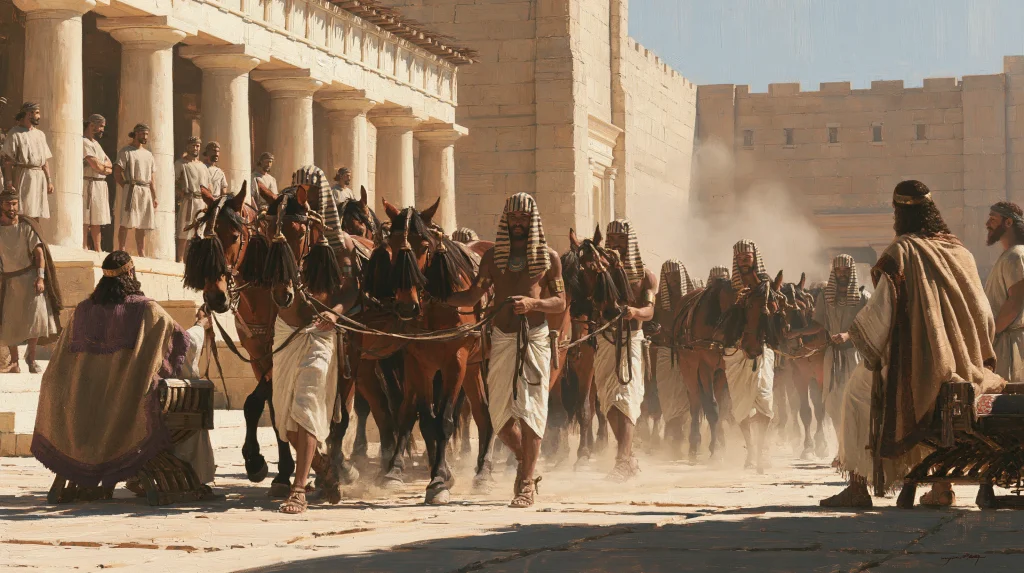
Jehoiakim, who rebelled before Zedekiah, died in late 598 BCE according to Wikipedia, before the siege that ended with the surrender of Jerusalem in March 597 BCE. The sources disagree about how. 2 Kings 24:6 says only that he “slept with his fathers”, and 2 Chronicles 36:6 says Nebuchadnezzar “bound him in fetters, to carry him to Babylon”, without saying that this happened. Jeremiah 22:19 predicts that he would be “buried with the burial of an ass” and “drawn and cast forth beyond the gates of Jerusalem”, and 36:30 that his body would be “cast out in the day to the heat”. Wikipedia reports that Josephus has Nebuchadnezzar kill him and order the body thrown before the walls, that rabbinic accounts conflict, and that the Babylonian Chronicle does not mention his death.
No source consulted says that he was dragged through the streets when his revolt failed. The word “dragged” appears in a modern translation of Jeremiah 22:19 that Wikipedia quotes, “dragged and cast out beyond the gates of Jerusalem”, and a prophecy is not a report.
Ashkelon, Tribute and Captives
Nebuchadnezzar’s earlier campaigns are in the Babylonian Chronicle that livius.org calls ABC 5. In his first year, it says, the kings of the Hatti-land came before him and “he received their heavy tribute”. He then took Ashkelon in Kislimu, “captured its king and plundered it” and “turned the city into a mound and heaps of ruins”. The lines say nothing of captives brought to Babylon, so a scene of the king watching them arrive is not in the chronicle as translated. In his seventh year it says he “besieged the city of Judah”, on the second of Addaru “seized the city and captured the king” and appointed “a king of his own choice”. 2 Kings 24:17 names that king as Zedekiah.
What Can Be Said
The Bible records that Zedekiah was taken near Jericho, judged at Riblah, saw his sons killed, was blinded and bound, and was carried to Babylon, where he was held until his death. The underground passage comes from later tradition, the judgement comes before the burning of the temple in the order of the text, and no source consulted says Jehoiakim was dragged. What can be said plainly is narrow: the king’s sons were killed before his eyes, his eyes were put out, and the text takes him no further than a prison in Babylon.

