The Siege of Jerusalem, 589 to 587 BCE: What the Texts Say
Biblical History, Texts & Traditions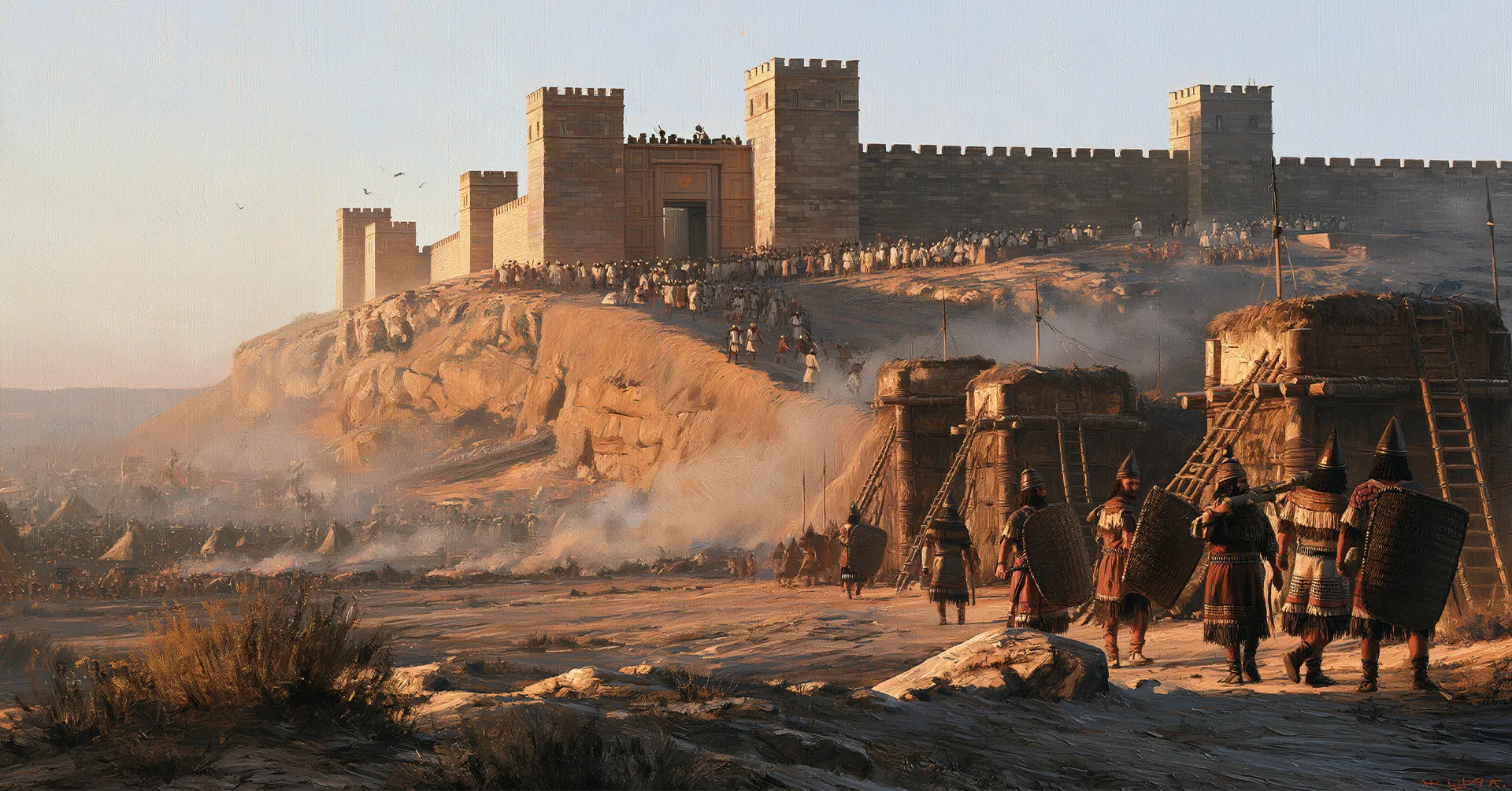
AI reconstruction, not a photograph.
The siege of Jerusalem by Nebuchadnezzar of Babylon began in the ninth year of King Zedekiah, and by the eleventh the city had no bread and its walls were broken. Scholars place the fall in 587 or 586 BCE. The Bible dates the breach to the ninth day of the fourth month and the burning of the temple to the fifth month, Lamentations describes women eating their children, and no source consulted mentions iron axes. This article sets out how long the siege lasted, what the texts say about famine, plague and cannibalism, how the breach and the fire are dated and what the sources leave open.
How Long the Siege Lasted
Babylon had pressed Judah before. In the days of Nebuchadnezzar, who reigned from 605 to 562 BCE according to the New World Encyclopedia, Jehoiakim “became his servant three years: then he turned and rebelled against him” (2 Kings 24:1). His son Jehoiachin reigned three months, and the king of Babylon made Mattaniah king and “changed his name to Zedekiah” (24:8, 17). Zedekiah in turn “rebelled against the king of Babylon” (24:20).
The siege began “in the tenth month, in the tenth day of the month” of Zedekiah’s ninth year, when the army “pitched against it; and they built forts against it round about” (2 Kings 25:1). The city “was besieged unto the eleventh year of king Zedekiah” (25:2), and counting from the tenth month of the ninth year to the fourth month of the eleventh gives about eighteen months. Wikipedia places the start in January 589 BCE and says the siege lasted “either eighteen or thirty months”. It was not continuous: when Pharaoh’s army came out of Egypt, “the Chaldeans that besieged Jerusalem heard tidings of them, they departed from Jerusalem” (Jeremiah 37:5), though Jeremiah warned that “the Chaldeans shall come again” (37:8).
Hunger, Plague and Broken Promises
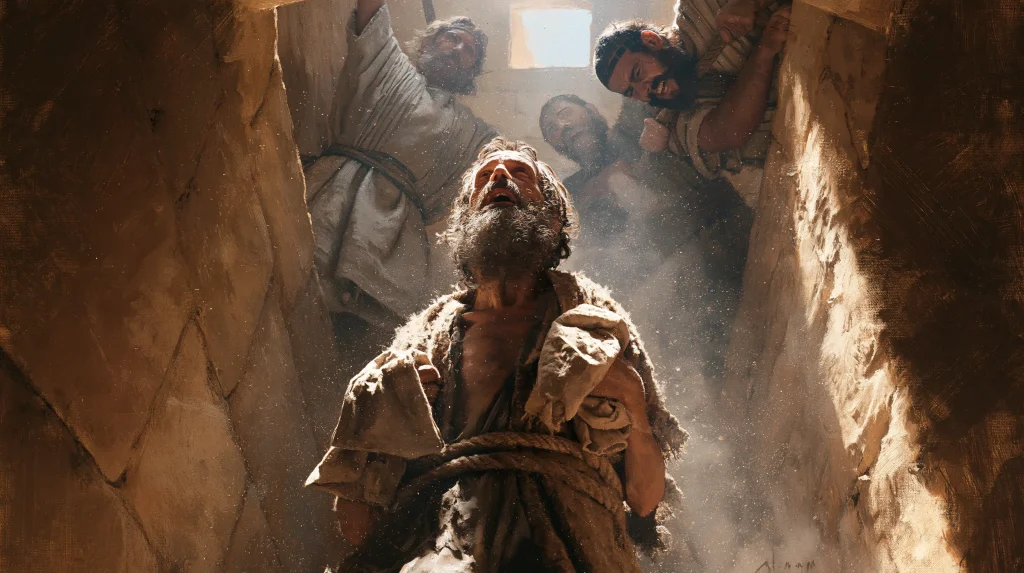
By the fourth month of the eleventh year “there was no bread for the people of the land” (2 Kings 25:3). The court official Ebed-melech told the king that Jeremiah, whom the princes had cast into a dungeon, would die of hunger, “for there is no more bread in the city” (Jeremiah 38:9). He and his men lowered “old cast clouts and old rotten rags” on cords so that the prophet could pad the ropes under his arms, and Jeremiah was drawn up (38:11-13). Lamentations adds the children, who “say to their mothers, Where is corn and wine?” (2:12), and the survivors, who say “Our skin was black like an oven because of the terrible famine” (5:10).
Plague is a harder case. Pestilence appears in Jeremiah’s warnings, where those who stay in the city “shall die by the sword, by the famine, and by the pestilence” (38:2), and in Ezekiel (5:12), but the accounts of the fall in 2 Kings 25 and Jeremiah 52 describe no outbreak.
Two episodes show leaders failing under pressure. After Zedekiah made a covenant to free Hebrew servants, “afterward they turned” and “brought them into subjection” again (Jeremiah 34:11), and the princes demanded Jeremiah’s death because he “weakeneth the hands of the men of war” (38:4). These are particular acts reported in the text, and any wider verdict on the city’s morals is an interpretation.
What Lamentations Says About Cannibalism
Two poems in Lamentations refer to cannibalism. “Shall the women eat their fruit, and children of a span long?” asks 2:20, and 4:10 says “The hands of the pitiful women have sodden their own children”. Both are poetry. Of the first, the website Enter the Bible says that whether it happened is something “we simply cannot know”, though it is “not out of the realm of possibility” that the poet saw it, and the horror conveys the people’s suffering “regardless of whether particular incidents of cannibalism actually happened”.
The theme is older than the siege. Deuteronomy 28:53 warns of eating “the flesh of thy sons and of thy daughters” in “the siege, and in the straitness”, and Ezekiel prophesied of Jerusalem that “the fathers shall eat the sons in the midst of thee” (5:10). 2 Kings 6 narrates a case, but at Samaria, where a woman says “we boiled my son, and did eat him” (6:29). Cannibalism in the siege of Jerusalem is therefore attested in poetry and foretold in law and prophecy, and the accounts of the fall in 2 Kings 25 and Jeremiah 52 do not mention it.
The Breach and the Fire
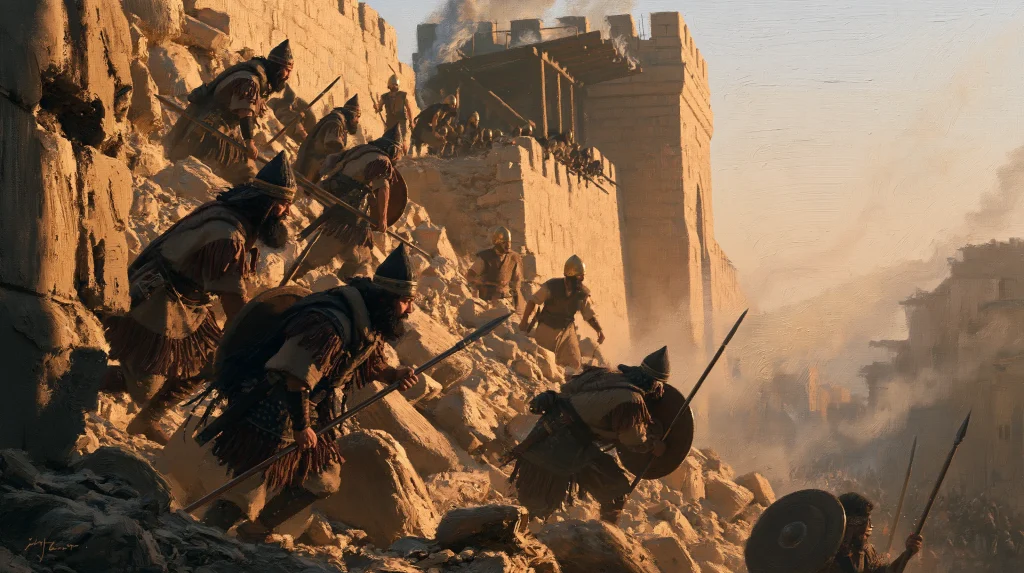
The breach came on the ninth day of the fourth month, when “the city was broken up” (Jeremiah 39:2), and the men of war fled by night (2 Kings 25:4). The princes of Babylon “came in, and sat in the middle gate” (Jeremiah 39:3). The fourth month is Tammuz in the later Jewish calendar. Jewish tradition marks the breach on the seventeenth of Tammuz, and Wikipedia reports that the Jerusalem Talmud explains the difference by calling the biblical record “distorted”.
The fire came in the fifth month. 2 Kings 25:8 has Nebuzaradan, captain of the guard, come to Jerusalem on the seventh day, and he “burnt the house of the LORD, and the king’s house” (25:9), while Jeremiah 52:12 gives the tenth day. The Talmud (Ta’anit 29a), as summarised in a lesson from Torat Har Etzion, says that on the seventh foreign forces entered the temple and on the ninth, near nightfall, set it on fire, and that it burned through the next day. Rabbi Yochanan said he would have set the fast on the tenth, “because most of the Temple burned on that day”. In that account the seventh, ninth and tenth are days of Av, not Tammuz.
Axes, Gates and Ash
No source consulted mentions iron axes or forced gates. The nearest text is Psalm 74, a lament over a ruined sanctuary, where the enemy “break down the carved work thereof at once with axes and hammers” and “have cast fire into thy sanctuary” (74:6-7). It gives no date and no enemy’s name, so it cannot fix a day for the temple’s fall.
2 Chronicles 36:17 says the king of the Chaldees “slew their young men with the sword in the house of their sanctuary”, and 2 Kings 25:10 has the army “brake down the walls of Jerusalem round about”. The rest of the people were carried away, but the captain of the guard “left of the poor of the land to be vinedressers and husbandmen” (25:12), and Jeremiah 39:10 says he “gave them vineyards and fields”. The texts say the poorest were left to work the land and do not say where they lived.
What the Dates and Digs Leave Open
Scholars still disagree on the year. Wikipedia says the fall is dated to “586 BC or 587 BC”, and the Center for Online Judaic Studies has the Babylonians breaking through the walls in July 586 BCE. Archaeology confirms a fire, since Wikipedia reports that the Babylonians “systematically destroyed the city with fire”, but a burnt layer cannot give a day of the month or the tools used.
Nathan Steinmeyer, in Bible History Daily, says Lachish Letter 4 has a sender watching the signal fires of Lachish because Azekah cannot be seen, a line that may reflect Azekah’s fall to the Babylonians. Jeremiah 34:7 names Lachish and Azekah as the “defenced cities” that “remained of the cities of Judah”. The Babylonian Chronicle that records the capture of Jerusalem in 597 BCE ends in Nebuchadnezzar’s eleventh year, 594/593 BCE, and livius.org says the second capture was certainly mentioned in its lost sequel.
What Can Be Said
The Bible records a siege of about eighteen months, a city out of bread, a breach on the ninth day of the fourth month and a fire in the fifth. Cannibalism is described in poems and foretold in law and prophecy, and nobody can say how often it happened. What can be said plainly is narrow: the city starved for months before its walls were broken, and no source consulted mentions iron axes.

